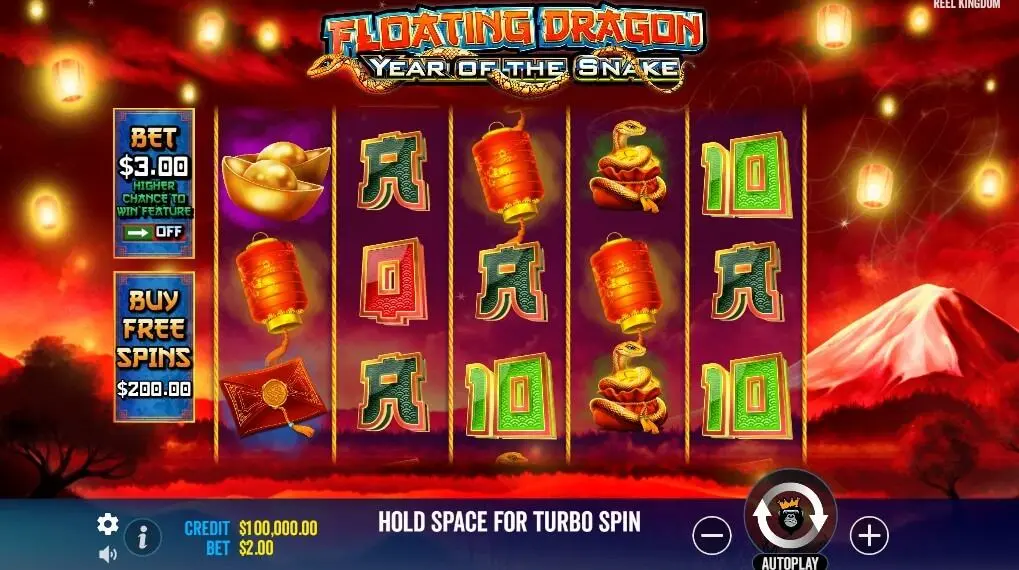
If you are considering the Floating Dragon – Year of the Snake slot, the short version is this: it is a high-volatility, 10-payline game from Pragmatic Play with a published RTP of 96.71% and a max win of 5,000x your stake. That combination means long quiet stretches punctuated by the occasional large swing. Whether that appeals depends on your bankroll tolerance and how you like your sessions to feel. Below is a full breakdown of the maths, the mechanics, and what demo play actually tells you — and what it does not.
Floating Dragon – Year of the Snake at a glance
Pragmatic Play has built this game on a 5-reel, 10-payline structure. The RTP of 96.71% sits 0.39 percentage points above the provider’s own portfolio average of 96.32% and a full percentage point above the broader corpus average of 95.71%. That is a meaningful edge relative to the median slot, though it only materialises over hundreds of thousands of spins. With a minimum stake of $/£/€0.10 and a maximum of $/£/€250.00, the game accommodates both cautious testers and high-roller sessions, though the high volatility rating means the lower end of that range will produce a very different experience than the upper end.
The max win is capped at 5,000x your stake. On a $/£/€0.10 minimum bet, the theoretical ceiling is $/£/€500. On the $/£/€250 maximum, it reaches $/£/€1,250,000. These are theoretical limits, not expected outcomes. Pragmatic Play ranks this game at 1,932nd in popularity across a catalog of 739 titles from the same provider, placing it in the 90.3rd percentile — a solid mid-tier performer that most casual players will not have encountered yet.
| Provider | Pragmatic Play |
|---|---|
| RTP | 96.71% |
| Volatility | High |
| Reels | 5 |
| Paylines | 10 |
| Theme | Asian |
| Bet range | $/£/€0.10 – $/£/€250.00 |
| Max win | 5,000x |
| Free demo | Yes |
What a 96.71% RTP actually returns
Return to Player is a long-run statistical average, not a promise for any individual session. A 96.71% RTP means that for every $/£/€100 wagered across a very large sample — millions of spins — the game is programmed to return $/£/€96.71 on average. The remaining $/£/€3.29 is the house edge.
To put concrete numbers on this: at the minimum stake of $/£/€0.10, one spin costs $/£/€0.10. Over 1,000 spins, your total wager is $/£/€100. At 96.71% RTP, the expected return over that sample is $/£/€96.71 — a theoretical loss of $/£/€3.29. At 10,000 spins ($/£/€1,000 wagered), the expected return is $/£/€967.10. These figures assume perfect distribution; real sessions will deviate significantly from this mean.
Compared to the corpus average RTP of 95.71%, the Floating Dragon – Year of the Snake slot returns an extra $/£/€1.00 per $/£/€100 wagered in the long run. That gap widens when compared to games that sit below the corpus average — for example, The Book of Amaterasu at 95.0% returns $/£/€0.71 less per $/£/€100 than this title. Over a 50,000-spin session at the minimum stake ($/£/€5,000 wagered), that difference adds up to roughly $/£/€35.50 in expected value. The edge is real but modest — it matters most over very long horizons.
High volatility and what your session will feel like
High volatility means the game’s pay table is weighted toward fewer, larger wins rather than frequent small payouts. In practical terms, you should expect extended runs of spins where nothing meaningful lands. When wins do arrive, they can be substantially larger relative to your stake, but they are not evenly distributed across your session.
This has direct consequences for session planning. A 500-spin session at $/£/€0.10 per spin costs $/£/€50. With high volatility, a significant portion of that budget may be consumed before a single bonus feature triggers. You could finish a session well below or well above your starting balance — that variance is the defining characteristic of this volatility tier. If you prefer consistent, incremental returns, a medium-volatility game will feel more predictable. High volatility suits players who accept longer dry spells in exchange for the chance of outsized single wins.
Pragmatic Play does not publish hit frequency data for this title, so there is no reliable way to estimate how often wins occur between large payouts. Treat any hit frequency numbers you find elsewhere as unverified.
The 5-reel layout and how wins are counted
The game uses a 5-reel, 10-payline structure. Wins are counted across these 10 fixed paylines — the number of lines cannot be adjusted up or down. This is a straightforward configuration compared to “ways to win” mechanics that can produce hundreds or thousands of payout combinations. With 10 paylines, the game keeps the maths relatively transparent: each spin evaluates exactly 10 potential winning paths across the reels.
The 5-reel setup is the industry standard, and Pragmatic Play uses it across the vast majority of its 739-game catalog. If you have played other Pragmatic Play titles, the basic flow will feel familiar. The payline count does not affect RTP or volatility — those are determined by the symbol weighting and pay table — but it does mean the visual complexity of each spin is lower than a 243-ways or megaways game. Fewer active lines means fewer simultaneous near-misses on screen, which some players find less stressful during long sessions.
Stake range and sizing a bankroll
The minimum bet is $/£/€0.10 and the maximum is $/£/€250.00. That is a 2,500x range between floor and ceiling — wider than many Pragmatic Play slots and accommodating enough for almost any bankroll size.
For practical bankroll planning, the volatility tier matters more than the stake range. A common guideline for high-volatility slots is to carry at least 200–300 times your base stake as a session bankroll. At the $/£/€0.10 minimum, that means $/£/€20–30 gives you enough runway to ride out a dry spell without busting early. At a $/£/€1.00 stake, you would want $/£/€200–300 set aside. At the $/£/€250 maximum, a session bankroll of $/£/€50,000–75,000 would be proportionally appropriate — though very few players will operate at that level.
The wide stake range also means the game scales well if you want to test strategy at low cost. Running 1,000 spins at $/£/€0.10 costs $/£/€100 total, giving you a meaningful sample without significant financial exposure. If you prefer Wong Choy, which offers a similar RTP of 96.74% in the same Asian theme category, the stake range will differ — always worth checking before committing a session budget.
Playing the Floating Dragon – Year of the Snake demo before you commit
A free demo is available for this game, and it is the most honest way to evaluate whether the session feel matches your preferences. The demo uses the same RNG and pay table as the real-money version, so the statistical behaviour — volatility, hit distribution, bonus frequency — is identical. What changes is the absence of real financial consequence, which alters how you experience swings. A 200-spin demo at the minimum stake costs nothing but gives you a concrete feel for the pacing.
What the demo cannot do is predict future results. Each spin in the demo is independent of the one before it, just as each real-money spin is. A demo session where you hit a large win does not make the game “hot,” and a losing demo session does not mean the game is “due” for a payout. The maths does not track your history.
If you choose to move from demo to real money, set a budget you are genuinely comfortable losing — not one you hope to win back. Treat the session as paid entertainment, like a cinema ticket. Set a time limit alongside your financial limit. If gambling stops being fun, stop. You must be 18 or older to play. Resources like GamCare and BeGambleAware are available if you need support.
Verdict: who should play Floating Dragon – Year of the Snake
This game suits players who want a mathematically solid slot with above-average RTP and can tolerate high-volatility swings. The 96.71% RTP is genuinely above both the Pragmatic Play average (96.32%) and the broader corpus average (95.71%), so the house edge is thinner than most. The 10-payline, 5-reel layout is simple and transparent — there is no mechanic to learn before you start spinning.
It is a poorer fit for players who want frequent small wins, visual complexity, or a game that stretches a small bankroll across a long evening. The high volatility means short sessions at low stakes will produce unpredictable results, and the 10 paylines will not generate the constant near-miss action that some players enjoy. If you prefer a similar theme with more predictable pacing, Mystic Fortune Deluxe matches this game’s 96.71% RTP while offering a different volatility profile. For a Pragmatic Play alternative with a different mathematical feel, Sweet Bonanza at 96.51% RTP uses a cluster-pay mechanic instead of fixed paylines. The demo is free to play — use it to decide whether this game’s maths and pacing suit how you like to spin.
More from Pragmatic Play
- Christmas Big Bass Bonanza — 96.71% RTP
- Buffalo King Untamed Megaways — 96.02% RTP
- Sweet Bonanza 1000 — 96.53% RTP
- Fire Stampede Ultimate — 96.45% RTP
- Fire Strike — 96.5% RTP
- Sweet Kingdom — 96.52% RTP
- Gods of Oblivion — 94.5% RTP
- Big Bass Vegas Double Down Deluxe — 96.5% RTP
Frequently Asked Questions
Can I play the Floating Dragon – Year of the Snake slot for free without downloading anything?
Yes. A free demo is available directly in your browser — no download required. The demo uses the same math model and pay table as the real-money version, so it gives you an accurate feel for the game's volatility and pacing without any financial risk or software installation.
What is the RTP of Floating Dragon – Year of the Snake and is it above average?
The published RTP is 96.71%, which is 0.39 percentage points above Pragmatic Play's portfolio average of 96.32% and a full percentage point above the broader corpus average of 95.71%. Over very large sample sizes, this translates to slightly better expected returns compared to the average online slot.
How volatile is this slot and what does that mean for my bankroll?
Pragmatic Play rates this game as high volatility. That means wins are less frequent but potentially larger when they land. A practical guideline is to carry at least 200–300 times your base stake as a session bankroll to absorb dry spells without depleting your balance prematurely.
What is the maximum win in Floating Dragon – Year of the Snake?
The max win is capped at 5,000x your stake. On the $/£/€0.10 minimum bet, that theoretical ceiling is $/£/€500; on the $/£/€250 maximum, it reaches $/£/€1,250,000. These are theoretical limits under ideal conditions, not expected session outcomes.
How does Floating Dragon – Year of the Snake compare to Gates of Olympus?
Both are Pragmatic Play titles with high volatility. Floating Dragon – Year of the Snake offers a slightly higher RTP at 96.71% compared to Gates of Olympus at 96.50%, and uses 10 fixed paylines rather than Gates of Olympus's mechanics. Your choice between them comes down to theme preference and which pay structure you find more engaging.