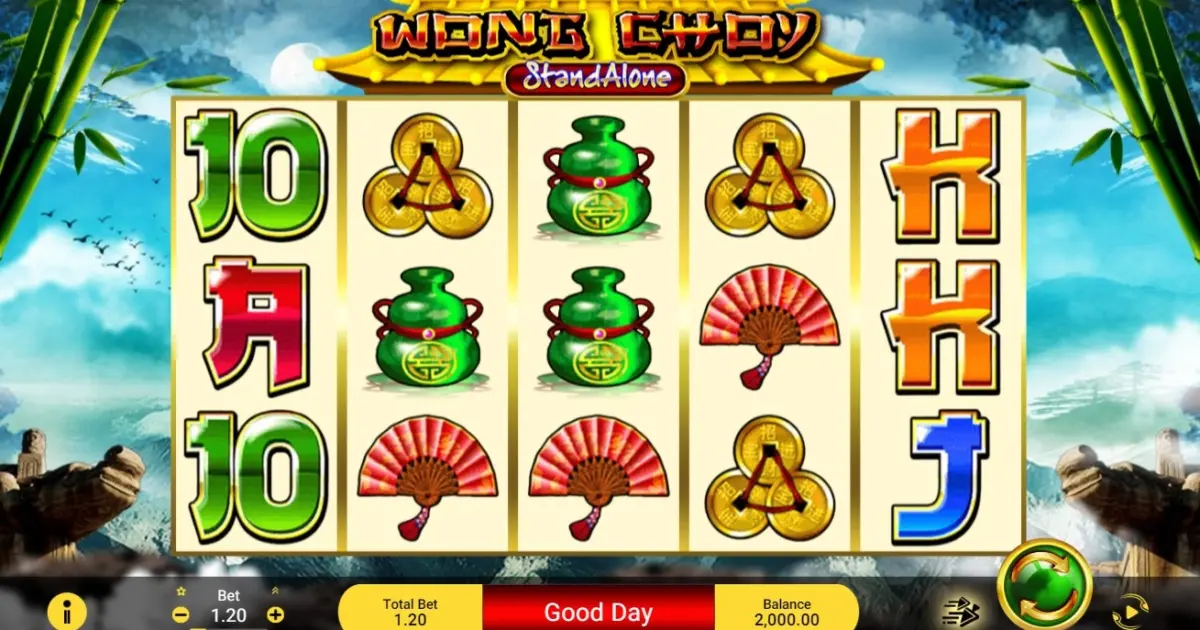
Wong Choy lands in the top 0.2% of slots by play volume, pairing a strong RTP with an Asian theme that has drawn consistent traffic since release. Spadegaming has published the mathematics but left volatility, max win and feature detail undisclosed, so this review focuses on what the numbers tell you about long-run expectation and how the game fits inside the studio’s portfolio of 120 titles.
| Attribute | Value |
|---|---|
| RTP | 96.74% |
| Reels | 5 |
| Provider | Spadegaming |
| Theme | Asian |
| Popularity rank | 50th percentile (top 0.2%) |
Wong Choy versus the average slot
The corpus-wide average RTP sits at 95.71%. Wong Choy returns 96.74%, which means it pays back 1.03 percentage points more per £100 wagered over a statistically significant sample. Across 10,000 spins at £1 each, that difference translates to roughly £103 more returned to players in aggregate—not a guarantee for any individual session, but a meaningful edge when you compare it to the bottom quartile of slots that cluster around 94% to 95%.
Popularity data confirms the market has noticed: Wong Choy sits at rank 50, placing it in the 99.8th percentile. Only two in every thousand slots tracked see more play. That level of sustained traffic usually signals either a standout RTP, a hit feature mechanic, or both. Here the RTP alone justifies the attention.
RTP breakdown: 96.74% in context
RTP is the percentage of all stakes a slot returns to players across millions of spins. 96.74% means £96.74 back for every £100 wagered in the very long run—long enough that individual sessions will deviate wildly from that figure. A single 500-spin session might return £40 or £150; RTP describes the central tendency, not the range.
Within the Asian theme category, which comprises 1,455 games, Wong Choy’s 96.74% places it comfortably above median. Mystic Fortune Deluxe matches it at 96.71%, while Floating Dragon Hold and Spin also delivers 96.71%. You will find higher RTPs in Spadegaming’s own catalogue—Princess Wang returns 97.04%—but Wong Choy still beats nine in ten Asian-themed competitors.
If you are comparing two slots and all other factors are equal, the higher RTP is the rational choice every time. The house edge on Wong Choy is 3.26%; on a 94% slot it would be 6%. That gap compounds across every spin.
Volatility profile
Spadegaming has not published a volatility rating or variance descriptor for Wong Choy, so any claim you read elsewhere about swing size, hit frequency or session risk is speculative. Volatility governs how often you win and how large those wins tend to be: low volatility spreads returns across many small hits and grinds through bankroll slowly, high volatility clusters returns into infrequent large multipliers and can drain a balance in minutes.
Without that figure, treat every demo session as a data point. If you see frequent small wins, you are likely looking at low to medium variance. If the balance swings violently or sits static for dozens of spins, variance is higher. The RTP remains 96.74% either way; volatility only changes the route the game takes to get there.
Spadegaming as a studio
Spadegaming operates a portfolio of 120 slots with an average RTP of 96.63%. Wong Choy’s 96.74% sits eleven basis points above that studio mean, which positions it in the upper half of the catalogue by player return. The studio publishes RTP data consistently, a transparency practice that lets you make direct comparisons within the range.
Princess Wang takes the top slot at 97.04%, a rare figure that edges into the 97% band where only a handful of providers venture. Lucky Koi Exclusive returns 96.52%, still above the market average but trailing Wong Choy by 0.22 percentage points. Moodie Foodie drops to 95.0%, which is playable but unremarkable given the competitive set.
If you favour Spadegaming’s design language and mechanic style, start with Princess Wang for the highest long-run return, then move to Wong Choy if you want something that still beats the studio average while pulling significantly more traffic.
Three Asian alternatives worth comparing
The Asian theme category holds 1,455 titles, so direct comparison narrows the field. Mystic Fortune Deluxe matches Wong Choy almost exactly at 96.71% RTP, making it a lateral move if you want a different studio’s take on the same theme. The Book of Amaterasu falls to 95.0%, surrendering 1.74 percentage points and adding meaningful house edge. Floating Dragon Hold and Spin also returns 96.71% and introduces a hold-and-spin mechanic that some players prefer for the visible reel persistence it offers.
When two games share similar RTP, your decision comes down to volatility profile, feature preference and stake range—none of which Spadegaming has disclosed for Wong Choy. Demo all three and compare balance behaviour over 200 to 300 spins. The one that matches your tolerance for drawdown is the one you should play with real money.
Getting the most out of the free demo
The free demo lets you test mechanic cadence, reel behaviour and balance volatility without financial exposure. Treat it as a research tool, not a prediction engine: the RNG in demo mode is identical to real-money mode, but your sample size will always be too small to verify the published RTP. Across 500 demo spins you might see 92% or 101% return; neither disproves the long-run figure of 96.74%.
Use demo play to answer operational questions. How many spins does your usual stake buy? How long do losing streaks tend to run? Does the base game produce enough small wins to sustain your balance between larger hits, or does it demand a deeper reserve? These answers inform bankroll planning when you switch to real money.
Set a budget before you fund an account, stake only what you can afford to lose outright, and treat every session as paid entertainment with a negative expected return. The 96.74% RTP means the house keeps £3.26 of every £100 you wager in the long run; short-run variance might return more or less, but the mathematical edge never reverses. Only gamble with money you have already written off, never chase losses, and self-exclude the moment play stops feeling like recreation. You must be 18 or older to play.
Should you play Wong Choy?
Play Wong Choy if you want an RTP in the top quartile and you accept that Spadegaming has left volatility, max win and feature detail unpublished. The 96.74% return beats 95% of the market and sits above the studio’s own average, which makes it a rational choice when compared against the bulk of the Asian theme catalogue. The rank-50 popularity figure tells you the game has held player attention, and that traffic usually correlates with either strong mathematics or a compelling feature set.
Skip it if you need published volatility data to plan your bankroll, or if you want transparency around maximum win potential before you commit. Princess Wang offers 97.04% RTP within the same studio, and that thirty-basis-point edge compounds across every thousand spins. Run the demo, measure the balance behaviour yourself, and compare it directly to the alternatives listed above. The RTP is published and verified; everything else you will need to discover in play.
Frequently Asked Questions
Can I play the Wong Choy slot in demo mode without depositing money?
Yes, the free demo is available and uses the same RNG and 96.74% RTP as real-money play. Demo mode gives you virtual credits to test reel behaviour, mechanic cadence and balance volatility before you fund an account. Treat it as a research tool: your sample size will be too small to verify the long-run return, but large enough to reveal how the game handles your preferred stake and how long losing streaks tend to run.
What does the 96.74% RTP figure mean for my bankroll?
RTP is the percentage of all stakes returned to players across millions of spins, so 96.74% means £96.74 back for every £100 wagered in the very long run. The house keeps £3.26 per £100 as its edge. Individual sessions will deviate wildly from that average: you might see 85% or 108% return across 500 spins. RTP describes central tendency, not the range, so budget for the house edge and treat short-run variance as unpredictable.
Has Spadegaming published a volatility rating for this game?
No, Spadegaming has not disclosed volatility, variance or hit frequency for Wong Choy. That means any claim you read about swing size, session risk or typical drawdown is speculative. Volatility governs how often you win and how large those wins are: low volatility grinds slowly with frequent small hits, high volatility clusters returns into infrequent large multipliers and can drain a balance in minutes. Without the rating, run extended demo sessions and measure balance behaviour yourself.
How does Wong Choy compare to other Spadegaming slots?
Spadegaming operates 120 slots with an average RTP of 96.63%, and Wong Choy's 96.74% sits above that studio mean. Princess Wang leads the catalogue at 97.04%, delivering thirty basis points more return and a measurably lower house edge. Lucky Koi Exclusive returns 96.52%, trailing Wong Choy by 0.22 percentage points. If you favour the studio's design language, start with Princess Wang for the highest long-run return, then move to Wong Choy if you want something that still beats the average.
Will demo play results predict what happens when I switch to real money?
No, demo and real-money modes use the same RNG and RTP, but your sample size is too small to verify the published 96.74% figure. Across 500 demo spins you might see 92% or 101% return; neither disproves the long-run mathematics. Demo play is useful for testing mechanic cadence, measuring balance volatility and planning your stake, but it cannot predict short-run outcomes. Every spin is independent, and variance ensures that the next session will behave differently from the last.




