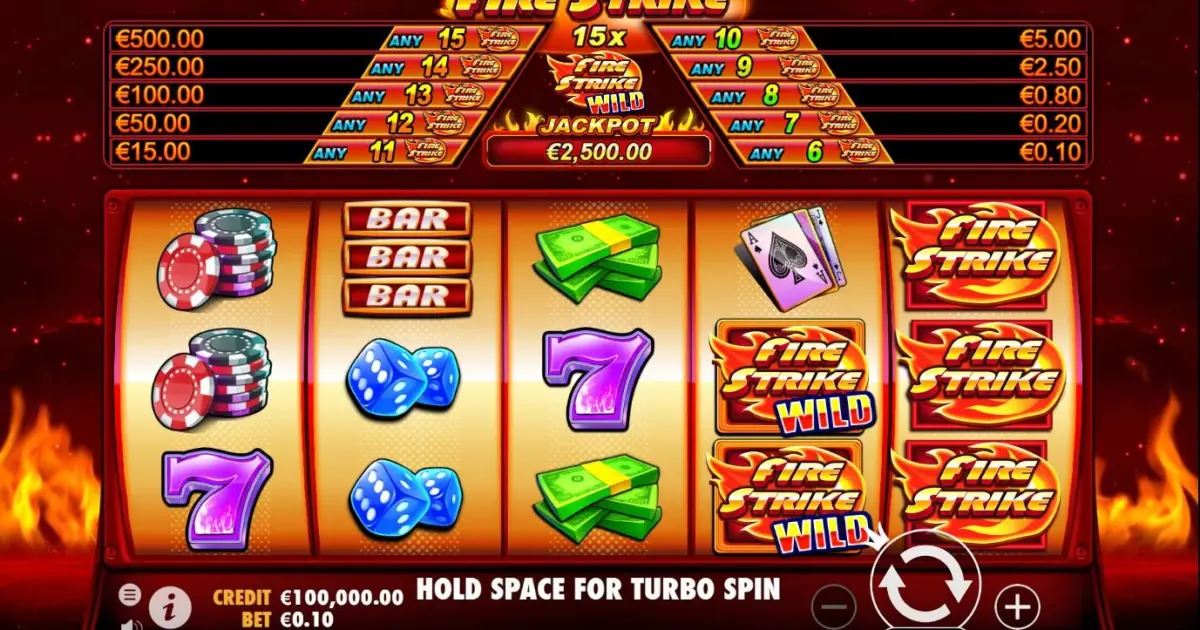
Fire Strike slot sits comfortably above the industry average with a 96.5% return-to-player figure, yet the missing volatility data means you cannot fully gauge how that RTP will distribute across a session. The game holds a 98.4th-percentile popularity ranking, so a large number of players are already trying it — whether that tells you anything useful is a separate question.
Who makes Fire Strike
Pragmatic Play developed and published Fire Strike. The provider currently lists 739 titles in its catalogue, making it one of the largest slot portfolios in the regulated market. Pragmatic Play operates under licences in multiple jurisdictions and supplies games to operators across Europe, Latin America, and North America. Their games share a common framework: a standard reel layout, a paytable accessible before play, and a published RTP figure on the information screen of each title. Fire Strike follows that convention, with five reels as its structural basis.
The theme label on this game reads “5-Reels” — a technical descriptor rather than a narrative or visual one. It tells you the grid shape but nothing about what the symbols depict, what animations trigger, or whether the presentation leans classic or contemporary. Pragmatic Play does not categorise this title under a story-driven theme like mythology, adventure, or fruit-classic, which means you should treat visual and audio expectations with caution. What you see when you open the demo is the only reliable guide to the game’s atmosphere.
| Provider | Pragmatic Play |
|---|---|
| RTP | 96.5% |
| Reels | 5 |
| Free demo | Yes |
Where Fire Strike sits in the Pragmatic Play catalogue
Among Pragmatic Play’s 739 games, Fire Strike ranks at position 323 by popularity, placing it in the top 2.5% of their catalogue by player engagement. That is a strong showing for a title whose theme label offers no obvious hook — no ancient gods, no candy land, no fruit-machine nostalgia that typically drives search volume. The ranking suggests the game earns plays through placement in operator lobbies rather than through name recognition alone.
Comparing it to better-known titles from the same provider clarifies where it fits in the return landscape. Gates of Olympus matches Fire Strike exactly at 96.5% RTP, and Sweet Bonanza edges it marginally at 96.51%. Joker’s Jewels shares the same 96.5% figure. All three of these games carry recognisable identities that Fire Strike lacks — distinct themes, established bonus structures, and community discussion around their features. Fire Strike occupies a similar numerical position but without the same public profile.
The provider’s average RTP across all 739 titles stands at 96.32%. Fire Strike exceeds that by 0.18 percentage points. Across a corpus that includes games with lower returns and older legacy titles, this places Fire Strike in the upper band of Pragmatic Play’s published figures, though not at the very top.
RTP: 96.5% against a 96.32% house average
The 96.5% RTP means that over a very large number of spins — millions, not hundreds — the game returns 96.50 for every 100 wagered, holding 3.50 as theoretical house edge. In practice, you will encounter this figure nowhere near a session. RTP is a long-run statistical property; a 500-spin session could return 60% or 140% and both outcomes are entirely consistent with a 96.5% theoretical average.
Against the industry corpus average of 95.71%, Fire Strike delivers 0.79 percentage points more return. That difference translates concretely: over 10,000 spins at a fixed stake of £1, the theoretical difference between the two games is £79. The gap is meaningful in aggregate but invisible in any single playing session.
Against the Pragmatic Play average of 96.32%, the 0.18 percentage point difference is smaller. Over 10,000 spins at £1 stake, that gap amounts to £18 in theoretical return. The RTP figure is a useful sorting mechanism when comparing games side by side, but it does not predict whether your individual session will be positive or negative.
Volatility and who it suits
Pragmatic Play has not published a volatility rating for Fire Strike. This is unusual — most of their titles carry a low, medium, or high designation, and many display the rating directly on the game’s information panel. The absence means you cannot determine how the 96.5% RTP is distributed: whether it arrives through frequent small wins or rare large payouts.
Volatility governs session experience more directly than RTP. A low-volatility game with 96.5% RTP delivers smaller wins more often, stretching your bankroll across more spins but rarely producing a large single return. A high-volatility game with the same RTP concentrates payouts into fewer, bigger events, meaning long stretches of losses punctuated by occasional large returns. Without knowing which profile Fire Strike follows, you cannot plan a bankroll for this game the way you could for a title with a published rating.
If volatility data appears in the game’s information screen when you open the demo, read it there. Pragmatic Play’s published data on the game itself is more authoritative than third-party estimates, which vary widely across review sites. If no rating appears on the information screen, treat any figure quoted elsewhere as unconfirmed.
Playing Fire Strike for free
A free demo is available for this title, and you can play it without registration or deposit on our site. The demo uses the same math model as the real-money version — the same reel layout, the same symbols, and the same paytable. What it cannot replicate is the financial consequence of each outcome, and that consequence is a meaningful part of how players perceive volatility and bonus frequency. A session that feels manageable in demo play can feel very different when real stakes are at risk.
Use the demo to assess presentation quality, confirm whether the paytable and any in-game features match expectations formed from the theme label, and get a sense of how often wins appear in a short sample. If the game does not feel right after a few hundred demo spins, no amount of switching to real money will change that assessment.
If you decide to play for real money, set a session budget before you start and treat the money spent as the cost of entertainment, not an investment with an expected return. The house edge is built into every spin regardless of outcomes you have already seen. Only play if you are 18 or over, and only within a budget you can afford to lose entirely.
Similar picks
Fire Strike is categorised under a “5-Reels” theme label, and no other games in our corpus share that exact classification. This means there is no filtered set of comparable titles grouped by the same technical descriptor. If you want games from the same provider with similar return figures, the closest comparisons are all Pragmatic Play titles: Sweet Bonanza at 96.51% RTP offers a cluster-pays mechanic and a recognisable theme, while Joker’s Jewels at 96.5% presents a more traditional reel-and-payline structure. Both publish volatility data, filling the gap that Fire Strike leaves open.
Verdict
Fire Strike offers a 96.5% RTP that places it above both its provider’s average and the broader industry benchmark. Its popularity ranking confirms that players are finding it in operator lobbies and engaging with it at a rate that puts it in the top percentile of Pragmatic Play’s catalogue. The missing volatility rating, however, is a genuine gap in the information you need for informed play. Without knowing how that 96.5% is distributed across wins and losses, you are playing with incomplete data — the game could be low-volatility, medium, or high, and the bankroll implications differ substantially across those profiles.
For players who value published data and want to make decisions based on the full picture, the three linked titles from the same provider offer identical return figures with confirmed volatility ratings. Fire Strike is a viable option for players who prioritise RTP above all other factors and who will supplement the missing volatility information with their own demo observation.
Frequently Asked Questions
Is Fire Strike available to play for free?
Yes, a free demo of Fire Strike is available on our site without registration or deposit. The demo runs the same math model as the real-money version, so the 96.5% RTP and five-reel structure are identical. You can use it to evaluate presentation, check the paytable, and observe win frequency before committing any funds.
What is the RTP of Fire Strike and how does it compare to Pragmatic Play's other games?
Fire Strike has a 96.5% RTP, which is 0.18 percentage points above Pragmatic Play's catalogue average of 96.32% across 739 titles. It matches the RTP of Gates of Olympus and Joker's Jewels exactly, and sits just below Sweet Bonanza at 96.51%. Against the broader industry average of 95.71%, Fire Strike delivers 0.79 percentage points more.
Is Fire Strike a high, medium, or low volatility slot?
Pragmatic Play has not published a volatility rating for Fire Strike, which is unusual given that most of their 739 catalogue titles carry a clear designation. Without this data you cannot determine whether the 96.5% RTP arrives through frequent small wins or rare large payouts. Check the information screen inside the game itself, as in-game published data is more reliable than third-party estimates.
Who makes Fire Strike and how many games has that provider released?
Fire Strike is made by Pragmatic Play, one of the largest slot providers in the regulated market with 739 titles currently listed in their catalogue. The provider operates under licences in multiple jurisdictions across Europe, Latin America, and North America, and their games share standard structural conventions including published RTP figures and accessible paytables.
Can playing Fire Strike for free help you predict real-money results?
No. A demo session shares the same math model as real-money play, but outcomes in both cases are governed by a random number generator applied to independent spins. A winning demo streak does not increase your probability of a winning real-money session, and a losing demo does not mean the game is "due." The demo is a tool for evaluating presentation and structure, not for forecasting financial outcomes.




