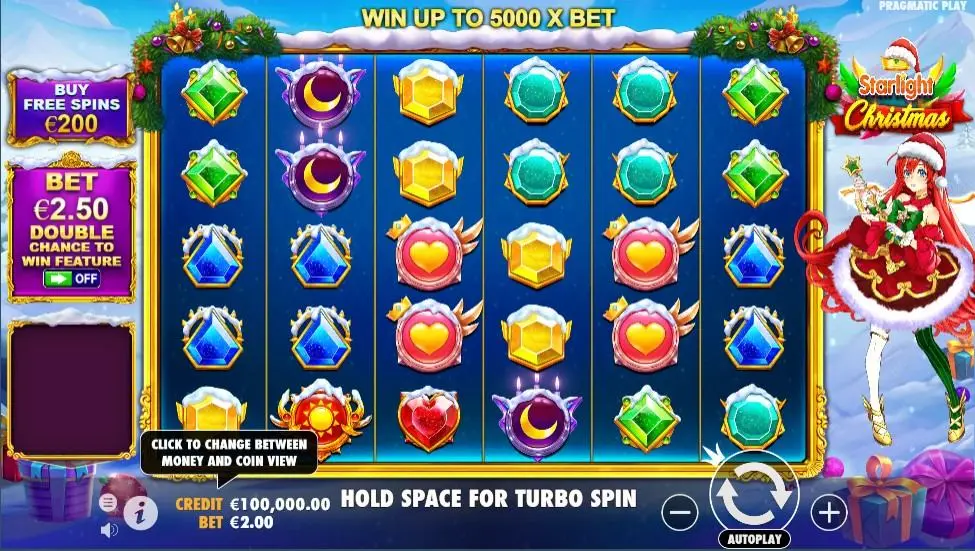
The starlight christmas slot returns 96.5% to players over a very large sample, which places it 0.79 percentage points above the average game in our library. That is a meaningful edge, though high volatility means you will not feel that edge on any single session.
Starlight Christmas versus the average slot
Across every title in our catalogue, the average RTP sits at 95.71%. Starlight Christmas at 96.5% clears that benchmark by 0.79 percentage points. Over 10,000 spins at a £1 stake, that difference translates to roughly £79 more returned to you compared to a game at the corpus average. Of course, that figure is a theoretical expectation spread across thousands of independent spins — no individual session guarantees it.
Against Pragmatic Play’s own portfolio, the gap narrows considerably. Their 739-game library averages 96.32% RTP, so Starlight Christmas sits just 0.18 points above its provider’s typical output. That places it squarely in the middle of Pragmatic’s range rather than at the top.
Pragmatic Play has not published a max win multiplier for this title in the data available to us. Treat any maximum-win figure you encounter on other review sites with caution, since we cannot verify it from official sources.
RTP breakdown: 96.5% in context
An RTP of 96.5% means that across a sufficiently large number of spins, the game returns £96.50 for every £100 wagered. The house edge is 3.5%, which is the mathematical cost of playing. This number is a long-run average calculated over millions of simulated rounds — it does not describe what happens across 200 spins or 2,000 spins.
| Metric | Value |
|---|---|
| RTP | 96.5% |
| Volatility | High |
| Reels | 6 |
| Minimum bet | $0.20 / £0.20 / €0.20 |
| Maximum bet | $100 / £100 / €100 |
| Popularity rank | 356 of all games tracked |
| Popularity percentile | 98.2% |
The 6-reel layout supports cluster-pays or ways mechanics common to Pragmatic’s modern titles, though the specific payline structure is not detailed in available documentation.
Volatility profile
High volatility means your session will be uneven. You will encounter long stretches of small returns or dead spins punctuated by occasional larger payouts. This does not mean the game pays less overall — the 96.5% RTP holds regardless of volatility — but it changes the shape of the return distribution.
Practically, high volatility demands a larger bankroll relative to your stake. A £50 budget at £1 per spin covers 50 rounds, which is thin for a high-variance title where dry spells of 40 or 60 spins are statistically unremarkable. At the £0.20 minimum stake, that same £50 gives you 250 spins and a far more reasonable chance of surviving a variance cluster. If you are planning to play with real money, sizing your stake so that your total budget covers at least 200 rounds is prudent.
Every spin is independent. There is no sequence that “resets” the game or makes a payout more likely after a losing stretch. High volatility produces those streaks; they are the math working as intended, not a signal about what comes next.
Pragmatic Play as a studio
Pragmatic Play has published 739 games, making it one of the highest-volume slot providers in the market. That breadth produces a wide quality range, so the specific RTP of each title matters more than the studio name alone. At 96.5%, Starlight Christmas sits marginally above the provider’s own 96.32% average, which is a neutral signal.
If you are evaluating Pragmatic’s portfolio for similar mechanics or themes, Gates of Olympus matches Starlight Christmas at exactly 96.5% RTP with a similarly volatile structure and a 6-reel grid. Sweet Bonanza edges slightly higher at 96.51% and uses a tumble mechanic rather than traditional paylines. For a lower-variance alternative from the same studio, Joker’s Jewels holds the same 96.5% RTP but applies a medium volatility that produces more frequent, smaller wins.
Three Christmas alternatives worth comparing
Starlight Christmas competes in a crowded seasonal field. Our database tracks 467 Christmas-themed slots, so it is useful to compare a few directly before committing.
Gates of Olympus Xmas 1000 shares the same 96.5% RTP and the 6-reel Pragmatic framework, making it the closest structural match. If the Christmas skin is your primary draw, this variant lets you test identical maths under a different presentation.
Lucky Santa Bonanza drops to 96.12% RTP — a 0.38-point deficit that costs roughly £38 per £10,000 wagered over the long run. Santa Sphere: Hold the Spin sits lower still at 96.05%, a 0.45-point gap. Both are playable choices if their mechanics appeal, but they carry a measurably higher house edge than Starlight Christmas.
Getting the most out of the free demo
A free demo version of Starlight Christmas is available, and using it before playing with real money is the single most practical step you can take. Demo play lets you observe the rhythm of high-volatility outcomes — how long the dry stretches run, how often meaningful hits land — without financial exposure. You get a felt sense of what 200 or 300 spins actually looks like on this game.
However, demo results carry no predictive value for real-money sessions. The outcome distribution is identical, but your perception of variance in a demo is distorted because there is nothing at stake. Do not treat a lucky demo session as evidence that the game is “ready to pay” — each spin is independent regardless of what preceded it in any mode.
Play only what you can afford to lose entirely. Set a budget before your first real-money spin and stop when it is spent, treating the experience as paid entertainment with uncertain returns rather than as an income source. You must be 18 or older to wager real money.
Should you play Starlight Christmas?
The numbers support the game: 96.5% RTP, above-average for the market, and a 6-reel structure that Pragmatic has refined across hundreds of titles. The rank of 356 and 98.2nd popularity percentile tell you that a large number of players are actively choosing it.
What should give you pause is the high volatility paired with an absent max-win figure. Without a published cap on potential payout, you cannot properly assess whether the risk-reward asymmetry is acceptable. Use the demo, set a stake that gives you 200+ spins of runway, and if you decide to play for real money, treat the session as entertainment at a fixed cost.
Frequently Asked Questions
Can you play Starlight Christmas for free?
Yes, a free demo version of Starlight Christmas is available on this site. The demo runs the same 96.5% RTP maths and high volatility as the real-money version, letting you experience 6-reel outcomes without any financial risk. Demo play does not predict real-money results, but it gives you a practical sense of the game's variance.
What is the RTP of Starlight Christmas?
Starlight Christmas has an RTP of 96.5%, which means it theoretically returns £96.50 for every £100 wagered across a very large sample of spins. This is 0.79 percentage points above the 95.71% corpus average and 0.18 points above Pragmatic Play's own 96.32% portfolio average.
Is Starlight Christmas high volatility?
Yes, Starlight Christmas is classified as a high-volatility slot. This means your sessions will feature longer stretches of small or absent wins with occasional larger payouts. High volatility does not reduce the 96.5% RTP, but it demands a larger bankroll relative to your stake to survive the variance clusters that occur.
What other Pragmatic Play slots should I compare?
Gates of Olympus and Sweet Bonanza both match Starlight Christmas closely at 96.5% and 96.51% RTP respectively, using 6-reel grids and high volatility. If you prefer a lower-variance experience from the same studio, Joker's Jewels holds the same 96.5% RTP with a more forgiving medium volatility profile.
What is the minimum and maximum bet on Starlight Christmas?
The stake range runs from $0.20, £0.20, or €0.20 at the low end to $100, £100, or €100 at the high end. At the minimum bet, a £50 budget provides 250 spins, which offers reasonable runway for a high-volatility title where 40-spin dry spells are statistically normal.