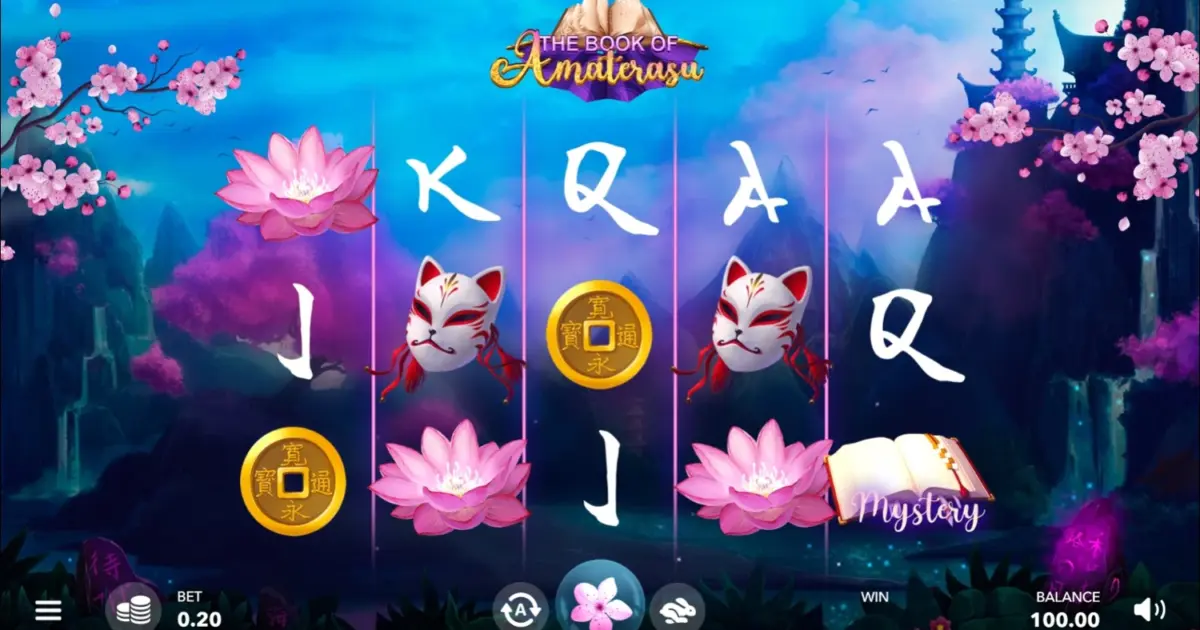
This Mascot Gaming release sits at 95.0% RTP, which is below both the provider’s own average and the broader corpus benchmark on this site. The Book of Amaterasu Slot is genuinely popular, ranked 48th by play volume and sitting in the 99.8th percentile, but popularity and expected value are separate things. If you are comparing Asian-themed slots before committing money, what follows lays out the figures Mascot Gaming has actually published and flags plainly what remains unknown.
The Book of Amaterasu Slot at a glance
Mascot Gaming describes The Book of Amaterasu as a 5-reel slot drawing on an Asian theme. The title references Amaterasu, a deity central to Japanese mythology, and the game is indexed under that cultural grouping on this site alongside 1,454 other titles. Free play is available, so you can examine the layout and mechanics before risking a penny.
Here is a summary of the data points Mascot Gaming has confirmed versus those that remain unpublished:
| Attribute | Value |
|---|---|
| Provider | Mascot Gaming |
| RTP | 95.0% |
| Reels | 5 |
| Theme | Asian |
| Volatility rating | Not published |
| Paylines / Ways | Not published |
| Max win multiplier | Not published |
| Hit frequency | Not published |
| Stake range | Not published |
| Free demo | Available |
| Popularity rank (this site) | 48th of all indexed slots |
Those five “Not published” rows matter. Mascot Gaming makes 114 titles in total, and this one carries a notably sparse public data sheet. You can find a slightly more complete figure set on Fruit Disco, another Mascot release that publishes an RTP of 95.23%, and even that is only marginally higher. The lack of disclosed volatility or hit frequency means you will need to build your own expectations from the theme, reel count, and the single RTP figure provided.
What a 95.0% RTP actually returns
RTP is a long-run statistical average calculated across millions of simulated spins. It does not describe what any single session will deliver, but it sets a ceiling on what a group of players collectively keeps from what they wager over a very long horizon. At 95.0%, the house edge is 5.0%. For every $100 in total action across a large enough sample, the model returns $95.00 to players and retains $5.00.
The corpus average across all slots indexed on this site is 95.71%. That puts The Book of Amaterasu 0.71 percentage points below the market standard. In practical terms, if you were wagering $1 per spin for 10,000 spins, the theoretical return at 95.0% is $9,500, while the same bankroll on a game at 95.71% returns $9,571. The difference is $71 over 10,000 spins at that stake, or roughly $7.10 per 1,000 spins.
That spread widens with higher stakes. A player wagering $2.50 per spin across the same 10,000 rounds would see a theoretical gap of $177.50. Over many sessions, the difference between a below-average RTP and an average one is not trivial, even though neither figure tells you anything about a single evening’s result.
Compared to its own provider’s average of 95.42%, The Book of Amaterasu trails by 0.42 percentage points. Mascot Gaming’s portfolio skews toward mid-to-low RTP territory, so this title is not an outlier within their catalogue, but neither does it reward the player who wants to stay at the table longer. If you are shopping for an Asian-themed slot with meaningfully better return numbers, Wong Choy publishes 96.74% RTP—a 1.74-point advantage—and sits in the same theme category. The math is straightforward: higher RTP means the theoretical drain rate per unit wagered is lower, and your session lasts longer on identical funds.
Volatility and what your session will feel like
Mascot Gaming has not published a volatility rating for this title, which is the most consequential gap in the fact sheet. Volatility determines how a game’s theoretical RTP distributes across individual outcomes. A low-volatility slot pays small amounts frequently, so your balance declines gradually with steady, modest hits. A high-volatility slot pays infrequently but can swing much larger amounts when it does, meaning long dry spells punctuated by bursts.
Without a published volatility figure, you cannot accurately plan your bankroll around the frequency or size of wins. You can look at the popularity rank (48th) and the Asian theme category, which tends to contain games in the medium-to-high volatility range, but that is a heuristic, not a fact. Do not treat thematic proximity as a substitute for a disclosed volatility label.
Many Asian-themed slots on this site do not publish hit frequency either. Where that data is available, it typically ranges between 20% and 35%, meaning roughly one in five to one in three spins produces a win of any size. If you decide to play The Book of Amaterasu, treat the first session on demo as a personal data-gathering exercise: spin through 100 rounds, log the wins, and form your own impression of the payout rhythm. Demo play cannot guarantee that the same pattern will appear when money is on the line, but it does reveal whether the pace of play feels comfortable to you.
The 5-reel layout and how wins are counted
Five reels is the standard grid for most modern video slots, and The Book of Amaterasu follows that convention. The reel count tells you the game has more than three columns of symbols, which typically allows for layered mechanics and multi-symbol combinations across the screen. What the FACTS do not tell you is how many paylines the game uses, whether it employs a “ways to win” mechanic (such as 243 ways or 1,024 ways), or whether the grid expands during bonus rounds.
This absence matters because payline count and ways structures directly affect how often winning combinations appear. A 5-reel, 20-payline slot behaves very differently from a 5-reel, 243-ways slot, even at identical RTP. With a ways mechanic, matching symbols on adjacent reels from left to right form winning combinations regardless of their row position, which increases hit frequency at the cost of individual win size per combination. With fixed paylines, symbols must land on specific horizontal or diagonal lines to register, producing fewer wins of larger average size.
Since Mascot Gaming has not disclosed this structural detail, the only reliable path is to load the demo and read the paytable in-game. Many 5-reel Asian slots use ways systems, but that is a probability, not a certainty.
Stake range and sizing a bankroll
No minimum or maximum stake has been published for this title. Without those figures, you cannot calculate an exact bankroll requirement or determine how many spins your starting balance will cover. The general principle remains constant: divide your total session budget by the product of your per-spin stake and the number of spins you want to play.
For example, if a game allows $0.20 per spin and you want to play 300 rounds, your budget is $60. At $1 per spin across the same 300 rounds, you need $300. The RTP of 95.0% means the expected drain is 5% of total wagered action regardless of stake, but the number of spins you can sustain before your balance depletes is entirely a function of the stake-to-budget ratio. A game with a $5 minimum stake is effectively inaccessible to a $20 session budget; a game with a $0.10 minimum extends it to 200 rounds.
When Mascot Gaming publishes the range—or when you see it displayed in-game during demo play—plug those numbers into this framework before you deposit. The absence of a published max win multiplier compounds this uncertainty. If the theoretical ceiling is low, a conservative stake protects more of your budget. If the game can pay several hundred times your stake on a single hit, a smaller per-spin wager buys you more attempts to reach those rare outcomes without exhausting your funds.
Playing the Book of Amaterasu demo before you commit
A free demo version of this game is available, which means you can explore the reel structure, check the in-game help screens for paylines and stake limits, and get a feel for the tempo without spending money. Use it deliberately: note the stake options, observe how often the grid produces any payout at all, and check whether a bonus feature triggers and at what apparent frequency. A 50-spin demo sample is too small to draw conclusions about RTP, but it is enough to confirm whether the presentation and pacing suit your preferences.
Slot outcomes are independent events. No amount of demo play, pattern-watching, or time spent studying the paytable changes the mathematical probability of the next spin. Demo play also cannot predict whether real-money sessions will feel identical; the RNG does not change between modes, but the psychological pressure of playing with funds alters how you perceive variance.
All players should be 18 or over. Set a budget before you start, treat any losses as the cost of entertainment, and stop when that budget is spent. If gambling stops being recreational, resources like GamCare or the National Council on Problem Gambling can help.
Verdict: who should play The Book of Amaterasu
On the numbers available, this is a below-average RTP title with significant undisclosed data points. At 95.0%, it returns $5 less per $100 wagered than the corpus average of 95.71%, and it trails even its own provider’s average. That is not a disqualifying margin for a casual player, but it is a meaningful one over a large number of sessions. The missing volatility figure, absent payline disclosure, and unpublished max win mean you are walking into a session with more unknowns than most players should tolerate when better-documented alternatives exist.
If you enjoy the visual and audio presentation of Asian-themed slots and the demo’s rhythm appeals to you, the 5-reel grid and 95.0% RTP are workable if you size your stakes conservatively and accept the longer theoretical drain compared to higher-return titles. If you are specifically hunting for the best value in the Asian theme category, Floating Dragon Hold and Spin delivers 96.71% RTP with published feature data, making the comparison straightforward and favourable to the player.
The Book of Amaterasu earns its 99.8th-percentile popularity rank on theme appeal and presentation, not on mathematical advantage. That is not a criticism—it is an observation about which numbers actually matter to your wallet. Decide which ones you care about, then play accordingly.
Frequently Asked Questions
Does The Book of Amaterasu have a free demo?
Yes. A free demo version is available, letting you test the 5-reel layout, check stake options in-game, and assess the payout rhythm without risking money. The demo mirrors the same RNG as the real-money version, so it reflects genuine spin mechanics, but it cannot guarantee that your demo experience will match real-money results.
What is the RTP of The Book of Amaterasu?
Mascot Gaming lists the RTP at 95.0%, which is 0.71 percentage points below the 95.71% average across this review site's full catalogue and 0.42 points below Mascot Gaming's own provider average of 95.42%. At that rate, the model retains $5.00 for every $100 wagered across a very large sample.
How volatile is The Book of Amaterasu?
Mascot Gaming has not published a volatility rating for this title, which is the single most important missing data point. Without it, you cannot predict win frequency or swing size accurately. Loading the demo and tracking outcomes across 100-plus spins is the only way to form a personal impression of the game's tempo.
Who makes The Book of Amaterasu and what else do they offer?
Mascot Gaming developed The Book of Amaterasu, a provider with 114 slots in their catalogue. Their average RTP sits at 95.42%, and other titles include Fruit Disco at 95.23% and The Biggest Win x50 at 95.21%. The provider tends to operate in the mid-range RTP bracket across its full portfolio.
Can you win real money playing the demo version?
No. Demo play uses simulated credits with no cash value. Real-money play at an online casino is required to win funds, and outcomes are governed by random number generators regardless of whether you have practised on the free version first. Set a budget and treat real-money sessions as paid entertainment.




