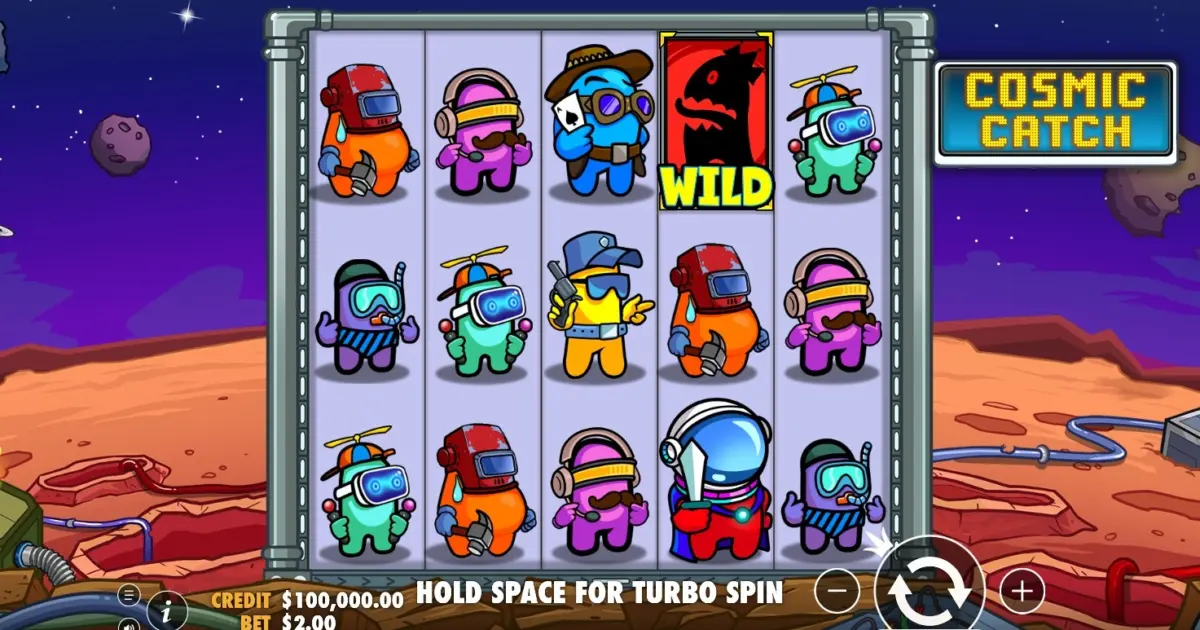
Cosmic Catch slot carries a 96.5% RTP — 0.79 points above the 95.71% corpus average across the titles indexed here. Pragmatic Play’s own portfolio averages 96.32%, so this title sits just above that studio benchmark too. What Pragmatic has not published is a volatility rating, a max-win multiplier, a hit-frequency figure or a confirmed stake range, which means you are evaluating this game on one number and a theme label.
Cosmic Catch versus the average slot
The +0.79-point RTP spread over the corpus average is meaningful but not dramatic. Across 10,000 spins at £1 per spin, the theoretical difference between 95.71% and 96.5% is £79 — money you would never detect in a single session but that accumulates over thousands of rounds. Pragmatic Play has not flagged Cosmic Catch as a high-RTP outlier the way some studios publish 97%+ titles to differentiate them from their core lineup. Instead it sits in the comfortable upper band of the provider’s own range, slightly above the 96.32% Pragmatic average, and well below the theoretical ceiling that a handful of niche operators negotiate. The takeaway: you are not gaining or losing ground by choosing this title over another Pragmatic game on RTP alone. The decision rests elsewhere.
| Provider | Pragmatic Play |
|---|---|
| RTP | 96.5% |
| Reels | 5 |
| Theme | Space and galaxy |
| Free demo | Yes |
RTP breakdown: 96.5% in context
RTP is a long-run statistical average calculated across millions of spins. A 96.5% figure means the game returns £96.50 for every £100 wagered across an astronomically large sample. It does not mean you will lose 3.5% of your balance on a 200-spin session. Real sessions produce results anywhere from zero return to multiples of your total stake, and the distribution of those outcomes is governed by volatility — which Pragmatic has not specified for Cosmic Catch.
What you can do is compare. Against Gates of Olympus, which also carries 96.5% RTP, the house edge is identical at the theoretical level. Any difference in how your session feels comes from variance structure, payline density and bonus frequency — factors Cosmic Catch’s spec sheet leaves blank. That blank space is the single most important thing to know before you commit real money.
Volatility profile
Pragmatic Play has not published a volatility rating for Cosmic Catch, and no third-party testing data appears in our source set. This is not a minor gap. Volatility determines whether your session will feel like a slow grind with occasional spikes or a rapid-fire sequence of small wins. Two slots can share an identical RTP and produce completely different bankroll experiences depending on their variance structure.
Without a confirmed rating, you cannot responsibly set a stake level based on the logic “this game pays small wins often” or “this one is a lottery ticket.” If you play Cosmic Catch for real money, the prudent approach is to treat it as unknown-variance and size your stake conservatively. Many Pragmatic 5-reel titles fall in the medium-to-high band, but “many” is not “this one,” and extrapolating from portfolio averages is a shortcut that has cost players more than it has saved them.
Pragmatic Play as a studio
With 739 indexed titles, Pragmatic Play is among the highest-volume slot developers in the regulated market. Their portfolio-wide average RTP of 96.32% is healthy and consistent — they do not publish outliers far above or below that line. Within that range, Cosmic Catch’s 96.5% places it in the upper quartile of Pragmatic’s own output.
The studio’s flagship Sweet Bonanza at 96.51% and Joker’s Jewels at 96.5% demonstrate the pattern: Pragmatic clusters most of its releases in a narrow 0.3-point band around 96.4%. This consistency means the RTP figure tells you little about individual game quality at Pragmatic. You should be comparing mechanics, theme and the volatility information Pragmatic does publish for its established titles — not hunting for an edge in the percentage alone.
Three Space and galaxy alternatives worth comparing
Cosmic Catch belongs to a 189-title space and galaxy cluster across our index. Three games in that theme deserve a direct comparison:
Cosmic Cash offers 96.55% RTP, a fraction above Cosmic Catch’s 96.5%. The near-identical percentage means you cannot distinguish these two on theoretical return — the differentiator will be whatever volatility and bonus structure each exposes. Cosmos Cash sits at 96.0%, half a point behind Cosmic Catch, which over a long session is a real edge in your favour if the volatility profiles match. At the other end, Pirots 4 publishes 94.0% RTP — well below both Pragmatic titles and below the corpus average. If RTP is your primary filter, it falls out of consideration immediately.
Getting the most out of the free demo
The Cosmic Catch free demo is available and requires no download, which makes it useful for one specific purpose: forming an intuitive sense of how often winning combinations appear and how large the gaps between them feel. The demo uses the same random-number sequence as the real-money version, but demo play cannot predict your real-money results. Treat the demo as a familiarity tool, not a statistical instrument.
Since volatility is unlisted, your demo session is the only proxy you have for observing win frequency and swing size. Run at least 200 spins and track the longest dry stretch and the largest single payout relative to your stake. That gives you a rough, personal sense of variance without relying on an absent official rating. If you later switch to real money, set a budget before you start and stop when it is spent — Cosmic Catch is paid entertainment, not income. Players must be 18 or over.
Should you play Cosmic Catch?
On the evidence Pragmatic Play has published, Cosmic Catch is a 96.5% RTP 5-reel space slot that sits marginally above both the studio’s and the market’s average return. That is competent and inoffensive — nothing in the data suggests it is a poor choice, and nothing suggests it is exceptional. The gap in Pragmatic’s disclosure is the real issue: no volatility rating, no max win, no confirmed stake range.
If you enjoy space-themed slots and want a mid-to-upper RTP game, it is a reasonable pick over the 189 other titles in its theme, many of which publish lower returns. If you need certainty about variance before committing a bankroll, choose a Pragmatic title that actually states its volatility first. The free demo costs nothing and gives you the one piece of information Pragmatic withheld.
Frequently Asked Questions
Is Cosmic Catch available to play for free?
Yes. Pragmatic Play's Cosmic Catch is available as a no-download free demo directly through this site. The demo uses the same reel layout and paytable as the real-money version, letting you observe win patterns without staking cash. It will not pay real money.
What is the RTP of Cosmic Catch?
Cosmic Catch carries a 96.5% RTP as published by Pragmatic Play. That places it 0.79 points above the 95.71% corpus average and 0.18 points above Pragmatic's own portfolio average of 96.32%. It is a solid but not exceptional figure within the provider's range.
What volatility does Cosmic Catch have?
Pragmatic Play has not published a volatility rating for Cosmic Catch. Without that figure you cannot predict whether your sessions will swing wide or deliver steady small returns. Two Pragmatic titles at the same 96.5% RTP can feel completely different in play, so treat the absence as a genuine information gap.
How does Cosmic Catch compare to Cosmos Cash?
Cosmic Cash offers 96.55% RTP against Cosmic Catch's 96.5% — a difference so small it is statistically irrelevant over any realistic session. Both fall in Pragmatic's upper band, and neither has a published volatility figure in our data set, so RTP is the only reliable comparison point.
Which other Pragmatic Play slots share the same RTP?
Gates of Olympus, Joker's Jewels and Sweet Bonanza all publish 96.5% or 96.51% RTP, placing them in the same narrow band as Cosmic Catch. This clustering shows that Pragmatic maintains consistent theoretical returns across its portfolio, so you choose between these titles on theme and mechanics rather than on house edge.




