The gods of oblivion slot sits below the market average on RTP, which is the single most important number for anyone planning a long session. Pragmatic Play published it at 94.5%, meaning you lose more per wager than you would on most of the provider’s other titles. If you are looking for the best mathematical return in this catalogue, you will find better options — but the 98.4th-percentile popularity rank suggests plenty of players disagree.
Gods of Oblivion at a glance
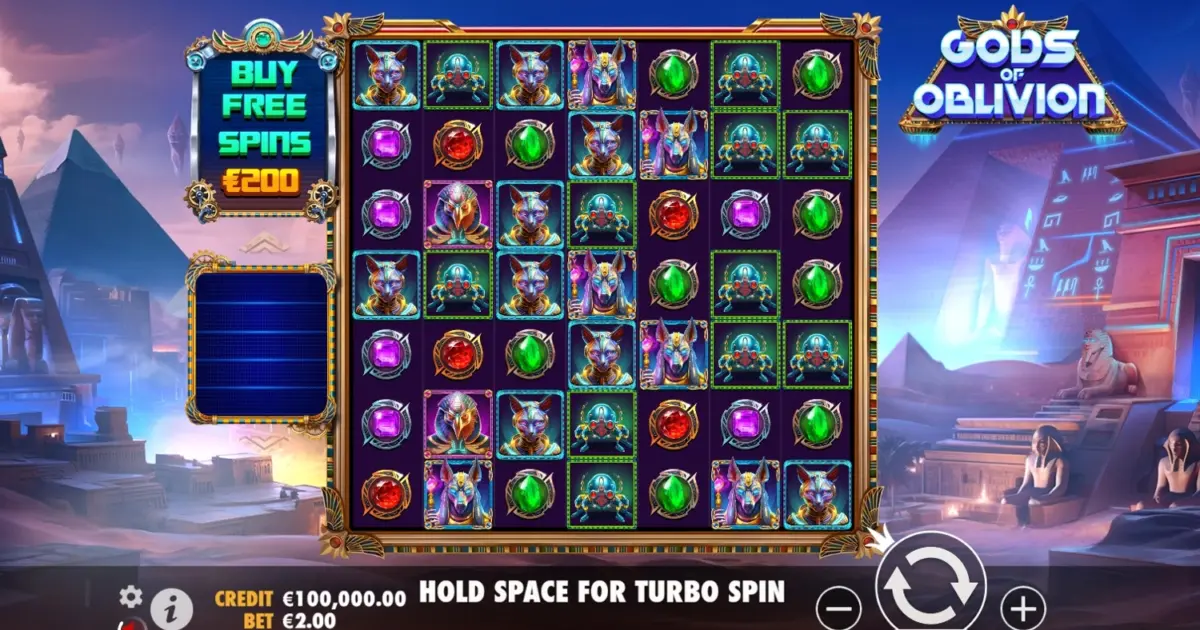
Pragmatic Play released this 7-reel title under an Egypt theme with sci-fi and mythology crossover elements. The table below collects every figure the developer has published publicly.
| Field | Value |
|---|---|
| Provider | Pragmatic Play |
| RTP | 94.5% |
| Reels | 7 |
| Primary theme | Egypt |
| Free demo | Available |
| Popularity rank | 330 (98.4th percentile) |
| Provider avg RTP | 96.32% |
| Corpus avg RTP | 95.71% |
Volatility, hit frequency, maximum win and stake range are all absent from the official data sheet. That missing information matters: you cannot size a session from published numbers alone, so lean on the free demo before risking money.
What a 94.5% RTP actually returns
RTP is a long-run average across millions of spins, not a prediction for one sitting.
Work through a concrete example. Suppose you spin 1,000 times at £1 per spin, wagering £1,000 total. At 94.5% RTP, the theoretical return is £945 — a house edge of £55. The corpus average of 95.71% would return £957.10 over the same session, so this game costs roughly £12 extra per thousand spins compared to the average slot.
Against Pragmatic Play’s own catalogue mean of 96.32%, the gap widens to £18.20 per thousand spins. Compare that with Gates of Olympus at 96.5% — a £20 difference per 1,000 spins at £1 each. Over 5,000 spins the gap is £100.
None of this guarantees a losing session. Short bursts swing either way because every spin is independent. But across many sessions the maths compounds, and 94.5% compounds faster than 96.5%.
Volatility and what your session will feel like
Pragmatic Play has not published a volatility rating for this title. That absence is itself a data point: without it you cannot predict whether your session will feel like a steady trickle of small wins or a long drought punctuated by rare large payouts.
What you can infer: the 7-reel format combined with an Egypt-and-sci-fi crossover theme is common across high-volatility releases in Pragmatic Play’s catalogue. That is a pattern, not a guarantee.
If volatility turns out to be high — which the free demo will reveal quickly — expect stretches where your balance drops 50 to 100 times your average bet before any single win appears. Your bankroll must survive those stretches. Book of Dead, another Egypt-themed game at a similar RTP tier, is rated high volatility and gives a useful reference for what that feels like over 500 spins.
The 7-reel layout and how wins are counted
Seven reels exceeds the traditional 5-reel layout that dominated slots for two decades. More reels means more symbol positions and more possible matching combinations, which generally expands the paytable and increases the ceiling for individual wins.
The developer has not specified whether this game uses fixed paylines, cluster pays or ways-based mechanics. A 7-line game and a 117,649-way game behave very differently on the same stake, so check the paytable screen in the demo before playing real money.
The theme labels — Egypt, Sci-fi, Gods — sit across 908 games in this category. Pragmatic Play’s other mythology titles use symbol-based pays on a standard grid. If this game follows a similar approach, expect conventional matching rather than cascading clusters. That is an educated guess from the label set, not a confirmed mechanic.
Stake range and sizing a bankroll
No minimum or maximum stake has been published for this game. That is unusual for Pragmatic Play, which typically lists bet ranges on its data sheets. Without those numbers you cannot calculate how many spins a given budget covers before entering the lobby.
As a general framework: if the minimum stake is £0.20 (common across this provider), a £50 session buys roughly 250 spins. At £0.50 minimum, the same budget covers 100 spins. A high-volatility game often needs 300 or more spins before a bonus triggers once, so the lower end of the range may leave you without meaningful play.
Sweet Bonanza uses a flexible stake range and is a useful comparison for how Pragmatic Play structures betting across its catalogue. Until live data appears, treat any bankroll plan as provisional.
Playing the Gods of Oblivion demo before you commit
The demo is available on this site with no registration or deposit. It uses simulated credits and identical mathematics to the real-money version — except that demo results do not predict real-money outcomes, because every spin is independent regardless of currency.
Use the demo to answer three questions: how volatile does the game feel over 200 spins, how often does any bonus trigger, and does the visual theme hold your attention. Those are subjective, but they determine whether you will enjoy a session or get frustrated and chase losses.
Responsible gambling note: treat this as paid entertainment. Set a loss limit before you play, consider any deposit as money spent on time, and never chase a loss to recover it. If you are 18 or over and within your budget, that is the entire rulebook.
Verdict: who should play Gods of Oblivion
This is a below-average return game that has attracted enormous attention. The 94.5% RTP is 1.21 points below the corpus average and 1.82 points below Pragmatic Play’s catalogue mean. The missing volatility, stake range and win-mechanic data means you cannot build a reliable session plan from published numbers alone.
That said, the 98.4th-percentile popularity rank tells you players engage with it despite the maths — likely because the visual design and bonus structure are entertaining. Entertainment value is a legitimate reason to play, provided you account for the extra house edge.
If RTP is your primary filter, skip this title. Compare it against Book of the Sun at 96.23% or Crazy Mummy at 96.0%, both of which sit above the corpus average while remaining in the Egypt theme. If the 7-reel format and crossover aesthetic draw you in, try the demo first, confirm volatility empirically, and size your bankroll for a below-average return.
Frequently Asked Questions
Is Gods of Oblivion free to play without depositing?
Yes. Pragmatic Play's Gods of Oblivion is available as a free demo on this review site with no registration or deposit required. The demo uses simulated credits and runs identical mathematics to the real-money version, making it useful for learning the game's feel before committing any budget.
What is the RTP of Gods of Oblivion and is it good?
Gods of Oblivion has a 94.5% RTP, which is 1.21 percentage points below the corpus average of 95.71% and 1.82 points below Pragmatic Play's own catalogue mean of 96.32%. Over 1,000 spins at £1 each, that translates to roughly £55 lost versus an average slot costing you about £43.
Is Gods of Oblivion high or low volatility?
Pragmatic Play has not published a volatility rating for Gods of Oblivion. Without an official figure you cannot predict whether wins arrive as a steady trickle or in rare large bursts. The free demo lets you test this empirically over a few hundred simulated spins before risking money.
What other Pragmatic Play slots should I compare it to?
Gates of Olympus runs at 96.5% RTP and Sweet Bonanza at 96.51%, both delivering roughly 2 percentage points more return per wager than Gods of Oblivion's 94.5%. Over 5,000 spins at £1 each, that gap adds up to about £100 in additional theoretical loss on the lower-RTP title.
Can demo play on Gods of Oblivion win real money?
No. Demo play uses simulated credits and cannot produce real-money payouts. Each spin is an independent event regardless of whether you wager real currency or virtual credits, so results in the demo neither predict nor influence outcomes in a real-money session.