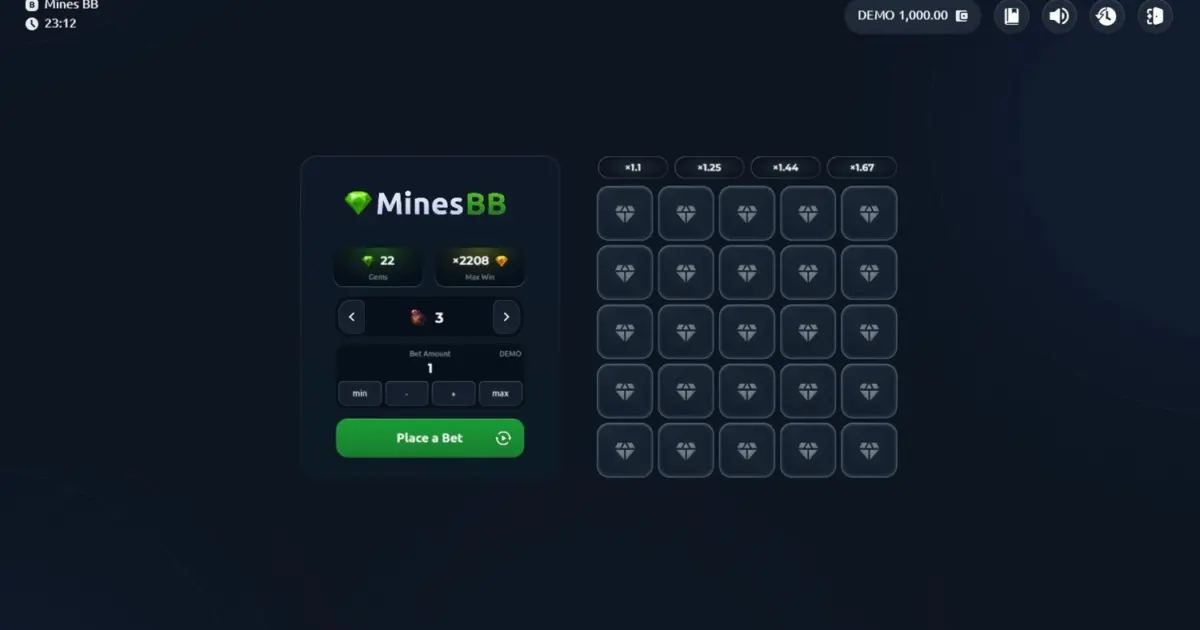
Mines BB from Barbara Bang is a straightforward crash game with a published RTP of 97.92% — above the corpus average — and a free demo available. If you want a quick, honest read on whether the math and pacing suit your play style, the short answer is that this game gives you the standard crash-game trade-off: smaller, more frequent wins versus the chance of a larger multiplier, with no system changing the underlying expected value.
Mines BB and the Barbara Bang game range
Barbara Bang is a smaller studio with a tight catalog — just two games tracked in this corpus, including Football Champions BB. That limited range means you are not choosing from dozens of crash titles; instead, Mines BB is essentially the provider’s sole representative in the format. For context, a single provider’s average RTP across its portfolio sits at 96.96%, while the corpus-wide average is 96.2%. Mines BB at 97.92% sits above both benchmarks, but the small sample size means those averages are driven by very few data points — not a broad statistical foundation. The popularity percentile of 94.5% suggests players who find the game tend to engage with it, which could reflect the RTP, the pacing, or both. Compared with a general-purpose crash catalog, Barbara Bang’s range is narrow; you are not getting dozens of thematic variations here, just one focused title doing one thing.
| Provider | Barbara Bang |
|---|---|
| RTP | 97.92% |
| Free demo | Yes |
| Site-wide average RTP | 96.2% |
The 97.92% figure and how the curve produces it
An RTP of 97.92% means that, over a statistically large number of rounds, the game is designed to return 97.92 cents for every dollar wagered. This is not a guarantee for any session — you could run hot or cold — but it is the long-run average built into the distribution of crash points. The 2.08% house edge is distributed across the full range of possible multipliers: some rounds crash immediately near 1.00x, others climb to high multipliers before crashing, and the frequency of each outcome is calibrated to produce the stated RTP. You cannot see this distribution from any single round or a short series of rounds; it only emerges over thousands of iterations. The curve itself — the rising multiplier — is the same format every crash game uses. What makes one crash game different from another is where the crash points land statistically, and that is what the RTP number summarizes. For a free-demo walkthrough, you can treat the demo as a risk-free way to see the pacing, but the demo uses the same maths as real-money play, so it does not predict or guarantee any particular session result.
What decides when the round crashes
Each round, the multiplier starts at 1.00x and rises until it hits a randomly determined crash point. The crash point for every round is generated independently — commonly using a provably-fair algorithm with a seed the player can verify after the round, or a standard RNG. Either way, the result of one round has no bearing on the next: a run of low crashes does not make a high crash “due”, and a run of high crashes does not make a low crash “due”. The player’s only decision is when to cash out — lock in the current multiplier or risk losing the stake. Cashing out at 1.50x gives you a smaller, more reliable return; waiting for 5x or higher gives a bigger payout but with a much higher chance of crashing before you get there. This is a variance trade-off, not an edge you can change. Auto-cashout and auto-bet settings exist in most crash games as convenience and risk-management tools — they enforce a discipline you set, but they do not alter the underlying expected value of any given round.
Fast rounds and why pacing matters
Crash games run on a tight loop — typically a new round every few seconds, with a brief betting window between crashes. This pacing is a design feature: it keeps the game flowing and means you can play many rounds in a short session. The practical consequence is that bankroll can move quickly in either direction. A series of low crashes at high frequency erodes a small balance fast, while a single high multiplier can recover or exceed previous losses — but only if you were still in the round when it happened. Because rounds repeat so rapidly, the RTP figure becomes meaningful only over a large sample. In a short session, variance dominates. The speed is also why the demo version is useful: it lets you see how fast rounds actually cycle without any financial exposure, so you can judge whether the pacing suits you before you consider real-money play. If you prefer slower, more deliberate decision-making, a table game with fewer hands per hour may suit your style better than the rapid crash format.
Variance in crash games versus other casino games
Crash games sit in a different variance profile than, say, blackjack or baccarat. In those games, each hand resolves at a known house edge with relatively moderate session swings. In a crash game, your session outcome depends heavily on the timing of your cash-outs relative to the crash points you hit. A player who consistently cashes out early will see small, frequent wins offset by occasional full-stake losses when the round crashes before the cash-out — the result is low variance but a session RTP close to the game’s long-run figure. A player who waits for high multipliers will see long losing streaks punctuated by large wins — high variance, but over enough rounds, still converging toward the same RTP. The decision you control is your position on this spectrum, not the house edge itself. For comparison, Aviator sits at 97.0% RTP and Mines at 95.0%, so Mines BB’s 97.92% is on the higher side for the format. The practical difference in expected value is small per round — a fraction of a cent per dollar — but it compounds over volume.
Playing responsibly
Crash games are designed for fast, repeated rounds, which can make it easy to lose track of time and spending. Set a budget before you start — a fixed amount you are willing to lose — and treat it as the cost of entertainment, not a way to generate income. The free demo is available for this reason: it lets you experience the game without financial risk. If you are playing for real money, stick to your limit, take breaks, and stop if the game stops being fun. You must be 18 or older to play. If gambling stops being entertainment, seek help from a responsible-gambling resource in your jurisdiction.
Verdict on Mines BB
Mines BB from Barbara Bang is a clean, no-frills crash game with a 97.92% RTP that sits above the corpus average. The provider’s catalog is small — just two games — so you are not choosing from a deep portfolio, but the one crash title it does offer is competently built around the standard multiplier/crash-point maths. The fast pacing, the free demo, and the above-average RTP are the main draws; the limited provider range and the absence of published details on provably-fair verification in the facts available are the main trade-offs. If you want a comparison outside the Barbara Bang catalog, Aviator and Mines are both worth checking for their different RTP profiles and pacing styles. As with any crash game, the only decision that matters is your cash-out timing, and no system changes the expected value behind the curve — the RTP is the number that matters over the long run.
Frequently Asked Questions
Can I play Mines BB for free without downloading anything?
Yes, Mines BB has a free demo available that runs in your browser with no download required. The demo uses the same maths as real-money play, so it shows you the pacing and curve behaviour without any financial risk.
What is the RTP of Mines BB and what does it mean?
Mines BB has a published RTP of 97.92%, meaning that over a large number of rounds the game is designed to return 97.92 cents per dollar wagered. This is a long-run average — any individual session can be higher or lower due to variance.
Can cashing out at a certain time or using a betting system change the odds?
No. The crash point for each round is randomly generated and independent of previous rounds. Your cash-out timing controls your variance — smaller, more frequent wins versus larger, less frequent ones — but it does not change the house edge or the expected value of any round.
Is Mines BB provably fair?
The facts available for this game do not specify whether Mines BB uses a provably-fair system. If provably-fair verification matters to you, check the game's own information screen or the provider's documentation before playing for real money.
How does Mines BB compare to Aviator by Spribe?
Mines BB from Barbara Bang has a 97.92% RTP, while Aviator sits at 97.0%. The difference in expected value per round is small — a fraction of a cent per dollar — but it compounds over volume. Both use the same core crash-game maths; the pacing and presentation differ.




