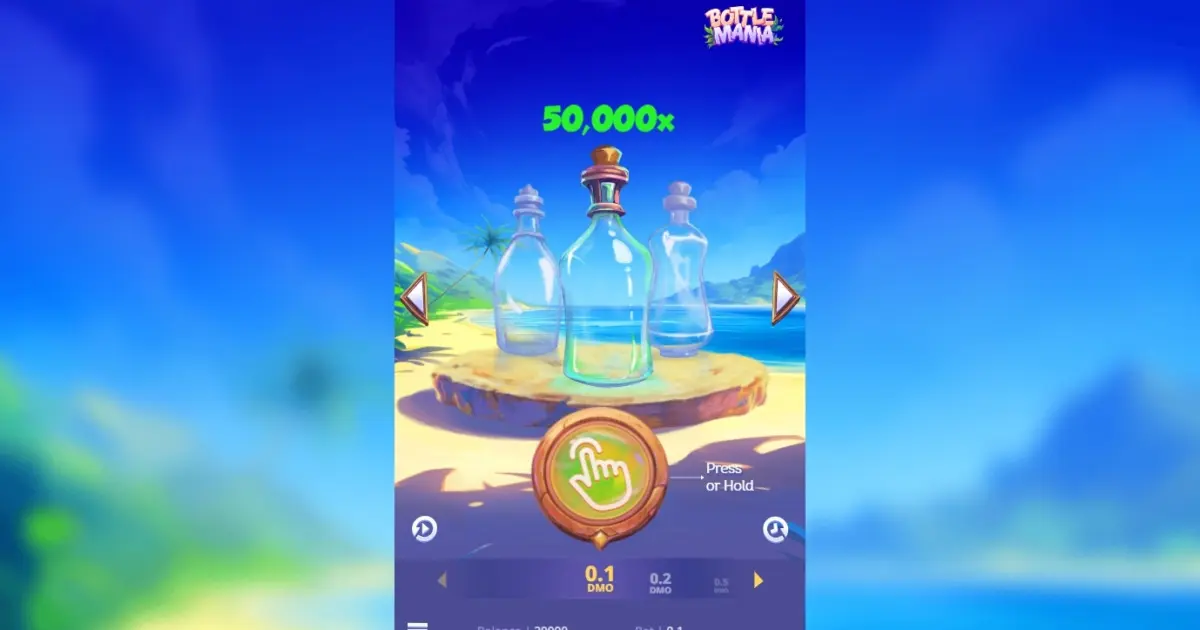
If you already know how crash games work, the short answer on this one is the RTP: Smartsoft Gaming publishes 97.5% for Bottle Mania, which is higher than the 96.2% average across the crash titles in our index and above the 96.9% average of Smartsoft’s own five games. That figure is the main reason to look at this game rather than another one, because the mechanic itself is the same rising multiplier you will find everywhere else in the category.
What follows covers what the bottle mania crash game actually asks of you, what the RTP number does and does not promise, and why no cash-out routine will move it. There is a free demo available, which is the sensible place to start.
How Bottle Mania plays
A round opens at 1.00x and the multiplier climbs. At some point, determined before the round is displayed to you, it crashes. If you have cashed out before that instant, you win your stake multiplied by the figure showing when you pressed the button. If you are still in when it crashes, the stake is gone. There is no third outcome, no partial recovery, no consolation return.
So the entire decision you make is timing. Cash out at 1.30x and you take a small, frequent win. Hold for 8x and you will be right much less often, but the wins are far larger when you are. Neither choice is better than the other in terms of long-run return; they are different variance profiles sitting on top of identical maths.
Most crash games offer auto-cashout, where you set a multiplier in advance and the game exits for you, and auto-bet, which repeats a stake for a set number of rounds. Treat both as discipline tools. They stop you from freezing at 4x and watching the curve die, but they do not shift a single decimal place of the return figure. Smartsoft Gaming has not published bet limits or a maximum multiplier cap for Bottle Mania in the information available here, so check the game’s own info screen before you commit real money.
| Provider | Smartsoft Gaming |
|---|---|
| RTP | 97.5% |
| Free demo | Yes |
| Site-wide average RTP | 96.2% |
Smartsoft Gaming and this game
Smartsoft Gaming has five games in our index, and they average 96.9% RTP between them, which is a genuinely tidy set of numbers for the category. Bottle Mania sits above that average at 97.5%, though it is not the studio’s highest.
That distinction goes to Mine Island at 98.0%, worth a look if the published return figure is the single thing you optimise for. Chicken Highway lands at 97.0%, close enough to Bottle Mania that the choice between them comes down to presentation rather than value. At the other end of the studio’s range, Crash Duel X is listed at 96.0%, which is a full 1.5 percentage points below this game.
Bottle Mania ranks 49th in our crash game listings and sits in the 82nd percentile for popularity, so it gets played, though it is not one of the handful of titles that dominate the category. Beyond the studio name and the bottle theme in the title, nothing further about the presentation is published here, so we will not describe visuals we have not seen.
Reading the 97.5% figure
A 97.5% RTP means that across an enormous number of rounds, the game is designed to return 97.5 units for every 100 staked. The other 2.5 units are the house edge. That edge is not applied round by round, and it is not a fee deducted from your win. It is built into the statistical distribution of crash points: the maths that decides how often the curve dies at 1.10x versus how often it runs to 50x.
The number that matters practically is the gap: 2.5% house edge versus the 3.8% implied by the 96.2% corpus average. Over a long session that difference is real. Over twenty rounds it is invisible, swamped entirely by variance.
This is the part worth being blunt about. RTP is a long-run design figure, not a session forecast. You can play a hundred rounds of a 97.5% game and finish well up, or lose every stake you place, and neither result tells you anything about whether the figure is accurate. Published RTP is useful for choosing between games. It is useless for predicting an evening.
Provably fair, explained in general terms
Crash games generate each round’s crash point independently, and studios use one of two broad approaches. A standard certified RNG produces the result server-side, and you trust the operator’s licensing and testing. A provably-fair system publishes a cryptographic seed and hash so that after the round you can verify the result was fixed before you placed your bet and was not adjusted in response to it.
The information available for Bottle Mania does not state which method Smartsoft Gaming uses here, so do not assume provably fair on the strength of the game being a crash title. If verifiable seeds matter to you, the game’s help screen and the operator’s fairness page are where to check, not a review.
Either way, one property holds: rounds are independent. A run of eight crashes under 1.50x does not make a high multiplier more likely on the ninth. A stretch of 20x results does not mean a low crash is queued up. There is no memory in the sequence, which is why words like due, hot and cold have no meaning in this format, however natural they feel to say while watching the curve.
Why no cash-out system changes the odds
Every crash strategy you will read about is a variance choice dressed up as an edge. Cashing out at a flat 1.50x every round wins often and returns little. Chasing 20x wins rarely and returns a lot when it lands. Splitting your stake across two auto-cashouts blends the two profiles. All three have the same expected value, set by the 97.5% figure, because none of them touches the distribution that generates crash points.
Progressions are worse, because they hide risk rather than reduce it. Doubling after a loss to recover it works right up until the run of losses outlasts your balance, which it eventually will. The one-third rule, the delayed-entry idea, waiting for a cluster of low crashes before betting big — each of these assumes rounds are connected. They are not.
What you can control is stake size, session length, and whether you set an auto-cashout before you start rather than deciding at 3x with money on the line. That is real risk management. It changes how long your budget lasts and how it feels. It does not change the 2.5% edge, and any source telling you otherwise is selling something.
Free play before real money
A Bottle Mania free demo is available, and it is the right way to meet this game. Rounds resolve in seconds, so you can see what a 1.20x cash-out feels like against a 10x hold, learn where the auto-cashout controls sit, and find out whether the pace suits you at all, without a balance attached.
Be clear about what the demo shows you. It demonstrates the interface and the rhythm. It does not predict real-money results, and a good demo run is not a signal. A hundred demo rounds is far too small a sample to say anything about a 97.5% figure.
Crash games are 18+, and the speed is the thing to respect here. When a round takes ten seconds, you can place more bets in twenty minutes than you would in an hour on most other formats. Decide your budget before you open the game, treat it as money spent on entertainment rather than money at work, and stop at the number you set. If that number starts moving upwards mid-session, close the tab.
Final take on Bottle Mania
The case for this game is the published number. At 97.5%, it beats the 96.2% average across our crash index by 1.3 percentage points and sits above Smartsoft Gaming’s own five-game average of 96.9%. In a category where the mechanic barely varies between titles, the return figure is the most useful thing separating one from another.
The case against is that it is not the best number even within this studio, and Mine Island’s 98.0% is a straightforward reason to compare before settling. Details Smartsoft has not published here — bet limits, a maximum multiplier cap, whether the fairness model is verifiable — are worth checking on the game’s info screen rather than assuming.
Play the demo first, set an auto-cashout before your first real round, and go in understanding that the 2.5% edge applies whatever you do with the button.
Frequently Asked Questions
Can I play Bottle Mania for free?
Yes, a free demo of Bottle Mania is available, so you can try the multiplier and the cash-out controls with no money staked. It shows you the pace and the interface accurately, but demo results do not predict real-money outcomes — a good run in the demo is not a signal of anything.
What is the RTP of Bottle Mania?
Smartsoft Gaming publishes 97.5% for Bottle Mania, which means a 2.5% house edge. That is above the 96.2% average across the crash games in our index. It is a long-run design figure measured over enormous numbers of rounds, not a prediction of what any single session will return.
Does cashing out at a certain multiplier improve your odds in Bottle Mania?
No. Cash-out timing changes your variance, not your expected value. A flat 1.50x exit wins often for little; holding for 20x wins rarely for more. Both return the same 97.5% long-run figure, because neither affects the distribution that generates each round's crash point.
Is Bottle Mania provably fair?
The information published for Bottle Mania does not say which fairness model Smartsoft Gaming uses, so check the game's info screen. Provably fair generally means the studio publishes a seed and hash letting you verify after the round that the crash point was fixed before your bet and not altered afterwards.
How does Bottle Mania compare to other Smartsoft Gaming crash games?
Smartsoft Gaming has five games in our index averaging 96.9% RTP. Bottle Mania's 97.5% is above that, but Mine Island is listed higher at 98.0%. Chicken Highway sits close at 97.0%, while Crash Duel X trails at 96.0% — a 1.5 point gap on the same core mechanic.