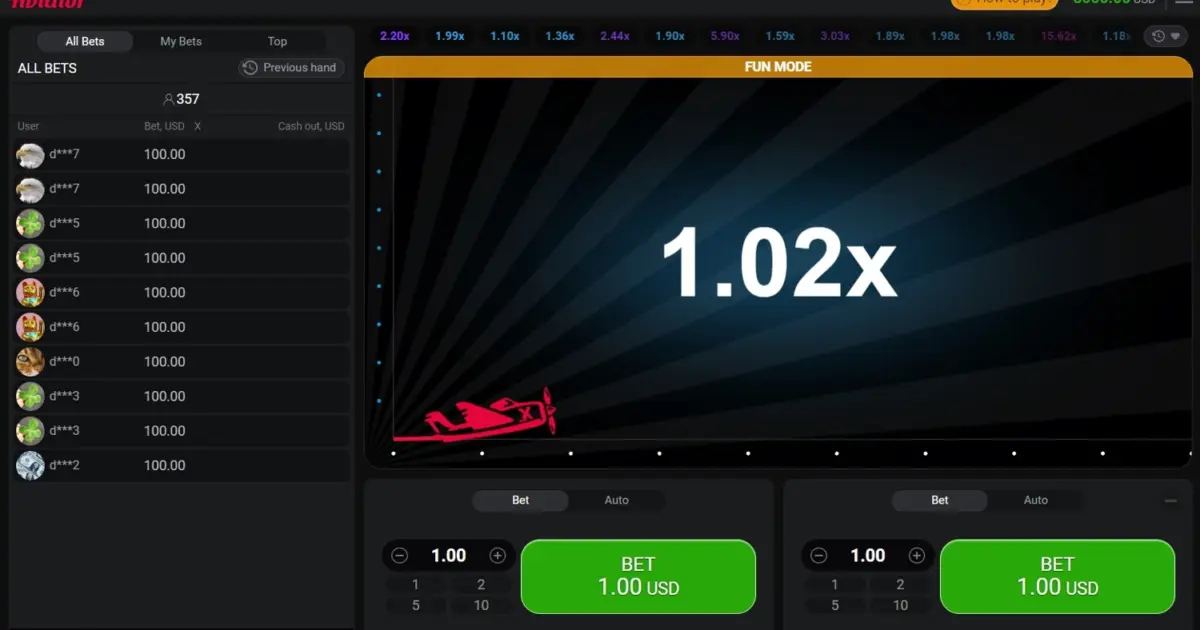
Aviator is a crash game where a multiplier starts at 1.00x and climbs until it randomly stops — cash out before that point and you win your stake times the displayed number. It has a published RTP of 97.0%, which sits slightly above the crash-game average, and a free demo is available so you can see the curve in action without spending a cent. The game does not try to be anything more than a clean multiplier with a single decision: when to get out.
How Aviator plays
Each round of Aviator begins with a multiplier at 1.00x. It rises on a curve — displayed as a red plane climbing a graph — and at a randomly determined moment it “crashes.” If you have cashed out before that crash, you receive your stake multiplied by whatever number was showing when you hit the button. If you have not cashed out, you lose your stake. There is no third outcome.
Bets range from $0.10 to $100.00 per round, and you can place a bet every few seconds because rounds are short. Some players use the auto-cashout feature to automatically exit at a chosen multiplier — say 1.50x or 2.00x — which enforces a fixed exit point but does not change the underlying odds. Others place two bets simultaneously, cashing one out early for partial safety while letting the second run. Both approaches are risk-management choices, not edge-gaining strategies.
The crash point itself is generated independently each round. A string of rounds ending at 1.10x does not make a 10.00x round “due,” and a run of high multipliers does not make the next one low. Each round is a fresh, isolated event. This is the core mechanic of every crash game, and Aviator follows it faithfully.
| Provider | Spribe |
|---|---|
| RTP | 97.0% |
| Bet range | $/£/€0.10 – $/£/€100.00 |
| Free demo | Yes |
| Site-wide average RTP | 96.2% |
Spribe and this game
Spribe is the studio behind Aviator, and the company has two crash games in the database reviewed here, with an average RTP across those titles of 97.0%. Aviator is by far the better-known of the two — it sits at the top of the crash-game rankings by popularity. Spribe built its reputation on simple, fast-loading titles that work well on mobile, and Aviator is the flagship example of that approach.
If you enjoy the Spribe style and want to try something from the same studio, Balloon offers the same 97.0% RTP in a different visual package. For players who prefer a different kind of instant-win mechanic, Mines (95.0% RTP) and Chicky Run (96.0% RTP) are popular alternatives that trade the rising multiplier for grid-based risk decisions. Each of these works on the same principle — a fixed house edge baked into the overall distribution of outcomes — but the way you interact with that edge feels different.
Reading the 97.0% figure
The RTP — return to player — for Aviator is 97.0%. In plain terms, this means that over a very large number of rounds, the game is designed to return $97 for every $100 wagered, keeping $3 as the house edge. That 3% edge is built into the statistical distribution of crash points across millions of rounds, not into any single result.
What this means for you in practice: over a short session, anything can happen. You might cash out at 5.00x three times in a row, or you might watch ten rounds crash below 1.30x without a single profitable exit. The 97.0% figure only becomes meaningful over a large sample. It is useful for comparing Aviator to other crash games — for instance, Chicky Run sits at 96.0% and Mines at 95.0%, so Aviator’s long-run maths are slightly more favourable to the player — but it does not predict what will happen in your next session.
The corpus average RTP across all crash games reviewed on this site is 96.2%, so Aviator’s 97.0% is 0.8 percentage points above that average. That is a modest but real difference in the long run, though it will not be visible in a single sitting of 50 or 100 rounds.
Provably fair, explained in general terms
Many crash games, including those by Spribe, use a provably fair system. The idea is straightforward: before each round starts, a server seed and a client seed are combined to produce the crash point through a cryptographic hash. You can inspect the seeds after the round and verify that the result was not altered mid-flight. The point is not that you can predict or influence the crash — you cannot — but that you can confirm the game did not cheat.
Provably fair does not mean “fair in your favour.” The house edge still applies, and the distribution of crash points still ensures the studio earns its margin over time. What it does eliminate is the possibility that the operator changed the result after seeing your bet. For a game as fast as Aviator, where rounds repeat every few seconds, that transparency matters: you know each outcome was locked in before the plane started climbing.
If you have never verified a provably fair result before, the game’s information panel typically explains the process step by step. It is worth reading once, even if you never do it again — it gives you a concrete understanding of why each round is truly random and unchangeable.
Why no cash-out system changes the odds
Crash games attract a lot of “systems” — cash out at 1.50x every time, use the one-third rule, double after a loss, wait for three low rounds then bet big. None of these change the expected value. The crash point is generated independently each round, so past results have zero influence on future ones. A sequence of low crashes does not make a high crash more likely, and vice versa.
What a system can do is change your variance profile. Cashing out at 1.20x every round means you will win more often but in smaller amounts, and the occasional crash below 1.20x wipes out several small wins. Cashing out at 5.00x means you will lose most rounds but occasionally land a large payout. Both strategies converge on the same 97.0% RTP over a large sample — the house edge does not care about your exit point.
Auto-cashout and auto-bet settings are useful for enforcing discipline. If you decide in advance that you will always exit at 2.00x, the auto-cashout button removes the temptation to chase a higher number mid-round. That is a legitimate risk-management tool. It is just not an odds improvement.
Free play before real money
A free demo of Aviator is available, and it uses the same mechanics and random-number generation as the real-money version. The multiplier curve behaves identically, the crash points follow the same distribution, and the RTP is the same. The only difference is that you are playing with virtual credits instead of actual funds. This makes the demo useful for understanding how the interface works, how fast rounds move, and how the auto-cashout feature behaves under real conditions.
It is worth noting that a free session can feel very different from a paid one. Without real money at stake, you may cash out at different points than you would when actual losses are possible. The demo shows you the mechanics; it does not show you how you will behave under pressure.
Set a budget before you switch to real money and stick to it. Crash games run fast — a round every few seconds adds up quickly. Treat every bet as the price of entertainment, not an investment with a return. If you are not enjoying the session, stop. 18+ only.
Final take on Aviator
Aviator is a straightforward crash game with a clean interface, a published 97.0% RTP, and bets ranging from $0.10 to $100.00. It does not dress up the core mechanic with unnecessary features — you watch a multiplier climb, you decide when to cash out, and the round ends when it crashes. That simplicity is the game’s main appeal and its honest limitation: there is nothing here that rewards skill or pattern recognition, only a variance trade-off you manage with your exit point.
Compared to other crash games in the database, Aviator’s RTP of 97.0% is above the corpus average of 96.2%, and it is the most popular title in the subcategory. If you want a crash game that does what it says on the tin, this is the benchmark. If you prefer a different aesthetic or mechanic, Balloon offers the same RTP from the same provider in a different package.
Frequently Asked Questions
Can I play Aviator for free without downloading anything?
Yes, a free demo of Aviator is available directly in-browser with no download required. The demo uses the same mechanics and 97.0% RTP as the real-money version, so you can see exactly how the multiplier curve works before committing any funds.
What is the RTP of Aviator and what does it mean?
Aviator has a published RTP of 97.0%, meaning that over a very large number of rounds, the game is designed to return $97 for every $100 wagered. Over a short session, results will vary widely — the figure is a long-run statistical average, not a session guarantee.
Does cashing out early or using a betting system improve my chances?
No. Each round's crash point is generated independently, so no cash-out timing, progression, or pattern changes the expected value. A system can change how often you win and how much you win when you do, but the 97.0% RTP stays the same over a large sample.
What does "provably fair" mean in a crash game like Aviator?
Provably fair means each round's crash point is determined by a cryptographic hash of combined server and client seeds before the round starts. You can verify the result after the round to confirm it was not altered, though the house edge still applies regardless of verification.
How does Aviator compare to other Spribe crash games?
Spribe has two crash games in the database with an average RTP of 97.0%. Aviator is the more popular of the two and sits at the top of the crash-game rankings. If you want the same RTP in a different visual style, Balloon is the other Spribe crash game available.




