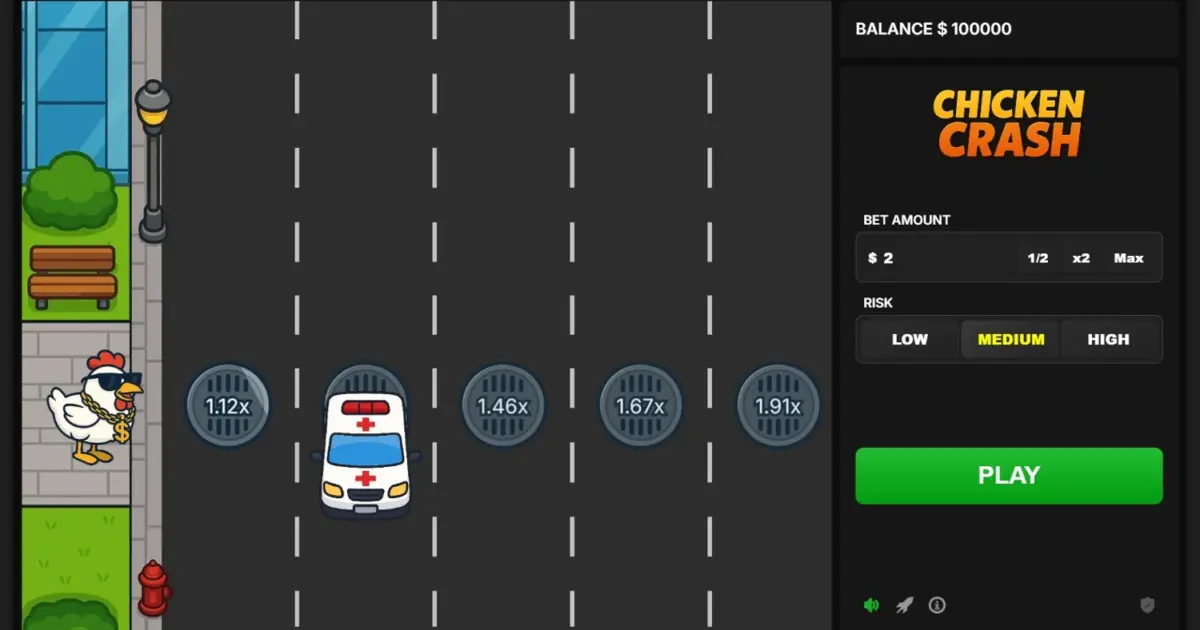
Chicken Crash is Astriona’s entry into the crash game format, and it publishes a return-to-player figure of 98.0%—a number that places it noticeably above the 96.2% corpus average for games in this site’s index. A free demo is available, which means you can observe how the multiplier behaves across a session before committing real stakes. Whether that combination of above-average RTP and no-risk testing makes it worth your time depends on what you expect from the format.
Is Chicken Crash worth your time?
Crash games occupy a narrow space between slots and live table games: one button press, one rising number, one binary outcome. You are either in when the curve stops, or you are not. There is no bonus round to unlock, no symbol matching, no progressive jackpot to chase. The entire decision-making process is compressed into the question “do I cash out now or one tick later?”
What makes this particular Astriona crash game interesting on paper is its RTP. At 98.0%, the house edge is roughly 2%, which is the thinnest margin you will commonly see in a crash game. Compare that to Neo Crash at 96.0% or the corpus average of 96.2%, and you are looking at a measurably better long-run return per wager. That does not mean you will win more frequently—variance in a crash game is enormous—but it means the statistical drain on your bankroll operates at a slower rate across hundreds of rounds.
For players who specifically prefer the crash format over slots or table games, a published 98% RTP is a meaningful reason to look at this title over alternatives. The free demo removes the usual barrier of trying something new at real cost.
| Provider | Astriona |
|---|---|
| RTP | 98.0% |
| Free demo | Yes |
| Site-wide average RTP | 96.2% |
Where the house edge is actually built in
Every crash game round begins at 1.00x and the multiplier rises until a randomly determined crash point halts it. If you cash out before that point, you receive your stake multiplied by the value shown at the moment of cash-out. If the curve crashes while you are still in, the stake is lost. There is no third outcome.
The 2% house edge is not hidden in a single round or a visual trick. It lives in the statistical distribution of crash points across all rounds. Astriona has not published a technical breakdown of how their RNG generates those distribution curves, but the principle is consistent across the format: the shape of the probability distribution ensures that over a large enough sample, the total money returned to players equals approximately 98 cents for every dollar wagered. The remaining 2 cents is the house edge.
What you need to understand is that no cash-out timing decision changes this figure. Cashing at 1.5x or at 15x does not alter your expected value—it alters the variance you are accepting. Early cash-outs lock smaller returns more often. Late cash-outs occasionally produce larger multipliers but lose the stake far more frequently. Over a long enough session, both approaches return approximately 98% of total money wagered, in line with the published RTP. The difference is only in how the money arrives, not how much arrives.
This is where the Chicken Crash rtp figure matters most as a planning tool rather than a prediction. It tells you what percentage of your total wagering volume the game is designed to return over thousands of rounds. It does not tell you what happens in the next ten rounds.
What the name tells you about the theme
Astriona’s Chicken Crash Snowstorm extends the same franchise name into a different seasonal setting, and the studio’s broader portfolio of seven titles includes Neo Crash and Flappy Rise alongside this game. The “chicken” motif places the game within a tradition of lighthearted, cartoon-adjacent crash game themes—think of the farm-animal genre that several providers explore with bright colors and simple character animations.
The theme does not affect the maths. A chicken that flies upward is functionally identical to a rocket, a plane, or a graph line. The visual presentation exists to make the multiplier curve engaging to watch, not to alter probability. What the name does tell you is that Astriona has built at least one other entry in this franchise, suggesting it represents the studio’s most commercially successful concept in the crash category. Their provider average RTP across all seven titles is 96.57%, and Chicken Crash sits above that at 98.0%—so the studio’s flagship concept is also its most generous return rate.
No theme-specific bonus features, progressive elements, or special rounds are indicated by the available data. If the presentation includes animated characters or seasonal elements beyond what the name suggests, that information is not published in the game’s specification sheet.
Reading the maximum multiplier
Astriona has not published a maximum multiplier cap for Chicken Crash. This is worth noting explicitly, because some crash games do set a hard ceiling (for example, 100x or 5,000x) beyond which the curve cannot reach, and knowing that figure helps you set realistic expectations about the variance range.
In the absence of a stated cap, two interpretations are possible. Either the game uses a theoretically unbounded distribution with such a small probability of extreme values that a stated cap would be meaningless, or the studio has simply not made the figure public. Without technical documentation or a provably-fair specification for this specific game, neither interpretation can be confirmed.
What you can do responsibly is treat any multiplier you see demonstrated in the free demo as one draw from the distribution, not as a representative example. If a demo session shows a 47x crash once in 200 rounds, that tells you the distribution produces occasional high values but says nothing about how often they appear or whether they will appear during your real-money session. The expected value calculation remains the same regardless of the range you observe: your total returns will tend toward 98% of total wagers over the long run.
Before playing for real money, check the game’s own information screen for any stated cap, bet limits, or distribution notes that Astriona may provide within the interface but not in external specifications.
How Chicken Crash compares to other crash games
Against the 96.2% corpus average, Astriona’s 98% RTP places this game in the upper tier of the format. Within the studio’s own portfolio, it leads their seven-title catalogue. The closest sibling, Chicken Crash Snowstorm, shares the identical 98% figure, suggesting Astriona has applied the same statistical framework across the franchise.
The other Astriona titles tell a different story. Neo Crash drops to 96%, matching the broader market average rather than exceeding it. Flappy Rise sits at the same 96%. If you are playing multiple games from this provider, the franchise entries carry a measurably better return rate than the rest of the catalogue.
Across the crash category broadly, 98% RTP is common among the top-performing titles from major providers. Many of the most-played crash games on other platforms publish figures between 97% and 99%. Chicken Crash at 98.0% is competitive but not exceptional within that context. Where it stands out is specifically against Astriona’s own average of 96.57%—a 1.43 percentage point gap that represents a roughly 40% reduction in effective house edge compared to the studio’s typical offering.
Bankroll and session limits
Crash games are deceptively fast. A single round can last seconds. At three to five rounds per minute, you are making 180 to 300 individual wagering decisions per hour. The speed is the point, but it also means that a session budget can disappear in minutes if you are not deliberate about it. Set your total spend before you open the game, and treat that number as a fixed cost for entertainment in the same way you would a concert ticket. This is not income—it is money you spend for the experience of watching the multiplier climb. The rounds will repeat faster than you can process the emotional impact of each loss, which makes pre-commitment to a limit essential rather than optional.
Auto-cashout is a useful tool for enforcing the session discipline you set for yourself. If you decide in advance that you will cash out at 2.0x every round, an auto-cashout at that value removes the temptation to “wait just one more tick” during a hot streak. But be clear about what it does and does not do: it enforces your decision consistently, it does not change the underlying 98% expected value. A 2.0x auto-cashout will produce more frequent small returns and more frequent total losses per round. The long-run result converges to the same RTP regardless of your chosen auto-cashout level.
If you find yourself increasing stakes to recover a loss, stop. The next round is independent of the last one. No sequence of outcomes changes the probability distribution that governs the next crash point.
Verdict
Chicken Crash is a well-constructed crash game with the single strongest attribute the format can offer: a genuinely competitive 98% RTP that places it above the market average and comfortably above its own studio’s typical offering. The free demo makes evaluation straightforward—you can verify the pacing, the interface, and the feel of the multiplier curve without spending anything. The absence of a published maximum multiplier and no stated provably-fair mechanism are gaps worth noting, but neither undermines the maths that governs long-run outcomes.
If you play crash games specifically and you want the highest published return rate available, this is a reasonable candidate. If you are drawn to the theme or the studio’s presentation style, the 98.0% figure removes the usual concern that you are choosing a game for aesthetic reasons at a mathematical cost. That combination is rarer than it sounds in this category.
Frequently Asked Questions
Can I play Chicken Crash for free?
Yes. A free demo is available for Chicken Crash, allowing you to observe multiplier behaviour and test cash-out strategies without depositing money. The demo uses the same random distribution as the real-money version, though no demo session predicts future outcomes in either mode.
What is the RTP of Chicken Crash?
Astriona publishes a 98.0% return-to-player figure for Chicken Crash. This means that across a very large number of rounds, the game is statistically designed to return approximately 98 cents for every dollar wagered, retaining roughly 2 cents as the house edge. It does not describe any single session.
Does cash-out timing change the odds in Chicken Crash?
No. The crash point for each round is generated independently, and the 98% expected value is fixed by the statistical distribution regardless of when you choose to cash out. Earlier cash-outs mean smaller, more frequent returns. Later cash-outs mean larger occasional wins paired with more frequent total losses.
Is Chicken Crash provably fair?
Astriona has not published a provably-fair mechanism for this game in the available specifications. Some crash games use verifiable seed systems that let players audit each round's randomness, but this information is not confirmed for Chicken Crash. Check the game's own information screen within the interface.
How does Chicken Crash compare to Neo Crash?
Both are Astriona crash games, but Chicken Crash publishes a 98.0% RTP compared to Neo Crash at 96.0%. This 2-percentage-point gap means Chicken Crash has a house edge roughly half that of Neo Crash, making it the stronger option from a long-run return perspective within the same provider.