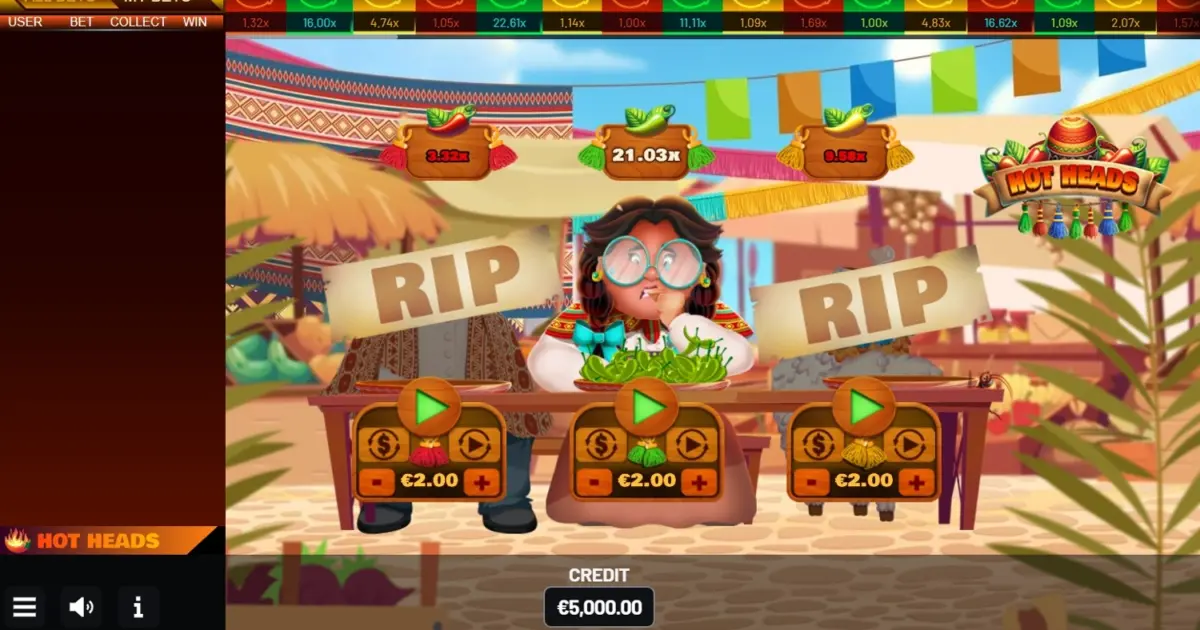
The decision-relevant fact about the hot heads crash game is its published return figure: Indigo Magic states 94% RTP, which is 2.2 percentage points below the 96.2% average across the games in our catalogue. That is a real cost per round in a format where rounds repeat every few seconds. A free demo is available, so you can watch the multiplier behave before any money is involved.
Nothing about the format is complicated, and that is worth saying up front. There is a rising multiplier, a crash that arrives at an unpredictable moment, and one decision: when to cash out. Everything else is presentation.
What kind of crash game is Hot Heads?
Hot Heads is a crash game published by Indigo Magic, one of four titles the studio has in our database. Crash games share a single structure regardless of studio. A round opens at 1.00x. The multiplier climbs. At some point determined before the round began, it stops, and the round is over. If you cashed out before that moment, your stake is returned multiplied by the figure showing when you pressed the button. If you were still holding, the stake is gone. There is no partial loss, no consolation outcome, no bonus round hiding behind the curve.
Our catalogue lists Hot Heads with a reel count of 3, which is a legacy field from slot data and does not describe anything meaningful about how a crash round plays. The game sits at rank 47 in our listings and in the 83rd percentile for popularity, so plenty of people are looking for it, but popularity says nothing about the odds.
Beyond the provider name, the return figure and the availability of a demo, Indigo Magic has not published details we can pass on. That absence matters more in crash games than in slots, and the next few sections explain why.
| Provider | Indigo Magic |
|---|---|
| RTP | 94.0% |
| Reels | 3 |
| Free demo | Yes |
| Site-wide average RTP | 96.2% |
The maths of a single round
Each round’s crash point is generated independently. That is the single most important sentence in any crash game review, and it has consequences people routinely ignore.
A run of five crashes below 1.5x does not make a high multiplier more likely on the sixth round. A run of three crashes above 20x does not mean the game is now “owed” a low one. The generator has no memory of what it produced a moment ago, and no round is ever due. Any pattern you notice in a session history is a pattern in a small sample, not a signal about the next round.
The one thing you control is variance. Cashing out at 1.30x wins often and wins little. Holding for 15x wins rarely and pays well when it lands. Both choices sit on the same expected-value line, because the house edge is baked into the distribution of crash points rather than applied to any particular decision. Shift your target up or down and you change how your bankroll swings; you do not change what it is worth in the long run.
That also disposes of the systems. Doubling after a loss, cashing out a third of the way to some target, alternating between two multipliers, waiting for a “cold” streak to end — none of these alter the odds. They alter how quickly you get to the same place.
Where the 94% comes from
A 94% RTP means that across a very large number of rounds, the game is designed to return 94 units for every 100 staked. The remaining 6 is the house edge, and it lives in the shape of the crash-point distribution: how often low crashes occur relative to high ones. It is not deducted from any individual round, which is why a single session can end well up or badly down while the long-run figure holds.
Some context on that number. Indigo Magic’s four titles in our database average 94.5% RTP, so 94% is slightly below even the studio’s own norm. Against the 96.2% corpus average, the gap is 2.2 points. In practical terms, staking 1 unit per round at 96.2% costs you an expected 0.038 per round; at 94% it costs 0.06. That is roughly 58% more expected cost per round for the same entertainment.
Crash games amplify this because the round cycle is short. A slot player might spin a few hundred times an hour. Crash rounds, especially with auto-bet running, can turn over far faster, and every round applies the same edge. Volume, not multiplier size, is what makes the RTP figure bite.
Reading the rules and max multiplier before you bet real money
Several things you would want to know about Hot Heads are not in our data, and it is more honest to name them than to guess.
Indigo Magic has not published a maximum multiplier cap for this game that we can report, so if you see a figure quoted elsewhere, treat it as unverified until you find it on the game’s own information screen. A cap matters: it sets a ceiling on the biggest possible outcome and, indirectly, tells you something about how the distribution is shaped at the top end.
We also have no confirmation of whether Hot Heads uses a provably fair system. In crash games, provably fair means the crash point derives from a seed you can inspect after the round, letting you verify the result was not adjusted mid-round. Where it exists, it is a genuine transparency feature. Where it is not stated, the game is presumably running a conventional RNG, which can be perfectly sound but gives you nothing to check yourself.
Bet limits and release date are likewise unpublished here. Before you stake real money, open the in-game info panel and check the RTP shown there, the minimum and maximum bet, and whether an auto-cashout setting is available. Auto-cashout is useful — it enforces a decision you made calmly rather than one you make while the number is climbing — but it is discipline, not an edge.
How Hot Heads compares to other crash games
Within Indigo Magic’s own catalogue, the comparison is straightforward on the one number we can compare. Samurai Ikusa is published at 96.0% RTP, two full points above Hot Heads, which makes it the better-value option from the same studio on that measure alone. Dega Baby sits at 94.0%, identical to Hot Heads, so choose between them on presentation rather than expected return. Santa’s Sack is also 94.0% if you want a seasonal version of the same maths.
Be clear about what these comparisons do and do not tell you. RTP is a long-run design figure, and two games at 94% can feel completely different in a hundred rounds depending on how their crash-point distributions are weighted. One might crash below 2x most of the time and occasionally run very high; another might cluster in the middle. Neither is better or worse in expected value, but they will treat a fixed cash-out target very differently.
What the comparison does tell you is that a 96% option exists inside the same studio’s range. If the return figure is the thing you care about, that is the more efficient place to put your stake.
Free demo and staying in control
A Hot Heads free demo is available, and it is the sensible place to start. Play money lets you see how quickly rounds cycle, where the multiplier tends to stop, and whether the auto-cashout tool works the way you expect — all without cost. What the demo cannot do is predict your real-money results. Demo sessions are independent rounds too, and a good run in play mode carries no information about what happens when you switch.
Crash games deserve a specific word of caution on control, because the round length is short and the next one is always seconds away. This is 18+ entertainment you pay for, not a way to make money. Decide the total you are willing to spend before you open the game, treat it as spent the moment you start, and stop when it is gone rather than when you feel a session is unfinished. If you use auto-bet, set a round limit as well as a cashout target — the speed of the format is exactly what makes an unbounded session expensive.
Final verdict
Hot Heads gives you a clean version of the crash format from a small studio, with a free demo available and a 94% published return that is the main thing to weigh. That figure is below Indigo Magic’s own 94.5% average and well below the 96.2% typical across the games we list, and in a format where rounds repeat this fast, the gap compounds quickly.
If you want to try it, the demo costs nothing and tells you whether the pacing and presentation suit you. If your priority is the return figure, Samurai Ikusa at 96.0% is the stronger pick from the same provider. And whichever you choose, remember that no cash-out rule, streak read or bet progression changes what the game is worth — only how fast you find out.
Frequently Asked Questions
Can I play Hot Heads for free?
Yes. A free demo of Hot Heads is available, so you can run rounds with play money and see how the multiplier behaves before staking anything. The demo uses the same independent round structure as real play, but results in demo mode tell you nothing about how a real-money session will go.
What is the RTP of Hot Heads?
Indigo Magic publishes 94% RTP for Hot Heads. That means the game is designed to return 94 units per 100 staked over a very large number of rounds, leaving a 6% house edge. It sits below the studio's own 94.5% average across four titles and 2.2 points under the 96.2% corpus average.
Does cashing out at the right moment improve your odds in Hot Heads?
No. Cash-out timing changes your variance, not your expected value. Early cash-outs win small amounts often; late ones win rarely and larger. The house edge sits in the distribution of crash points, so no timing rule, one-third pattern or bet progression alters the 94% long-run return figure.
Is Hot Heads provably fair?
We have no confirmation either way, so check the game's information screen. Provably fair means the crash point comes from a seed you can verify after the round, proving nothing was changed mid-round. Where it is not stated, a game is presumably using a standard RNG, which can be sound but is not independently checkable by you.
Who makes Hot Heads and what is the maximum multiplier?
Indigo Magic develops Hot Heads, one of four titles from the studio in our database. No maximum multiplier cap has been published for this game, so treat figures quoted elsewhere as unverified and check the in-game info panel. A cap, where a studio states one, is a ceiling on possible outcomes, not a typical result.