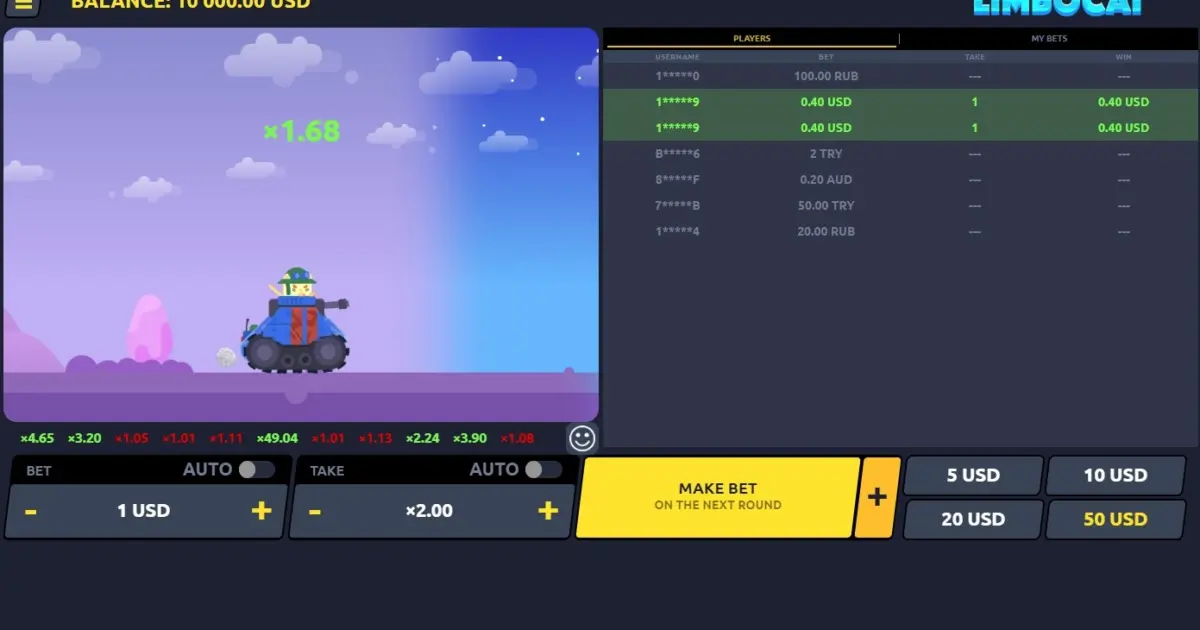
Limbo Cat is a crash game from Onlyplay that is worth your time if you want a straightforward, no-frills take on the format — and the 95% RTP is honest about what you are getting. The limbo cat crash game works like every other crash title: a multiplier climbs from 1.00x until it hits a randomly determined crash point, and you win your stake times the multiplier if you cash out first. There is no hidden mechanic here; the entire decision is when to leave the round, and that decision never changes the underlying odds.
Is Limbo Cat worth your time?
If you already know how crash games work and you want a clean, dependable version of them, Limbo Cat is a reasonable pick. Onlyplay has published a return-to-player figure of 95%, which sits just below the 96.2% average across the crash games in our corpus — a difference of 1.2 percentage points that matters over the long run but is not a dealbreaker for short sessions. The game is available in free demo mode, so you can test the mechanics without risking money, and it sits at the 90.8th percentile for popularity, meaning it is a game players actually seek out.
What Limbo Cat does not do is reinvent anything. There is no special feature that changes the curve, no bonus round, no way to improve your expected value through timing. If you are looking for a crash game that is easy to read and quick to play, this fits. If you are hoping for something that gives you an edge over the house, no crash game does that — Limbo Cat included.
| Provider | Onlyplay |
|---|---|
| RTP | 95.0% |
| Free demo | Yes |
| Site-wide average RTP | 96.2% |
Where the house edge is actually built in
The house edge in Limbo Cat is not in any single round — it lives in the statistical distribution of crash points. The game generates each crash point independently, and over a large number of rounds, that distribution produces the published 95% RTP. This is the same way an RTP figure works for a slot: it is a long-run average, not a promise about your next ten rounds.
This means a run of low crashes does not make a high crash “due,” and a run of high crashes does not make a low one “due.” Each round starts fresh. The practical consequence is that no cash-out timing rule, no “one-third rule,” and no manual pattern changes your expected value. Cashing out at 1.5x versus 3x changes your variance — how often you win and how big those wins are — but not the underlying 95% return. If you want to understand where the edge is, it is baked into the curve itself, and you cannot outplay it.
What the name tells you about the theme
The name “Limbo Cat” points to a playful, lighthearted theme built around a cat — and the word “limbo” is doing double duty here. It refers both to the limbo dance, where you go lower and lower under a bar, and to the limbo state of waiting in a round, watching the multiplier climb and deciding when to leave. The visual presentation follows that theme, but the theme is cosmetic; it has no effect on the crash point generation or the odds.
This is worth stressing because themed crash games can look like they have special rules. Limbo Cat does not. The cat on screen is not controlling the curve, and the limbo imagery is not a signal that the multiplier behaves differently. It is a wrapper around the same universal crash maths: a rising multiplier, a random crash point, and a cash-out decision that does not change the expected value.
Reading the maximum multiplier
Onlyplay has not published a maximum multiplier cap for Limbo Cat in the information available to us. That absence is worth taking seriously. When a studio states a cap — say, 10x — it is telling you the highest multiplier the game will ever reach before crashing, which helps you understand the shape of the distribution. Without a stated cap, you cannot assume one, and you should treat any number you see quoted elsewhere with caution.
What you can rely on is the general crash logic: the multiplier rises from 1.00x and can in principle keep climbing until it crashes, with higher multipliers becoming progressively less likely. The absence of a published cap does not mean the game is “looser” or “tighter” — it just means the studio has not told us the boundary. If you play for money, check the game’s own information screen, because that is the only authoritative source for the cap and the exact RTP.
How Limbo Cat compares to other crash games
The most decision-relevant comparison is the RTP. Limbo Cat sits at 95%, while the average across the crash games in our corpus is 96.2% — so it is slightly below the middle of the pack. Against its own provider, Onlyplay’s average RTP across 11 games is 95.91%, which puts Limbo Cat a touch under the studio’s own typical figure as well. None of this makes the game unplayable, but it does mean the house edge is marginally higher than what you would get from some alternatives.
For a direct comparison, ChiX from the same provider runs at 97% RTP, which is meaningfully better over the long run. F777 Fighter and Quantum X both sit at 95%, matching Limbo Cat exactly. If you are choosing between Onlyplay’s crash titles purely on return, ChiX is the stronger pick; if you prefer the Limbo Cat theme, you are not giving up anything relative to two of the provider’s other games.
Bankroll and session limits
Crash rounds repeat quickly, and that speed is the main bankroll risk. At 95% RTP, the expected loss per round is small, but rounds compound fast, and a long session can bleed a balance without any single dramatic loss. Set a budget in advance and treat it as the cost of entertainment, not as an investment you expect to grow.
Because the game offers auto-cashout and auto-bet settings, you can enforce discipline mechanically — set a cash-out multiplier you are comfortable with and let the game exit for you. These tools do not improve your odds; they prevent you from making impulsive timing decisions in the heat of a round. That is their real value.
And the standard reminder applies here: 18+, set a budget before you start, and treat any money you put in as spent. Crash games are entertainment you pay for, not income. The speed of the rounds makes it easy to lose track of both time and money, so a hard session limit is not optional — it is the single most effective control you have.
Verdict
Limbo Cat is a competent, conventional crash game from Onlyplay with a published 95% RTP and free demo availability. It does not try to be clever, and that is fine — the crash format does not reward cleverness anyway. Your only real decision is when to cash out, and that decision changes your variance, not your expected value.
The honest bottom line: if you like the theme and you want a straightforward crash experience, this is a solid choice, and the demo lets you try it for free first. If you are optimizing purely on return, the 95% figure is slightly below both the corpus average and Onlyplay’s own average, so a game like ChiX at 97% gives you better long-run value. Either way, go in knowing the house edge is built into the curve, not into any timing trick, and you will not be disappointed.
Frequently Asked Questions
Can I play Limbo Cat for free in demo mode?
Yes, Limbo Cat is available in free demo mode, so you can test the crash mechanics without risking real money. The demo uses the same multiplier curve and crash-point generation as the real game, but it does not predict real-money outcomes, and any results you see there carry no guarantee for paid play.
What is the RTP for Limbo Cat?
Onlyplay has published a 95% RTP for Limbo Cat. That figure is a long-run average across a very large number of rounds, not a promise about any individual session. It sits 1.2 percentage points below the 96.2% average for crash games in our corpus.
Does cash-out timing or a betting system change my odds in Limbo Cat?
No. The crash point for each round is generated independently, and no timing rule, progression, or manual pattern changes the underlying expected value. Cashing out earlier or later only changes your variance — how often you win and how big the wins are — not the 95% return built into the curve.
Who is the provider of Limbo Cat?
Limbo Cat is developed by Onlyplay, a studio whose 11 crash games average a 95.91% RTP. Limbo Cat's 95% figure is slightly below that provider average. Onlyplay has not published a maximum multiplier cap for this particular game in the information available.
How does Limbo Cat compare to ChiX?
Both are crash games from Onlyplay, but ChiX runs at a 97% RTP while Limbo Cat runs at 95%. Over a large number of rounds, that 2-point gap gives ChiX a meaningfully lower house edge. If you are choosing between the two purely on return, ChiX is the stronger pick.




