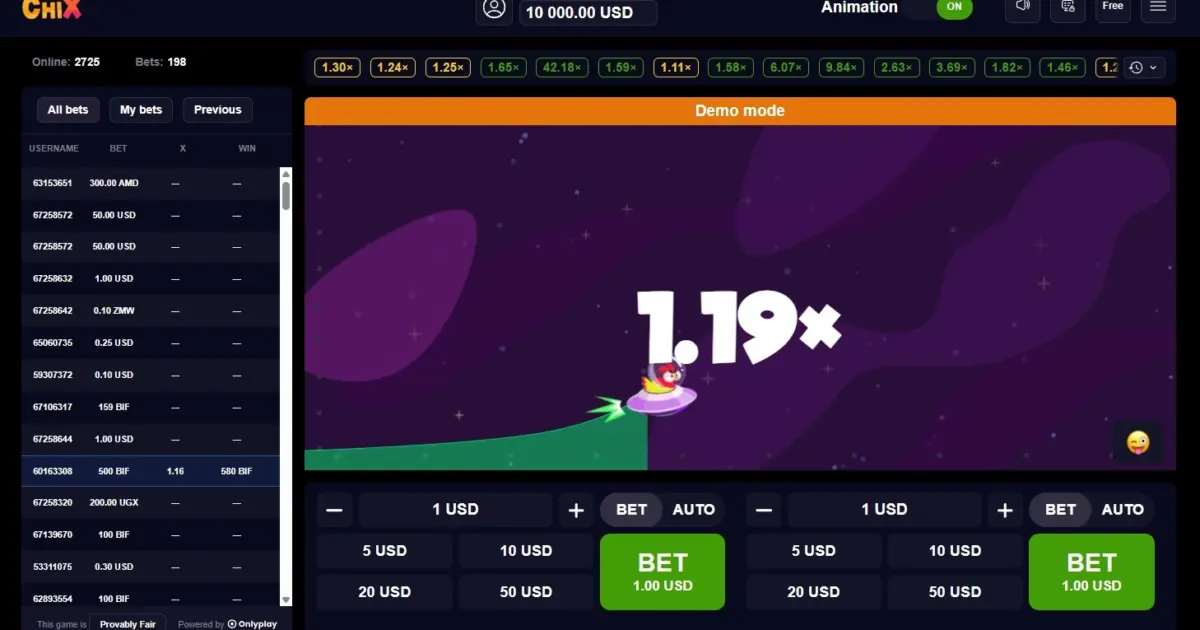
The chix crash game gives you a rising multiplier that can stop at any random instant. You stake a round, watch the number climb, and decide when to pull out. Cash out before the crash and you keep your stake times whatever multiplier you locked. Still in when it stops, and the stake is gone. Nothing else happens. ChiX carries a 97.0% RTP, which puts it slightly above the genre average and well above its own provider’s typical figure.
ChiX in one minute
Onlyplay built ChiX as a standard crash-format game: independent rounds, a multiplier that starts at 1.00× and climbs until a randomly determined crash point ends it. The studio has not published a maximum multiplier cap for this title, so you should check the game’s own information screen before playing for money and treat any number quoted elsewhere with caution.
The game ranks 15th in the crash category at a 94.9th-percentile popularity score, which means it draws more traffic than most of its peers. What draws people in is presentation — a fast, clean interface and a multiplayer bet feed. What matters for your results is the maths underneath, which we cover below.
If you enjoy the format and want to compare providers, Onlyplay has ten other crash titles. Limbo Cat and F777 Fighter sit at 95.0% RTP each, so ChiX outperforms them by a measurable margin on the only number that compounds over time.
Return to player: 97.0%
The ChiX rtp figure of 97.0% tells you what fraction of total stake the game returns to players across a very large number of rounds. It does not predict what happens in your session. Over a short stretch — a few dozen rounds — your actual return can be far higher or far lower because the crash-point distribution has wide variance. The 97.0% only emerges over tens of thousands of rounds.
Context matters. The corpus average across crash games is 96.2%, and Onlyplay’s own eleven-title average is 95.91%. ChiX sits 0.8 percentage points above the corpus average and more than one point above its provider’s typical output. That gap is real but small: per €100 wagered over the long run, you lose roughly €3 on ChiX versus €4.09 on the provider average. Over a 200-round session at €5 per round, that difference amounts to about €1.05. It will not change your experience within a single evening, but if you play regularly across many sessions, the compounding effect of a higher RTP is the single most controllable factor in how much you give back.
Onlyplay has not published a provably-fair verification mechanism for ChiX in its documentation. Without one, you cannot independently confirm that crash-point generation is unbiased. This does not mean the game is unfair — a licensed provider’s RNG is audited — but it does mean you are trusting the audit rather than verifying it yourself. If verifiability is important to you, that is a factor to weigh.
Independent rounds and why streaks mean nothing
Each round of ChiX generates its crash point independently. The multiplier that ended the last round has zero causal influence on the next one. A sequence of five consecutive crashes below 2.00× does not make a high multiplier “due.” A run of 10×-plus results does not make the next round more likely to crash early. The distribution is fixed; your observation window is tiny relative to the sample size needed for the long-run RTP to assert itself.
Players who chase streaks — doubling stakes after losses, or holding longer after wins — are responding to a pattern that does not exist. The expected value of every round is the same regardless of what preceded it. If you notice yourself looking for “signals” in the multiplier history, that is a reason to take a break, not a reason to adjust your timing.
The same logic applies to the auto-cashout settings discussed below. No pattern of cash-out points, no “one-third rule” where you exit at one-third of the average crash, and no progression system alters the underlying expected value. The house edge lives in the shape of the crash-point distribution, not in any individual round’s timing.
Setting an auto-cashout you can live with
ChiX lets you configure an automatic cash-out multiplier: the game pulls your stake out at whatever number you set, before you can change your mind. This is a discipline tool, not a strategy tool. It eliminates the split-second decision under pressure, which some players find useful for keeping variance manageable across a long session.
Here is the trade-off in plain terms. Setting auto-cashout at a low number like 1.50× means you lock in frequent small wins and occasionally lose when the game crashes below 1.50×. Setting it high, say 5.00×, means you win less often but collect a larger multiple when you do. Your expected loss per unit staked stays the same either way — the 3% house edge applies to every configuration. What changes is the shape of your session: low targets produce a slow grind, high targets produce long dry spells punctuated by wins.
Choose the auto-cashout level that matches how you want your session to feel, not one you think will beat the maths.
Multiplayer bet feeds and what they don’t change
Like most crash games, ChiX shows other players’ bets and cash-outs in real time as rounds unfold. This is a social layer. It tells you what other humans decided and when, but it carries no predictive information whatsoever about the next crash point. The players around you are responding to the same distribution you are, with the same expected value, and their timing decisions are as unrelated to future outcomes as yours are.
The feed can create a false sense of information — watching someone cash at 12× might make you hold longer than your own plan called for. If you use the auto-cashout, the feed becomes noise. If you cash manually, the feed is a temptation to override your own judgement in the moment. Neither response helps your expected value.
Trying the demo first
ChiX offers a free demo mode, so you can play through rounds with virtual stake before committing real money. The demo is useful for learning the interface — how fast the multiplier visually climbs, where the cash-out button sits, how the auto-cashout panel works, and how the bet feed displays. It is not a predictor of real-money outcomes. Your results in demo will be governed by the same independent distribution; nothing you learn in the free version transfers as a strategy to the paid version.
A note worth stating plainly: crash rounds repeat fast, often in under 15 seconds each, so a session can consume many rounds before you feel like time has passed. Set a budget in advance, treat the money as entertainment cost rather than investment, and stop when that budget is spent. Players must be 18 or over. No timing system, demo result, or pattern reading changes the house edge or guarantees a profit.
Who should play ChiX
ChiX suits players who enjoy the crash format and want a title with a slightly above-average RTP. The 97.0% figure means the long-run drain is modest compared to many peers in the category, including the provider’s own catalogue where titles like Quantum X sit at 95.0%. If you value verifiable randomness through a provably-fair system, ChiX may not satisfy that requirement since the provider has not published one for this game.
| Detail | Value |
|---|---|
| Provider | Onlyplay |
| RTP | 97.0% |
| Subcategory | Crash games |
| Category rank | 15th |
| Popularity percentile | 94.9 |
| Free demo | Available |
| Provider catalogue size | 11 games |
| Provider average RTP | 95.91% |
| Max multiplier cap | Not published |
| Provably fair | Not published |
It does not suit players looking for a game where skill meaningfully shifts the odds. There is no such game in this category, and ChiX is no exception. It does suit players who accept that the only decisions with real consequences are how much they stake and when they stop.
Frequently Asked Questions
Can I play ChiX for free?
Yes, ChiX has a free demo mode available through the game lobby. You play with virtual stake to learn the interface, the multiplier speed, and the auto-cashout settings. Results in the demo do not predict real-money outcomes, since each round is independently generated regardless of the mode you are playing in.
What does the 97.0% RTP mean for ChiX?
Over a very large number of rounds, ChiX returns 97.0% of total wagered stake to players, retaining 3.0% as house edge. This figure compounds over tens of thousands of rounds. In any individual session of 50 or 200 rounds, your actual return can vary widely due to the natural variance in the crash-point distribution.
Can a cash-out timing system beat ChiX?
No. Each ChiX round has the same fixed expected value regardless of when you choose to cash out. No sequence of manual exits, no "one-third rule," and no progression strategy alters the house edge built into the multiplier distribution. Auto-cashout enforces discipline but cannot improve your odds.
Who makes ChiX?
ChiX is developed by Onlyplay, a studio with 11 titles in the crash-games category and an average RTP of 95.91% across its portfolio. ChiX at 97.0% is the strongest figure among the provider's crash games listed here. The studio holds licensing for its titles, though specific jurisdictions vary.
How does ChiX compare to Limbo Cat?
ChiX carries a 97.0% RTP while Limbo Cat, also from Onlyplay, sits at 95.0%. That two-point difference means the long-run house drain is roughly two-thirds smaller on ChiX. Both games share the same crash mechanics, so the RTP gap is the primary factor distinguishing them over extended play.




