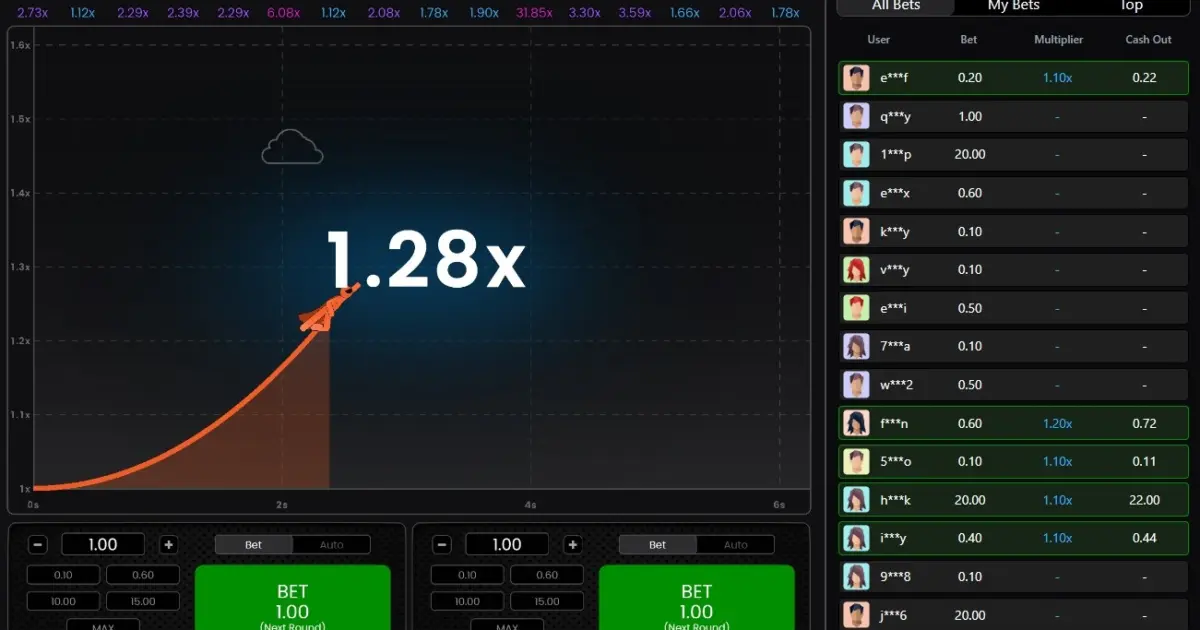
Is FlyX worth your time?
The FlyX crash game from Buck Stakes Entertainment is a straightforward multiplier title: the curve rises from 1.00x, you cash out before the crash, and the studio has published a 97% RTP across the game. With a free demo available and no download requirement, it is easy to evaluate the pacing and interface without risking money. Whether it earns a permanent spot in your rotation depends mostly on how much you value a clean presentation over a heavily themed visual layer, since this is one of only two titles the provider has released and the presentation is functional rather than elaborate.
| Field | Detail |
|---|---|
| Provider | Buck Stakes Entertainment |
| RTP | 97.0% |
| Category | Crash games |
| Free demo | Available |
| Provably fair | Not stated by provider |
| Maximum multiplier | Not published |
Where the house edge is actually built in
A 97% RTP means the game retains 3% of total stakes across a large number of rounds. That 3% is not a tax on your individual bet—it is a gap between the true statistical odds of each crash point and the multiplier you receive when you cash out. The distribution of crash points is weighted so that, averaged over thousands of rounds, 97 cents of every wagered dollar returns to players collectively. Your session may return 150% or 40%; the figure describes the long-run aggregate, not your evening.
The FlyX RTP of 97% places it alongside Aviator, which carries the same published figure, and above titles like Mines at 95%. Provider average and game average are identical at 97%, so there is no hidden portfolio variance to worry about here. The practical takeaway is that the edge is small and fixed. You cannot reduce it by timing your cash-out cleverly, and you cannot increase it by waiting longer. Every second you leave your bet on the curve exposes you to the same crash distribution regardless of your intent.
What the name tells you about the theme
FlyX carries no published theme tag in the provider data, and Buck Stakes Entertainment has released only two titles total, so there is no thematic family to compare it against within the provider’s catalog. The name itself reads as a functional label—the “Fly” prefix is common in crash-game nomenclature because it evokes the rising multiplier, and the “X” is a convention for the unknown endpoint. You should expect a clean, unadorned interface where the visual focus is the curve and the cash-out button.
This matters for one practical reason: a minimal theme means less visual noise competing for your attention during fast rounds. Crash rounds can resolve in under two seconds at the low end, so anything that slows your recognition of the multiplier value or the button state is a genuine friction point. A sparse design lets you read the number and react without parsing decorative elements first. The trade-off is that there is less character on screen between rounds, which some players find makes longer sessions feel flat.
Reading the maximum multiplier
Buck Stakes Entertainment has not published a maximum multiplier cap for FlyX. This absence is itself information. Some crash-game providers state a hard ceiling—10,000x or 50,000x—and when they do, it tells you the theoretical best-case payout on a single round. Without that figure, you cannot calculate your maximum possible win from a given stake, and you cannot verify whether the game’s code actually enforces a limit or simply lets the random distribution run to whatever value the seed produces.
In practice, the absence of a published cap should not be read as an invitation to expect extreme multipliers. The distribution still governs outcomes: values above 100x are rare in any crash game regardless of whether the theoretical ceiling is 500x or 5,000x, because the probability of the curve surviving that high falls roughly as the inverse of the multiplier. What matters for your bankroll planning is the realistic range you will encounter in most rounds—typically between 1.00x and roughly 3.00x for the bulk of outcomes—with the tail extending further but rarely enough to matter for session planning.
How the FlyX crash game compares to other crash games
Against the corpus average of 96.2% RTP for crash games, FlyX sits 0.8 points above. That gap is modest but real: over 10,000 rounds at $1 per round, the difference between 96.2% and 97% is roughly $80 in theoretical loss saved. It is not a reason to prefer this title over a game you enjoy more for its presentation, but it does mean FlyX is not quietly underpaying relative to its format peers.
Within Buck Stakes Entertainment’s catalog, the provider’s second title, FlyX Cash Turbo, carries the same 97% RTP. The “Cash Turbo” name suggests a faster round cycle—shorter intervals between crash points—which means more decisions per minute and correspondingly faster burn through a session budget. If you are evaluating the provider’s output, the two titles offer the same statistical return with different tempo, and your preference will come down to whether you want fewer, longer rounds or rapid-fire action.
Bankroll and session limits
Crash games resolve quickly. A typical round lasts between one and ten seconds, meaning you can place thirty to sixty bets in the time it takes to play a single slot feature. This speed compresses the variance experience: you will feel winning and losing streaks more intensely because they arrive in rapid succession, and the temptation to “chase” a crash below 1.50x by doubling down is stronger when the next round is already loading.
Set a session budget before you open the game and treat it as the cost of entertainment, not a bankroll to grow. FlyX is 18+ content. The 97% RTP means that, on average across all players and all time, 3% of every dollar leaves the system permanently. In a single session, your experience will deviate wildly from that figure, but the direction over hundreds of rounds is always toward the house keeping its percentage. Play the demo first to understand the round pacing, then decide what a real-money session is worth to you. No cash-out timing rule, auto-play pattern, or “strategy” alters the 3% figure. Auto-cashout at, say, 1.50x is a discipline tool that locks in smaller wins consistently—it does not change your expected value, which remains negative by the same margin regardless of the multiplier you target.
Verdict
FlyX is a competent, above-average crash game from a small provider that publishes its RTP clearly. At 97%, it meets or exceeds the format standard. The free demo and no-download access make evaluation painless. Where it loses points is in transparency around the maximum multiplier and provably-fair status—both absent from the provider’s published data. If you play crash games primarily for the mechanics and accept a minimal visual layer, FlyX does what it says. If you need a provably-fair verification workflow or a stated ceiling for bankroll math, look at Aviator, which publishes both. For a faster-tempo alternative from the same studio, FlyX Cash Turbo keeps the RTP constant and compresses the round intervals. Rank 38 at the 86th percentile of popularity suggests a steady audience without breakout momentum.
Frequently Asked Questions
Is there a FlyX free demo I can play without downloading anything?
Yes. Buck Stakes Entertainment makes a free demo of FlyX available with no download required. You can access the demo directly through any casino site that hosts the game. The demo uses virtual credits and operates on the same multiplier curve, so you can learn the round pacing and test auto-cashout settings without financial risk. Demo play does not predict real-money outcomes in any way.
What does the FlyX RTP of 97% actually mean for my session?
The published FlyX RTP of 97% means that across a very large number of rounds—typically hundreds of thousands or more—the game returns 97 cents of every dollar wagered to players collectively. In any individual session your return will deviate substantially in either direction. The figure describes the statistical distribution of crash points, not a guaranteed session outcome. You should expect your personal return to be higher or lower than 97% on any given night.
Can a cash-out strategy or timing system beat the FlyX house edge?
No. The 3% house edge in FlyX is embedded in the probability distribution that generates each crash point. Cashing out at 1.20x every round, at 2.00x every round, or using any pattern you devise does not alter your expected value—it remains negative by approximately 3% per unit wagered regardless of which multiplier you target. Auto-cashout settings help you avoid emotional decisions in the moment, but they do not shift the underlying math.
Is FlyX provably fair?
Buck Stakes Entertainment has not published a provably-fair verification mechanism for FlyX in the provider's game documentation. This does not mean the game is unfair or untested—licensing and certification requirements still apply—but it means you cannot independently verify the seed and crash-point generation after each round. Players who rely on provably-fair verification for audit purposes should check the game's information screen in their chosen casino before playing for money.
How does FlyX compare to Aviator as a crash game?
Both FlyX and Aviator publish a 97% RTP, so their long-run statistical return to players is identical. Aviator, made by Spribe, has published a maximum multiplier figure and a provably-fair algorithm, while FlyX does not list either. Aviator also has a significantly larger player base and more round data available for reference. FlyX is a valid alternative if you prefer a different presentation or round tempo, but the odds structure is the same.




