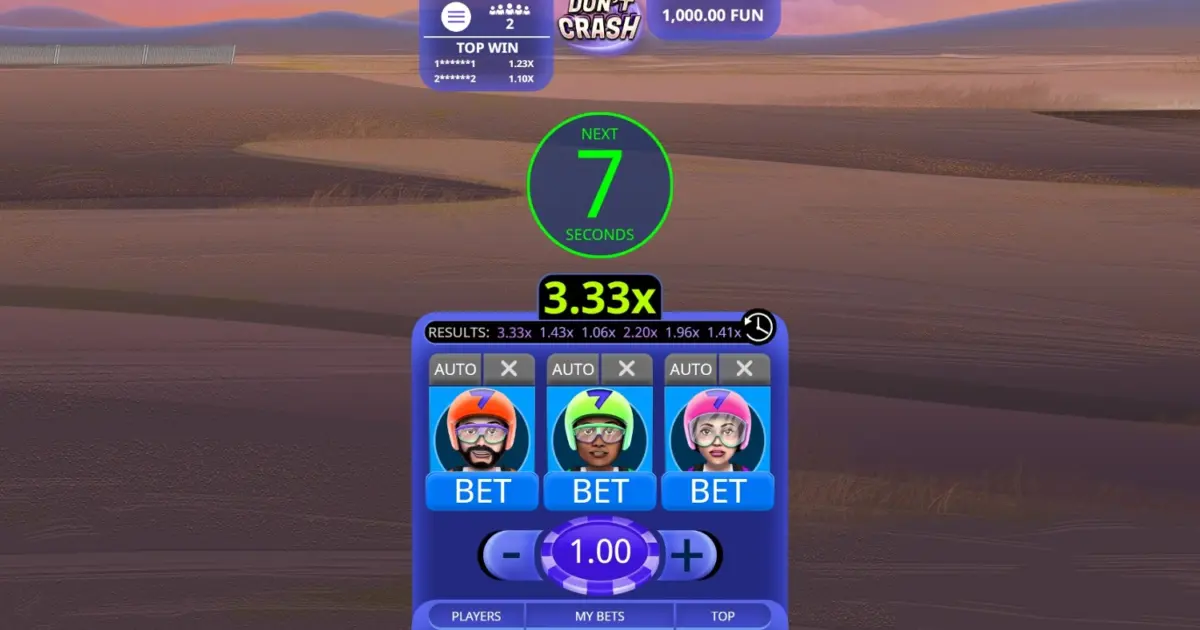
Don’t Crash from 7777 gaming is a clean, no-frills crash game with a published RTP of 97% — among the higher figures we track across crash games in our catalogue. There is no plot, no feature round, and no skill layer beyond the one decision every crash game offers: when to cash out. If you want an honest picture of what you are actually playing, this is the place to start.
The game is hard to criticise on transparency. A 97% return-to-player figure puts it slightly above our catalogue average of 96.2% for the format, and the studio publishes it openly. What matters is what that number means over the long run, not whether any single round feels generous or punishing. The rounds are quick; the maths does not care about your mood.
Is Don’t Crash worth your time?
If you already like crash games)Skip or want a low-variance version of the format, Don’t Crash is worth a serious look. The single most decision-relevant fact here is the RTP figure: 97% is a strong number for the genrecars. The games beside it in our catalogue — Aviator also sits at 97% — are its direct competition, and Don’t Crash matches them on published return while offering a simpler, more direct presentation.
The quick answer is yes, with a caveat. The game does not innovate: it is a multiplier curve, a cash-out button, and a 1.00x starting point, exactly like every other crash game. What it does offer is a lean version of the format with a transparent return figure. For players who want to test the mechanics in free demo mode first, Don’t Crash free demo is available without charge — a sensible way to see whether the game’s pacing suits you before you risk anything.
| Provider | 7777 gaming |
|---|---|
| RTP | 97.0% |
| Free demo | Yes |
| Site-wide average RTP | 96.2% |
Where the house edge is actually built in
The house edge in Don’t Crash is not hiding in the interface, the bet feed, or any cash-out rule. It lives entirely inside the statistical distribution of crash points. Every round starts at a 1.00x multiplier and climbs until the game picks a crash point; if you cash out before that point you win your stake times the multiplier at that moment, and if you are still in when it crashes you lose the stake.
That crash point is drawn independently each round. A run of low crashes does not make a high one “due”, and a run of high crashes does not make a low one “due” — each round is a fresh roll. Over a very large number of rounds, the distribution of crash points produces the long-run RTP of 97%, which means the house edge is about 3% over time. This is the same way slot RTP works, and it is the only number that matters for your expectation.
No cash-out timing — a “one-third rule”, a manual pattern, or anything else — changes that expected value. Cashing out earlier locks in a smaller multiplier more often; waiting longer risks losing everything for a shot at a bigger one. That is a variance trade-off you control, not an edge you can create. The maths behind the curve is fixed.
What the name tells you about the theme
The name “Don’t Crash” is the theme in its entirety. There is no narrative wrapper or elaborate visual world to parse — the instruction is the game. The presentation is built around that single idea: watch the multiplier risechers, decide when to cash out, and try not to let the round end before you do.
That minimalism is a strength for a crash game. The format’s interest comes from the tension between a rising number and the possibility it collapses at any instant, and Don’t Crash does not bury that under extra systems. 7777 gaming has kept the theme lean at most — the label suggests a direct, almost instructional design — which suits players who want the core crash experience without layers of decoration. There are no features that change the odds or add hidden complexity, which is exactly what an honest crash game should look like.
Reading the maximum multiplier
We need to be direct here: 7777 gaming has not published a maximum multiplier cap for Don’t Crash in the information we hold. That is not unusual for crash games, and it is not a flaw in itself — it simply means the studio has not stated a ceiling on how high the curve can climb before it crashes.
What this absence means for you is simple: treat any specific maximum-win figure you see quoted elsewhere with caution. The relevant number is not a cap on the multiplier anyway; it is the RTP. The 97% figure tells you the long-run return, and the multiplier cap, if one exists, only sets an upper bound on what a single round can pay — it does not change the house edge. If a maximum matters to you, check the game’s own information screen before you play for money. Neither the absence of a stated cap nor the presence of one changes the fundamental maths of the game.
How Don’t Crash compares to other crash games
The honest comparison starts with the numbers. Don’t Crash carries a published RTP of 97%, which sits 0.8 percentage points above our corpus average of 96.2% for the genre — a real but modest edge over the field. The closest named comparison in our catalogue is Aviator, which also publishes 97%: the two are statistically identical on return, and your choice between them comes down to presentation and pace rather than odds.
Mines is a different animal — it publishes 95% and plays as a grid-reveal game rather than a pure multiplier curve, so it is only a crash neighbour in the loosest sense. Chicky Run, at 96%, is a more direct comparison among light, casual crash-style games, and Don’t Crash’s 97% gives it a small, factual advantage there. On the published numbers, Don’t Crash is near the top of what we track — but a one-point RTP gap is not a reason to abandon a game you already enjoy.
Bankroll and session limits
Crash games repeat quickly, and Don’t Crash is no exception — a round can resolve in seconds. That speed is the main risk-management challenge. Set a budget for the session before you start, decide in advance what you are willing to lose, and treat the amount as spent entertainment, not money you expect back. An auto-cashout setting, if you use it, is a discipline tool — it locks in a chosen multiplier for you, but it does not change the odds. Bet sizing per round is your own decision, and it is the main lever you actually control.
This is the one place the format needs a plain word. 18+, set a budget in advance, and treat every bet as entertainment you pay for, not income. Rounds repeat faster here than almost any other casino format, so the same decision comes at you over and over in a short session — make your limits before the first round, not after a few losses.
Verdict
Don’t Crash is a lean, well-priced crash game. Its published 97% RTP is among the strongest figures we track in the genre, matching Aviator and beating Chicky Run, and the presentation stays out of its own way. If you want the core crash experience with a transparent return figure, and you want to try it first in demo mode, there is little to argue with here.
The limits are equally plain. It does not innovate, and the studio has not published a maximum multiplier cap, so treat any specific cap you see elsewhere as unverified. None of that changes the core maths: the house edge is fixed in the crash-point distribution, and no timing choice changes it. If you like the format and want a straightforward version with a strong published return, Don’t Crash earns its place.
Frequently Asked Questions
Can I play Don't Crash for free in demo mode?
Yes. A free demo version of Don't Crash is available, and it is the right way to feel out the game's pace before betting real money. Demo play never predicts real-money outcomes, but it lets you test cash-out timing and session pacing at no cost.
What is the RTP of Don't Crash, and what does it mean?
7777 gaming publishes a 97% return-to-player figure for Don't Crashcars. That means over a very large number of rounds the game returns 97% of stakes on average, a house edge of about 3%. It does not predict any single round; it describes the long-run distribution.
Does cash-out timing or a system change the odds in Don't Crash?
No. The crash point is drawn independently each round, and the house edge is fixed in that distribution. Cashing out early or late changes your variance — smaller wins more often versus bigger wins less often — but no timing rule or progression changes your expected value.
What does "provably fair" mean for games like Don't Crash?
Provably fair means the round's crash point is generated from a seed the player can verify after the round ends, confirming the result was not manipulated. The FACTS for Don't Crash do not state whether the game uses it, so treat that claim as unverified and check the game's own information screen.
How does Don't Crash compare to Aviator?
Both publish a 97% RTP, so statistically they are equivalent on return over the long run. The difference is presentation and pace: Aviator has its own distinctive flying-plane theme, while Don't Crash is leaner and more direct. Choose on style, not odds.




