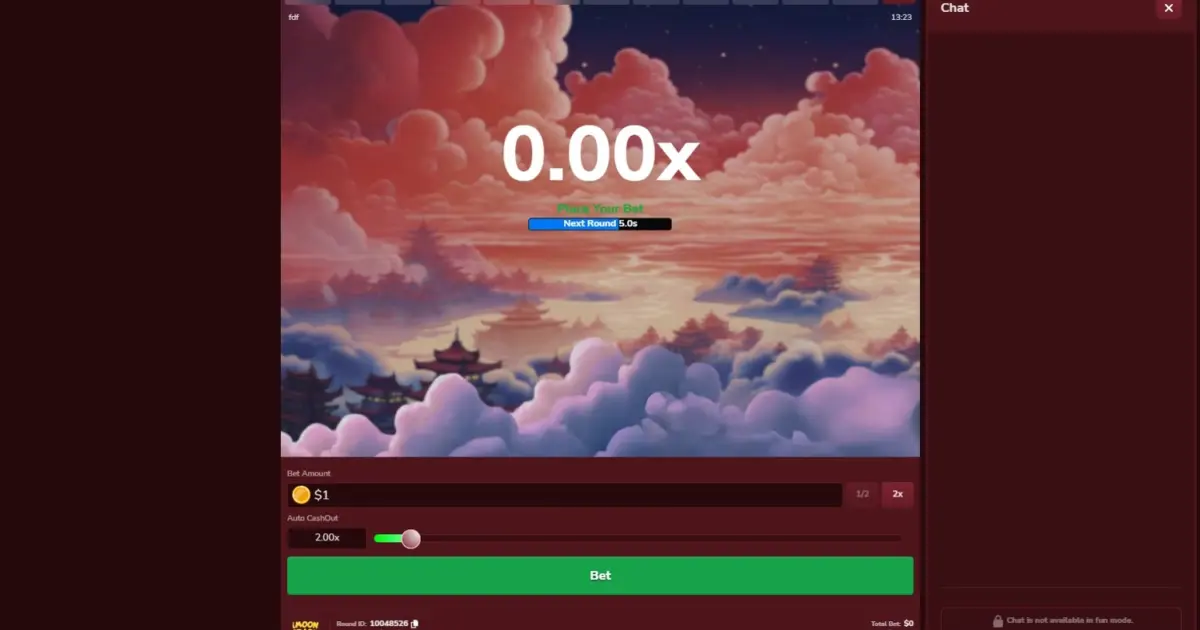
The Dragon Flare crash game from iMoon is a solid entry in a crowded format, and its published 98.0% return-to-player figure places it above the typical threshold you will find across this category. Whether that margin is enough to justify your time depends less on any single round and more on how you understand the maths underneath every multiplier spike. This review walks through what the game actually offers, how the curve works, and where the house edge sits.
Free play is available, so you can see the interface and pacing without committing a deposit, and the demo mode carries no time limit on your session.
Dragon Flare and the iMoon game range
iMoon publishes five titles in its portfolio, and Dragon Flare sits within that range alongside Trade Blazer, Crash 1917, and Crash Royale. The provider’s average RTP across its catalog is 98.4%, which is noticeably higher than the corpus average of 96.2% for crash games generally. Dragon Flare’s individual 98.0% figure sits just below that provider average but remains competitive.
Crash Royale, at 99.0%, edges above Dragon Flare by a full percentage point, which over ten thousand rounds translates to a meaningfully smaller house take. Trade Blazer and Crash 1917 share Dragon Flare’s exact 98.0% RTP, so choosing between them comes down to interface preference, theme, and pacing rather than any statistical advantage. The practical implication for you is simple: within iMoon’s own range, the maths are nearly identical, and no single title offers a structural edge over another.
Dragon Flare’s theme label suggests a fantasy or mythological aesthetic, but the underlying mechanics do not change based on skin. What you see on screen is presentation layered over the same independent multiplier distribution that governs every crash game.
The 98% figure and how the curve produces it
A 98.0% RTP does not mean you get back 98% of every bet. It means that across a very large number of rounds—typically hundreds of thousands or millions—the statistical distribution of crash points is calibrated so that the operator retains approximately 2% of total wagered. In any given session of fifty or two hundred rounds, your actual return could be 70% or 150% without contradicting the published figure.
The curve itself starts at 1.00x and rises continuously. The crash point for each round is drawn from a probability distribution where low multipliers appear more frequently and high multipliers appear rarely. This asymmetry is exactly where the 2% house margin lives: the expected value of a cash-out at any given multiplier is slightly below the multiplier itself, and that gap, multiplied across all possible cash-out points, produces the published RTP.
Here is a summary of Dragon Flare’s key published facts:
| Attribute | Detail |
|---|---|
| Provider | iMoon |
| RTP | 98.0% |
| Game category | Crash games |
| Free demo available | Yes |
| Maximum multiplier cap | Not published by iMoon for this title |
| Provably fair | Not confirmed in available data |
Where a maximum multiplier cap or provably-fair implementation is not stated by the provider, treat any figure you encounter elsewhere as unverified until you confirm it on the game’s own information screen.
What decides when the round crashes
Every round generates its crash point independently. A string of ten consecutive crashes below 1.50x does not make an 80x multiplier “due” on round eleven, and a run of high multipliers does not make the next round safer. Each round is a fresh draw from the same distribution, and the algorithm that produces it—whether a provably-fair seed system or a standard RNG—has no memory of previous outcomes.
This matters because the single most common mistake players make with crash games is pattern-seeking. You will see the multiplier climb to 3x, 4x, 5x across several rounds, and your brain will construct a narrative: “it’s running hot,” “the next one will be low,” or “the algorithm is in a high phase.” None of those narratives correspond to how the maths work. The probability of any given crash point is fixed per round regardless of what preceded it.
Auto-cashout settings let you pre-select a multiplier at which your stake is automatically redeemed. This is a discipline tool—it prevents the human tendency to hold too long when a curve is climbing—but it does not shift your expected value. Cashing out automatically at 2.00x every round means you will hit that number roughly 49% of the time (given the 2% house margin), and lose the other half. The distribution does not care that you chose your exit in advance.
Fast rounds and why pacing matters
Crash games run on short loops. A single round can last anywhere from a fraction of a second to several minutes, and the average duration across all rounds is short enough that you can complete dozens of bets in an hour without noticing the clock. Dragon Flare’s presentation does not slow this down—the multiplier curve is visible and the interface is immediate, so there is no loading delay between rounds.
Pacing matters for two reasons. First, faster rounds mean your hourly theoretical loss is higher at the same stake size, because the house edge is applied more frequently. If you bet 1 unit per round and play sixty rounds in an hour at 98% RTP, your expected hourly cost is 1.2 units. If the round duration shortens and you play one hundred rounds, that cost rises to 2 units with no change to the game itself. Second, fast rounds compress decision time. The gap between “the curve is rising, I should cash out” and “the curve has crashed” can be under a second, and repeated exposure to that pressure degrades judgment over a session.
There is no setting in Dragon Flare that slows the maths down. If you find yourself betting reflexively rather than deliberately, the round speed is the factor to manage, not the multiplier you are chasing.
Variance in crash games versus other casino games
Variance describes how widely individual results spread around the expected value. Crash games concentrate their distribution heavily at the low end: the majority of rounds crash below 2x, and the tail extends into multipliers that appear rarely but pay handsomely. This shape means that in any short session, most players will experience a sequence of small losses punctuated by occasional larger wins, with the net result drifting toward the RTP over a very long horizon.
Compared to a standard slot with, say, 96% RTP, a crash game at 98% looks better on paper, but the experience of playing it differs. Slots distribute their returns across many payline hits and bonus triggers; a crash round gives you one binary outcome—cashed out in time, or did not. There is no partial credit, no secondary win, no bonus multiplier that softens a loss. That structural simplicity means variance feels sharper, even when the published numbers look comparable.
Dragon Flare’s 98% RTP is genuinely high for the category, but “high RTP” and “low volatility” are not the same thing. You can sit at a high-RTP crash table and watch your balance swing dramatically across twenty rounds. The RTP guarantees long-run behaviour only, and “long-run” in a statistical sense means more rounds than most players will ever complete in a session.
Playing responsibly
Crash games repeat quickly, and that speed is the single most important factor to manage. Before you place a bet, decide on a total amount you are willing to spend as entertainment cost, set a session timer, and treat the entire stake as already spent the moment you click. If you are playing Dragon Flare or any other title in this format at 18 or over, the maths do not get better for being watched more carefully—a session that ends after thirty rounds with a loss is exactly as statistically valid as one that ends after three hundred. The game is entertainment you pay for, not income. If you notice yourself chasing a loss by raising your stake or extending your session, stop immediately and step away.
Verdict on Dragon Flare
Dragon Flare is a competent crash game with a published 98.0% RTP that sits above the category average and is reasonable even within iMoon’s own above-average portfolio. Free demo play removes the risk of trying it, and the round structure is straightforward enough that there is no learning curve to worry about.
The main caution is the same for every game in this format: the speed at which rounds resolve will expose your bankroll to the house edge more times per hour than you might expect from a slower casino game. That does not make Dragon Flare a bad choice—it makes it a game where your session length and stake size matter more than any timing strategy or cash-out “system.” If you understand the 98% figure as a long-run statistical property and the fast pacing as the real cost driver, you have the complete picture the game offers. No further edge is available regardless of how you play the multiplier.
Frequently Asked Questions
Can I play Dragon Flare for free without downloading anything?
Yes, iMoon provides a free demo mode for Dragon Flare that is available directly in your browser with no download required. The demo uses the same round structure as real play but with virtual credits, so you can observe the pacing and interface without committing funds. Free play is useful for understanding the format, though outcomes in demo mode carry no predictive weight for real-money sessions.
What does Dragon Flare's 98% RTP actually mean for a session?
It means the game's crash-point distribution is calibrated so that, over a very large number of rounds, approximately 2% of total wagered is retained as the house edge. In any individual session of fifty or two hundred rounds, your actual return could be significantly higher or lower than 98%. The figure describes long-run statistical behaviour, not a per-session guarantee, and no amount of cash-out timing changes it.
Does any cash-out strategy or timing pattern improve my odds in Dragon Flare?
No. The crash point for each round is generated independently, so no pattern of previous results informs the next one. Cashing out at a fixed multiplier consistently means you accept a specific risk-reward trade-off, but it does not alter the expected value that the distribution produces. Auto-cashout helps enforce discipline; it does not shift the 2% house margin in your favour.
Who develops Dragon Flare and what else is in their catalog?
Dragon Flare is developed by iMoon, a provider with five crash games in its portfolio. The studio's average RTP across those titles is 98.4%, placing the entire range above the broader crash-game corpus average. Related titles include Crash Royale at 99.0% RTP and Trade Blazer and Crash 1917, which match Dragon Flare's 98.0% figure exactly.
Is there a maximum multiplier cap published for Dragon Flare?
iMoon has not published a specific maximum multiplier cap for Dragon Flare in the available data. This means the game's information screen may display a limit, but no external figure can be confirmed here. Be cautious with any cap quoted on third-party sites until you verify it directly within the game interface before playing for real money.




