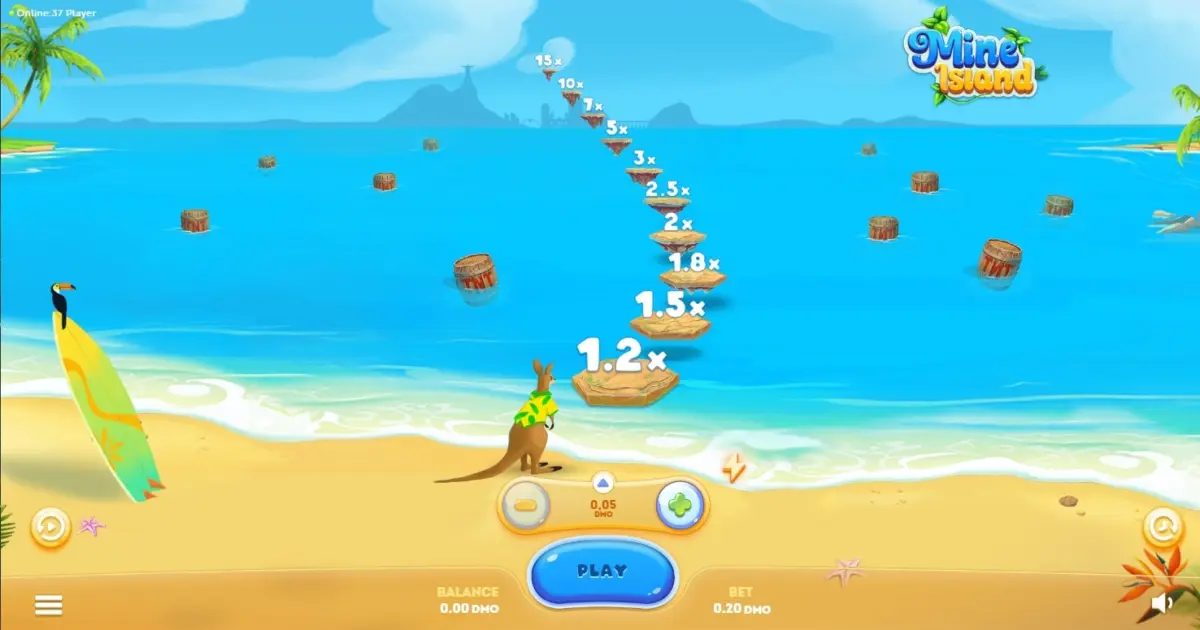
The main reason to look at this one is the number: Smartsoft Gaming publishes a return-to-player figure of 98% for the mine island crash game, which sits 1.8 percentage points above the 96.2% average across the games we cover. A free demo is available, so you can watch how the curve behaves at no cost. What you will not find is any way to influence when a round ends.
Mine Island and the Smartsoft Gaming game range
Smartsoft Gaming has five titles in our library, averaging 96.9% RTP between them. Mine Island is the highest of that group and ranks fourth overall in our crash category, sitting in the 98.9th percentile for popularity.
If you want to compare within the same studio, Bottle Mania is the closest on paper at 97.5%, and Chicken Highway sits at 97.0%. At the other end of the range, Crash Duel X is published at 96.0%, a full two points below Mine Island. That spread matters more than it might look: over a long session of fast rounds, two percentage points of house edge is the difference between a bankroll that erodes slowly and one that erodes at roughly double the rate.
Beyond the RTP figures and the provider, Smartsoft has not published details we can pass on here. Bet limits, the maximum multiplier cap and the presentation are not in the information available to us, so check the game’s own info screen before you play for money.
| Provider | Smartsoft Gaming |
|---|---|
| RTP | 98.0% |
| Free demo | Yes |
| Site-wide average RTP | 96.2% |
The 98% figure and how the curve produces it
A 98% RTP means that across a very large number of rounds, the game is designed to return 98 units for every 100 staked. The remaining 2% is the house edge. That figure is a long-run average, not a session forecast — a hundred rounds can land anywhere either side of it, and no individual round returns 98%.
In a crash game the edge lives in the statistical distribution of crash points rather than in any single round. The multiplier starts at 1.00x and rises; the round ends at a crash point drawn independently for that round. Cash out before it and you take your stake multiplied by whatever the counter read at that moment. Get caught in it and the stake is gone. There is no third outcome and no partial result.
The distribution is weighted so that low crash points occur often and high ones rarely, in the proportions needed to produce the published figure over time. That is why a 98% game and a 96% game can look identical while you watch them — the difference shows up in how frequently the curve dies early, aggregated over thousands of rounds rather than dozens.
What decides when the round crashes
The crash point is set before the multiplier starts climbing, by the game’s random number generation. Nothing you do during the round moves it. Cashing out at 1.30x rather than 4.00x changes what you collect, not when the curve ends.
Each round is generated independently of the last. Five crashes under 1.20x in a row do not make a high multiplier more likely on the sixth, and a run of 10x results does not mean the game is about to correct. There is no memory in the system to correct with. Any progression that raises your stake after losses, or any rule about cashing out at a fixed multiple, changes the shape of your results — bigger swings, or smaller ones — without touching expected value. The 2% edge applies to every unit you stake regardless of pattern.
Whether Mine Island uses a provably fair seed you can verify after the round, or a standard certified RNG, is not something the information available to us states. Both approaches are common in this format. The game’s own help screen is the place to confirm it.
Fast rounds and why pacing matters
Crash rounds are short. A curve that dies at 1.15x is over in a couple of seconds, and the next round is usually accepting bets almost immediately. That pacing is the format’s real risk, and it has nothing to do with the RTP.
Work it through in units. At 98% RTP, the expected cost of a round is 2% of your stake. Play 20 rounds a minute at 1 unit each and the expected cost is about 0.4 units a minute — roughly 24 units an hour. Slow to 5 rounds a minute and that falls to about 6. Same game, same edge, four times the difference in what an hour costs you. Round count is the variable you actually control.
Auto-cashout and auto-bet tools, where a game offers them, are worth understanding in that light. Setting an automatic exit at 1.50x removes the reflex element and enforces a decision you made calmly. It does not improve your odds by any amount. Auto-bet tends to push round count up, which pushes hourly cost up with it.
Variance in crash games versus other casino games
The unusual thing about crash is that you choose your own variance. In a slot, the volatility is fixed by the paytable. Here, a target of 1.20x wins often and pays little; a target of 20x almost never lands but pays large when it does. Both carry the same 2% expected cost per unit staked.
That trade-off is genuine and it is the only decision in the game. Low targets produce long stretches of small gains punctuated by losses that wipe several of them out. High targets produce long droughts. Neither is smarter. If you want your session to last, low targets and fewer rounds do that; if you want the chance of a large multiplier, you accept a much longer wait for it.
Note that the maximum multiplier cap for Mine Island is not published in the information we have. If you plan to chase high targets, that ceiling is worth checking in the game itself first.
Playing responsibly
Play is for over-18s only. Decide what the session can cost before you open the game, treat that amount as the price of the entertainment rather than money you expect back, and stop when it is gone. Rounds this short make it easy to stake far more in an hour than you intended, so setting a round count alongside a cash limit helps. If you find yourself increasing stakes to recover a loss, close the game. Free demo play is a fair way to see the pacing, but demo results predict nothing about real-money sessions.
Verdict on Mine Island
The 98% RTP is the strongest thing about it — the best of the five Smartsoft Gaming crash games in our library and comfortably above the 96.2% category average. If you already enjoy this format, a two-point house edge is about as favourable as published crash figures get.
What you should know going in: the maximum multiplier, bet limits and whether the game runs a verifiable provably fair seed are not covered by the information available here, so read the in-game info screen. And a strong RTP does not soften the pacing problem. At 20 rounds a minute, a 2% edge still compounds quickly. Try the Mine Island free demo, count how many rounds you actually play in five minutes, and use that number to decide what a real-money session would cost you.
Frequently Asked Questions
Can you play Mine Island for free?
Yes, a free demo is available, so you can watch how the multiplier curve behaves and how quickly rounds repeat without staking money. Use it to count how many rounds you play per minute, since that figure drives what a real-money session would cost. Demo results do not predict real-money outcomes.
What is the Mine Island RTP and what does it mean?
Smartsoft Gaming publishes 98% for Mine Island, meaning the game is designed to return 98 units per 100 staked over a very large number of rounds, leaving a 2% house edge. It is a long-run average, not a session forecast, and no single round returns 98%.
Does cashing out at the right moment improve your odds?
No. The crash point is drawn independently before the multiplier starts rising, so your cash-out timing decides what you collect, not when the round ends. Early exits win more often for less; late exits rarely land for more. Both carry the same 2% expected cost per unit staked.
What does provably fair mean in a crash game?
It means the game publishes a seed after each round that you can verify yourself, confirming the crash point was set in advance and not altered mid-round. Whether Mine Island uses this method or a standard certified RNG is not stated in the information available here, so check the game's info screen.
How does Mine Island compare to Bottle Mania?
Both are Smartsoft Gaming crash titles, but Mine Island's 98% RTP is half a point above Bottle Mania at 97.5%. Over thousands of fast rounds that gap adds up, so Mine Island is the better-priced of the two. Mechanically they share the same independent crash-point maths.




