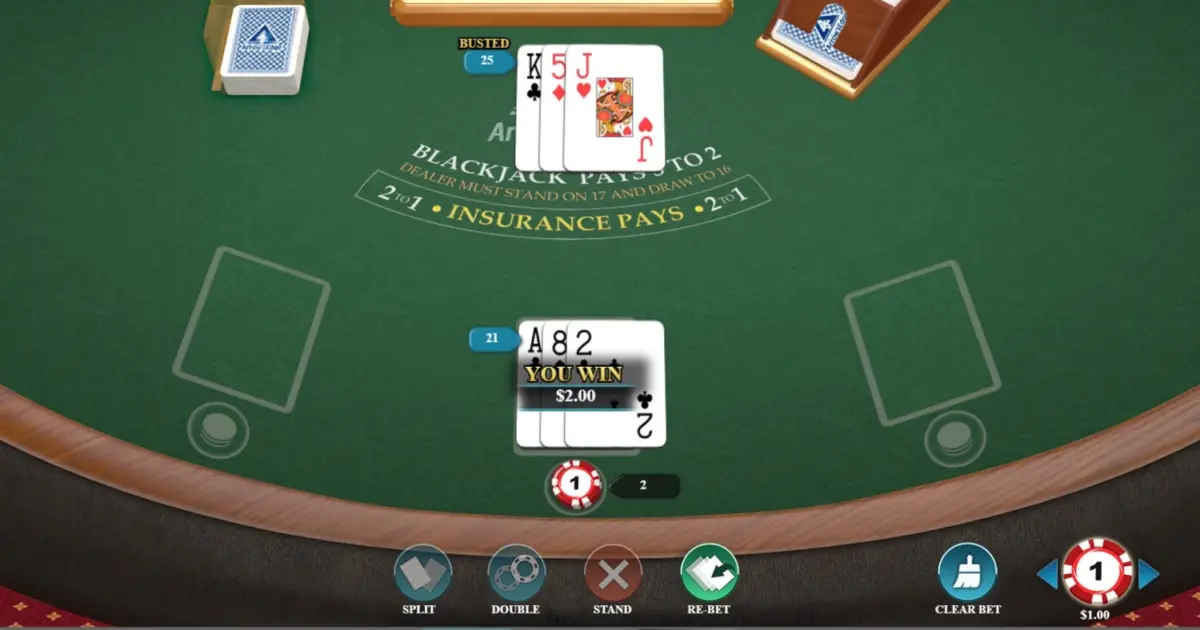
Single Deck Blackjack (Arrows Edge) sits at 99.5% RTP, matching the Arrow’s Edge blackjack average and ticking 0.09 percentage points above the broader market. That narrow house edge makes it competitive on paper, but the single-deck label carries a warning: fewer decks usually help the player, yet providers often pair single-deck games with rule changes—6:5 blackjack payouts or dealer hits soft 17—that hand the edge straight back. Arrow’s Edge does not publish the full rule set for this table, so the 99.5% figure is a promise that depends entirely on the rules you find when you open the game.
Single Deck Blackjack (Arrows Edge) and the Arrow’s Edge table range
Arrow’s Edge offers three blackjack tables in total, all carrying the same 99.5% RTP: Perfect Pairs Blackjack adds the Perfect Pairs side bet, and Multihand Blackjack lets you play multiple hands simultaneously against a single dealer up-card. Single Deck Blackjack (Arrows Edge) is the straight base game, no side bets, one hand at a time. The absence of published rule detail across all three tables is unusual: most providers state the deck count, blackjack payout ratio, and soft-17 rule in the game’s own help screen or marketing sheet, but Arrow’s Edge leaves that confirmation to the player. If you prefer multi-deck over single-deck for the steadier variance, or you want the multi-hand format, the RTP is identical across the range, so the choice comes down to rule transparency and preference rather than mathematical advantage.
The 99.5% figure, and the assumption behind it
An RTP of 99.5% means the house edge is 0.5%, and that edge applies only when you play perfect basic strategy on every decision—hit, stand, double, split—for hundreds of hands. Basic strategy is a solved chart, derived by computer from every possible combination of your cards and the dealer’s up-card, and it tells you the mathematically optimal play in each situation. A casual player who stands on 16 against a dealer 7, or who splits tens, or who takes insurance at standard 2:1 odds, realizes a materially higher house edge, often 2% or more. The 99.5% figure is the ceiling, not the floor, and it is only reachable if you bring the chart or have it memorized cold.
| Metric | Value |
|---|---|
| RTP | 99.5% |
| House edge | 0.5% |
| Provider | Arrow’s Edge |
| Deck count | Single deck (title implies; confirm in-game) |
| Free demo | Yes |
The title indicates single-deck rules, which normally means a lower house edge than six- or eight-deck shoes, because the removal of each card shifts the remaining deck composition more dramatically and benefits certain player decisions. A single deck also makes it easier to track which cards have appeared, though card counting does not work against an RNG table that reshuffles every hand—your count resets to zero before the next deal, so there is no advantage to extract. The 99.5% RTP already accounts for the single-deck structure and whatever other rules are live in the game; you cannot improve that figure by counting or by applying a betting progression.
Rules to confirm before you bet real money
Arrow’s Edge does not publish whether this table pays 3:2 or 6:5 on blackjack, whether the dealer hits or stands on soft 17, whether you can double after split, re-split aces, or surrender late. Every one of those rules moves the house edge by a few hundredths or a few tenths of a percent, and one rule in particular—6:5 blackjack payout instead of 3:2—costs the player roughly 1.4% and is the single most damaging change a provider can make. If this table pays 6:5, the house edge climbs well above 0.5%, and the 99.5% RTP would not hold. The in-game rules screen or paytable is the only reliable source for these figures; open the help panel before you commit real money and confirm the blackjack payout ratio, the soft-17 rule, and the double and split permissions. If the rules are not displayed clearly, that is itself a reason to choose a more transparent table.
Single-deck games often restrict doubling to hard 9, 10, or 11, and may prohibit re-splitting aces or doubling after split, precisely to offset the lower house edge that fewer decks would otherwise deliver. These restrictions are not inherently unfair—they are disclosed adjustments—but they matter to your session expectation, and you need to see them in writing before the first hand.
Strategy: the chart, not a system
Basic strategy is not a betting system or a progression; it is a lookup chart that tells you the correct play for every combination of your hand total and the dealer’s up-card, assuming you want to minimize the house edge over the long run. The chart differs slightly depending on the number of decks and the specific rules in force: single-deck strategy says to double 11 against a dealer ace, and to split 3s against a dealer 2, plays that change in a six-deck shoe. If you are playing single-deck rules, use a single-deck strategy chart; if the table turns out to be multi-deck despite the name, switch charts. The difference in edge is small—a few hundredths of a percent per decision—but those decisions compound over a session.
No betting progression, whether Martingale (double after a loss), D’Alembert (raise one unit after a loss, drop one after a win), or any other sequence, changes the house edge. Progressions reshape the variance—Martingale gives you frequent small wins and occasional catastrophic losses, flat betting spreads the variance more evenly—but the expected value per hand remains negative at 0.5% regardless of how you size your bets. A strategy cannot beat the house edge, and a hand is never “due” after a streak of losses. Each deal is an independent event against a reshuffled RNG deck.
Variance at the blackjack table
Blackjack has lower variance than slots or roulette, because the even-money payout structure (1:1 on a win, 3:2 on blackjack, 2:1 on insurance if offered) keeps individual swings smaller. A session of 100 hands at £1 per hand gives you an expected loss of £0.50 with perfect play, but the actual result will swing several pounds in either direction due to normal variance: you might finish up £8 or down £9, and both outcomes are consistent with a 0.5% house edge. Variance is higher at the start of a session and smooths out over thousands of hands; the law of large numbers guarantees the edge asserts itself eventually, but short sessions are decided as much by variance as by edge.
Bankroll size determines how many hands you can weather before a downswing exhausts your budget. A common rule of thumb is to bring at least 50 units for a session if you want a reasonable chance to play through normal variance without going bust, and 100 units if you plan to double or split aggressively when basic strategy calls for it. If your unit is £2 and you bring £100, you have 50 units and enough cushion for typical swings; if you bring £40, you have 20 units and a much higher risk of ruin on a short cold streak. Variance is not an enemy or a flaw—it is the reason short-term wins are possible—but it requires a buffer, and that buffer is always measured in units, not in absolute currency.
Free play first
Single Deck Blackjack (Arrows Edge) is available in free demo mode, and that demo is the only way to see the actual rule set without risking real money. Open the game in demo, navigate to the rules or paytable screen, and confirm the blackjack payout ratio, the dealer’s soft-17 action, and the double and split permissions before you decide whether the table is worth a real-money session. The demo uses the same RNG and the same rules as the real-money version; the only difference is that wins and losses have no financial consequence. Use it to test whether basic strategy is practical for you at this table, and to see how variance behaves over 50 or 100 hands. Demo results do not predict real-money outcomes, but they do show you the rule set and the interface, and that information is decision-relevant.
Blackjack is entertainment, not income. Set a budget in advance, treat losses as the cost of the session, and stop when the budget is gone or when the session stops being enjoyable, whichever comes first. If you find yourself chasing losses or playing beyond your budget, step back. This is a game of skill relative to other casino games, but the house edge is always present, and no session is ever a sure win. 18+ only. Play responsibly.
Who this table is for
Single Deck Blackjack (Arrows Edge) is for the player who wants a clean single-hand game, no side bets, and who is prepared to confirm the rule set manually because the provider does not publish it up front. The 99.5% RTP is competitive if the rules support it—if the blackjack payout is 3:2 and the dealer stands on soft 17—but the lack of published detail makes this a poor choice for anyone who wants rule transparency before opening the game. If you prefer to compare tables by reading the rules in a spec sheet rather than hunting through in-game help screens, American Blackjack or Classic Blackjack are clearer alternatives at comparable RTP. If you like the Arrow’s Edge platform and want basic strategy practice without complex side-bet decisions, this table delivers that, but only after you have done the rule-checking work yourself.
Frequently Asked Questions
Is Single Deck Blackjack (Arrows Edge) available in free demo mode?
Yes, the table offers a free demo with the same rules and RNG as the real-money version. Use the demo to open the in-game paytable and confirm the blackjack payout ratio, soft-17 rule, and double-after-split permissions before committing real money, because Arrow's Edge does not publish those figures in advance.
What is the RTP of Single Deck Blackjack (Arrows Edge) and does it assume perfect play?
The RTP is 99.5%, which means a 0.5% house edge, and that figure assumes you play perfect basic strategy on every hand. Casual play—standing on 16 against a dealer 7, splitting tens, taking insurance—raises the house edge to 2% or more, so the published RTP is only reachable if you use the strategy chart correctly.
Does the single-deck format let you count cards and beat the house edge?
No. This is an RNG table that reshuffles after every hand, so your count resets to zero before the next deal and there is no deck penetration to exploit. Card counting works only in live or shuffled-shoe games where multiple hands are dealt before a reshuffle, not against an RNG that resets the deck composition every round.
How does Single Deck Blackjack (Arrows Edge) compare to Multihand Blackjack from the same provider?
Both tables carry the same 99.5% RTP. Multihand Blackjack lets you play multiple hands simultaneously against one dealer up-card, which increases variance and hands-per-hour but does not change the house edge. Single Deck Blackjack (Arrows Edge) is the straight single-hand game with no side bets, better for players who want to focus on one decision at a time.
What rules should I check before playing this table for real money?
Confirm the blackjack payout ratio (3:2 is standard, 6:5 costs you 1.4%), whether the dealer hits or stands on soft 17, and whether you can double after split or re-split aces. Arrow's Edge does not publish these rules outside the game, so open the help screen in demo mode first. If the table pays 6:5 on blackjack, the 99.5% RTP claim is incompatible with standard single-deck math and you should choose a different table.




