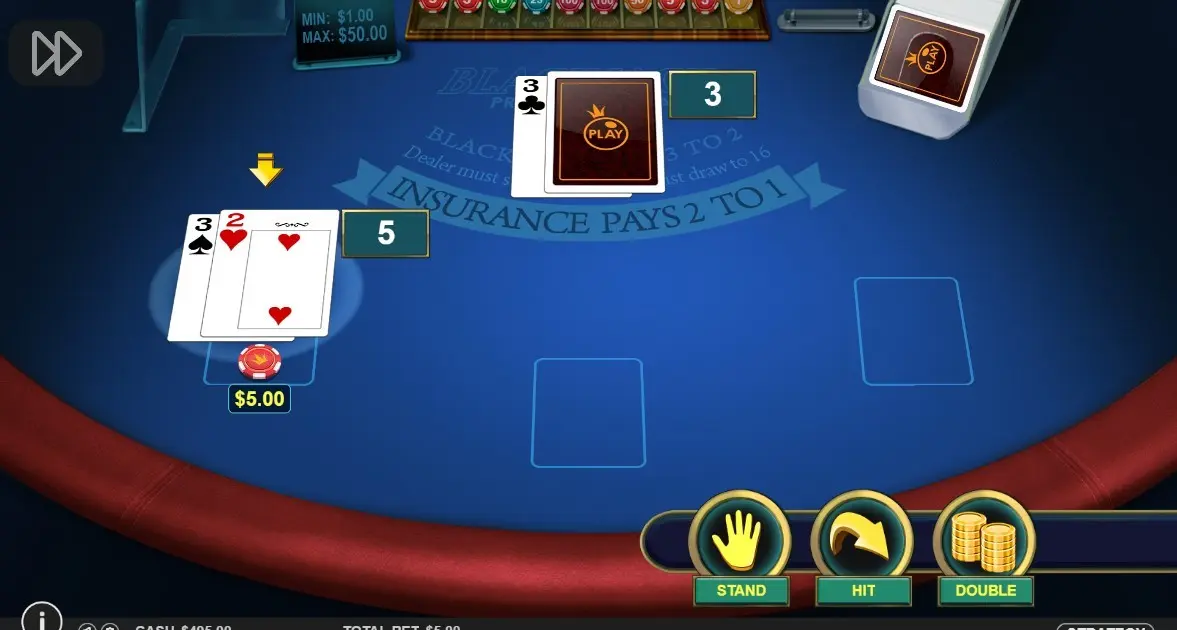
Pragmatic Play’s American Blackjack sits at the top end of the RTP range with a published 99.5% return, matching the best figures in the provider’s two-table blackjack lineup. The title signals hole-card peek rules—dealer takes both cards at the start and checks for blackjack before players act on doubles or splits—which protects those extra bets from a dealer natural. If you play perfect basic strategy on every decision, the house edge here runs around half a percent. Casual play without the chart will cost you several points more, so this is a table that rewards homework.
Is American Blackjack a fair table?
The 99.5% RTP assumes you execute basic strategy flawlessly on every hand. That is not a system or a progression; it is the mathematically solved decision chart for every two-card total against every dealer upcard. Any deviation from that chart—hitting a hard 17, standing on soft 18 against a ten, skipping the double on 11—hands the house a larger edge. A player who guesses or follows intuition instead of the chart will realise an effective return several percentage points lower than the published figure, often closer to 96% or worse. The 99.5% ceiling is real, but reaching it requires discipline and reference to the chart until the moves are automatic.
Pragmatic Play does not publish full rule detail for this table in most markets, so you will need to check the in-game paytable to confirm the blackjack payout ratio, whether the dealer hits or stands on soft 17, the deck count, and any surrender or double-after-split permissions. Each of those variables moves the house edge by a few hundredths to a few tenths of a percent. The 99.5% figure suggests a rules package in the 3:2 payout, multi-deck range with dealer peek, but confirm before you commit real money.
| Attribute | Value |
|---|---|
| RTP | 99.5% |
| Provider | Pragmatic Play |
| Variant | American (hole card + peek) |
| Free demo | Yes |
| Popularity percentile | 94.7 |
Pragmatic Play and this table
Pragmatic Play offers two blackjack tables in total, and both carry the same 99.5% return. The other is Multihand Blackjack, which lets you play up to three hands simultaneously against a single dealer shoe. The rule sets are equivalent, so the choice between the two comes down to whether you want to spread your session bankroll across multiple hands per round or focus on one decision at a time. Multi-hand play increases the number of outcomes per hour, which means you will see the long-run edge faster—useful if you are drilling basic strategy, less so if variance in a short session matters to you.
Pragmatic Play’s blackjack offerings are lean compared to the provider’s slots catalogue, but the 99.5% figure places both tables above the corpus average of 99.41% RTP for blackjack games in this category. That nine-hundredths-of-a-percent difference is modest in absolute terms, but it signals that Pragmatic Play chose a player-friendly rule set rather than tightening the payout or adding a harmful rule such as dealer hit on soft 17 or a 6:5 blackjack.
Rule set: what the title implies
The name “American Blackjack” indicates hole-card rules, which normally means the dealer receives two cards at the start of the hand—one face up, one face down—and peeks at the hole card if the upcard is an ace or a ten-value card. If the dealer has blackjack, the hand ends immediately. Any player who doubled down or split a pair loses only the original bet, not the additional wager. This is a material protection compared to European no-hole-card rules, where the dealer does not take the second card until all players have acted, and a dealer blackjack collects all bets including doubles and splits.
That said, the title is a strong hint, not a confirmed specification. Pragmatic Play does not publish the deck count, the exact blackjack payout, or the soft-17 rule for this table in most distribution channels, and those details change the house edge. A single-deck game with 3:2 blackjack and dealer stand on soft 17 can push the house edge below 0.2%; an eight-deck shoe with dealer hit on soft 17 and no double-after-split will sit closer to 0.6%. The 99.5% RTP suggests the rules fall somewhere in the middle of that range, but you must confirm in the game’s own rules screen before playing for money.
The maths of a blackjack hand
Blackjack is a negative-expectation game. The house edge exists because the player acts first and busts first, and a player who busts loses immediately even if the dealer busts on the same round. That structural advantage cannot be eliminated, only minimised. Basic strategy is the set of plays that minimises the house edge by choosing the mathematically correct action—hit, stand, double, split, or surrender—for every combination of player hand and dealer upcard. It does not guarantee a win on any individual hand; it guarantees the smallest possible loss over thousands of hands.
The edge moves with the rules. A 3:2 blackjack payout is the foundational assumption; switching to 6:5 costs the player roughly 1.4 percentage points and is the single most damaging rule change a casino can make. Dealer hitting soft 17 instead of standing adds about 0.2% to the house edge. Fewer decks favour the player slightly, because blackjacks become more frequent and the composition of the remaining shoe carries more information. Double-after-split and late surrender both reduce the house edge by a tenth of a percent or so when used correctly. Re-splitting aces and dealer peek both protect the player in specific situations.
Card counting does not work at this table. American Blackjack is an RNG game that reshuffles the deck after every hand, so no count can accumulate and no information carries over from one round to the next. The same is true for any online blackjack table unless it explicitly advertises a live dealer and a physical shoe. Counting is a tool for tracking the remaining composition of a fixed shoe; without a fixed shoe, there is nothing to track.
Common mistakes that cost you the edge
Insurance is a side bet that pays 2:1 when the dealer shows an ace and turns out to have blackjack. At standard odds, insurance is a losing proposition unless you are counting cards and know the remaining deck is rich in tens. In a freshly shuffled or RNG shoe, the true odds are worse than 2:1, and taking insurance every time the dealer shows an ace increases the house edge by about 0.5%. The fact that it is called “insurance” does not change the mathematics; it is a separate wager with its own negative expectation.
Deviating from basic strategy because a hand “feels” wrong is the second most expensive error. Basic strategy is solved; it is not a heuristic or a guideline. Standing on 16 against a dealer 10 because you are afraid to bust is a mistake—the chart says hit, and the long-run cost of standing is measurable. The same applies to splitting 10s when the dealer shows a weak card, doubling soft hands incorrectly, or failing to double down on 11. Every deviation from the chart hands the house a larger edge, and those tenths of a percent compound quickly over a session.
Side bets such as Perfect Pairs or 21+3, if offered, carry a far higher house edge than the base game—often 3% to 6% or more. They add variance and the possibility of a large payout on a single hand, but they do not improve your expectation. If you are playing to minimise cost, avoid side bets entirely. Betting progressions such as Martingale or D’Alembert change the shape of your session variance—how often you finish ahead versus how large the losses are when you finish behind—but they do not change the expected value. No progression can overcome a negative-expectation game, and a steep progression can exhaust your bankroll in a short losing streak.
Trying it free first
American Blackjack is available in free-demo mode, and that is the correct place to drill basic strategy until the chart becomes automatic. Demo play uses the same RNG and the same rule set as real-money play, so the decisions are identical; only the financial risk is absent. Use the demo to practice doubling soft hands, splitting pairs correctly, and recognising when to hit or stand on borderline totals such as 12 through 16 against a dealer upcard. The goal is to eliminate hesitation and guesswork before you play for money.
When you do play for real money, set a budget in advance and treat it as the cost of entertainment, not a path to income. Blackjack offers one of the lowest house edges in the casino, but it is still a negative-expectation game, and the longer you play, the more likely you are to finish behind. Keep your unit size small relative to your bankroll—common advice is 1% to 2% of your total stake per hand—so that normal variance does not exhaust your budget in the first few rounds. This is a game for players aged 18 and over, and it is your responsibility to stay within limits you set for yourself. If you find yourself chasing losses or playing beyond your budget, step away.
For a comparison, Classic Blackjack sits at 99.28% RTP and may use a different rule set depending on the provider, while Blackjack Multihand VIP matches the 99.5% figure and offers a higher-stakes multi-hand format.
Final take on American Blackjack
Pragmatic Play’s American Blackjack is a straightforward, high-RTP single-hand table with hole-card peek rules that protect doubled and split bets from a dealer natural. The 99.5% return is excellent for the genre, but only if you play basic strategy without deviation. The title implies a rules package favourable to the player, but Pragmatic Play does not publish full specifications, so confirm the blackjack payout, deck count, and soft-17 rule in the game’s own paytable before committing money. Avoid insurance, skip any side bets, and do not chase losses with a progression. If you want to play blackjack at one of the best available edges and you are willing to learn the chart, this table delivers.
Frequently Asked Questions
Is American Blackjack available in free demo mode?
Yes, American Blackjack offers a free-demo version that uses the same RNG and rule set as real-money play. Demo mode is the correct environment for drilling basic strategy until the chart becomes automatic, because the decisions are identical and only the financial risk is removed. Use it to practice splitting pairs, doubling soft hands, and playing borderline totals such as 12 through 16 against strong dealer upcards before you risk your bankroll.
What RTP does American Blackjack deliver and what does that figure assume?
Pragmatic Play publishes a 99.5% RTP for American Blackjack, which is one of the best figures in the blackjack category and sits above the corpus average of 99.41%. That return assumes you execute perfect basic strategy on every hand without deviation. Any mistake—standing when the chart says hit, skipping a double on 11, taking insurance—hands the house a larger edge, and casual play without reference to the chart will realise an effective return several percentage points lower, often closer to 96% or worse.
Does card counting work on this table?
No, card counting does not work on American Blackjack because it is an RNG-based game that reshuffles the deck after every hand. Counting relies on tracking the remaining composition of a fixed shoe, and when the deck resets after each round, no count can accumulate and no information carries over. This applies to every online blackjack table unless it explicitly advertises a live dealer dealing from a physical shoe.
How does American Blackjack compare to Pragmatic Play's Multihand Blackjack?
Both tables carry the same 99.5% RTP and use equivalent rule sets, so the difference is structural rather than mathematical. American Blackjack is a single-hand game, while Multihand Blackjack lets you play up to three hands simultaneously against one dealer shoe. Multi-hand play increases the number of decisions per hour, which surfaces the long-run edge faster—useful for strategy practice, but it also accelerates variance and requires a larger session bankroll to avoid ruin during a short losing streak.
What is the biggest mistake players make on this table?
Taking insurance is the most common expensive error. Insurance is a side bet that pays 2:1 when the dealer shows an ace and has blackjack, but at standard odds the true probability is worse than 2:1, making it a losing wager unless you are counting cards in a live-shoe game. Taking insurance every time the dealer shows an ace increases the house edge by about half a percentage point. The second costliest mistake is deviating from basic strategy based on intuition or fear of busting, which compounds quickly over a session.




