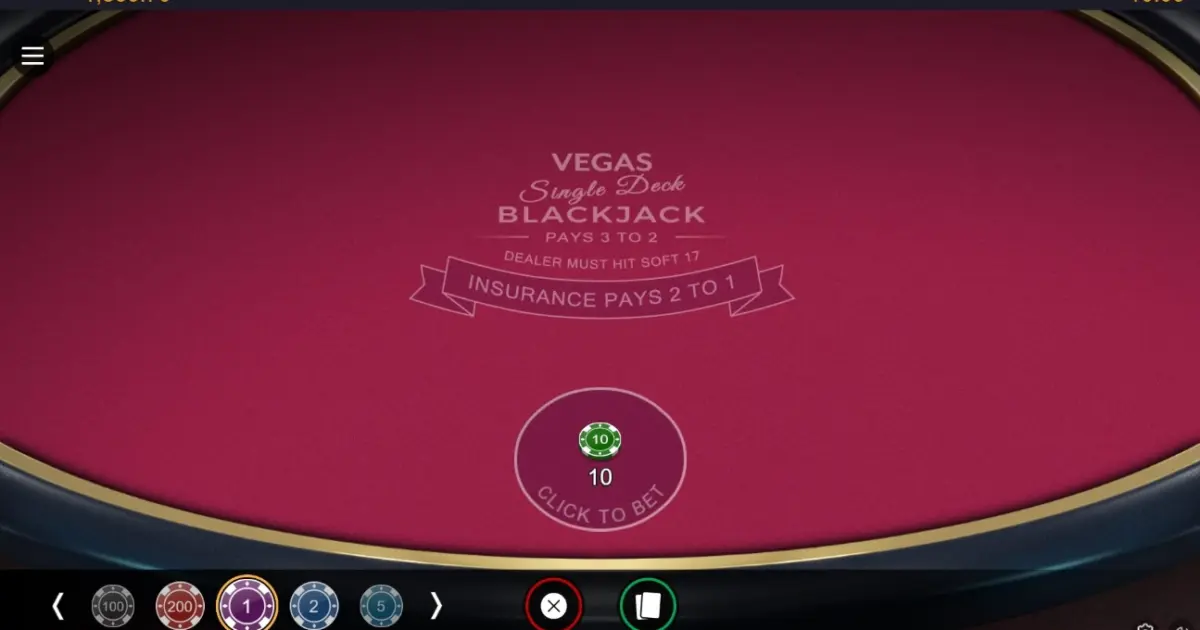
Vegas Single Deck Blackjack from Switch Studios is a table worth your attention, chiefly because of its headline figure: a 99.7% RTP, the second-highest among the provider’s blackjacks and a hair above the corpus average of 99.41%. That number only holds if you play perfect basic strategy on every hand, and the “single deck” label carries rule implications you should verify before betting real money. As a free demo, it is a sensible place to practise that strategy without risking a cent.
How Vegas Single Deck Blackjack plays
This is a standard blackjack table from Switch Studios, a provider known for clean, dependable layouts rather than flash. The base game follows the familiar loop: you get two cards, the dealer gets two, and you decide whether to hit, stand, double or split against the dealer’s upcard. The aim is unchanged — beat the dealer’s hand without going over 21.
Switch Studios publishes the 99.7% return figure, but it does not publish the full rule set for this table, and that matters. The deck count, whether the dealer hits or stands on soft 17, the blackjack payout, and the doubling and splitting rules are all unconfirmed facts. Each of these shifts the house edge by fractions of a percent, so the gap between the advertised RTP and what you actually realise can be larger than you expect.
The good news is that the free demo is available, so you can open the table and read the in-game rules screen before committing anything. That is the single most useful thing you can do here.
| Provider | Switch Studios |
|---|---|
| RTP | 99.7% |
| Free demo | Yes |
Single Deck rules and what the name tells you
The title says “Single Deck,” and that is a strong hint rather than a confirmed rule. In classic single-deck blackjack, fewer decks normally lower the house edge because the player’s advantage from naturals and doubles improves. But the catch is that operators routinely pair single-deck games with rule tweaks that claw that edge back — most damagingly a 6:5 blackjack payout instead of 3:2.
That distinction is critical. A 3:2 payout returns 1.5× your stake on a natural, while 6:5 returns just 1.2×. The switch to 6:5 costs the player roughly 1.4% of the house edge, and it is the single most damaging rule change in blackjack. If this table pays 6:5, the true edge is materially worse than the 99.7% headline suggests.
Note the title says “Vegas,” not “Vegas Strip.” A true Vegas Strip table uses four decks, dealer stands on soft 17, and doubling after split is allowed. The “Single Deck” label here points the other way. The name alone cannot tell you which rules apply, so treat it as a prompt to check the paytable, not as a statement of fact. Switch Studios does not confirm the deck count for this table, and it changes the edge by a few hundredths of a percent either way.
Reading the 99.7% return figure
The 99.7% RTP is the best-known fact about this table, and it deserves a careful reading. RTP is simply 100% minus the house edge, so 99.7% implies a house edge of 0.3% — an excellent figure if you can actually realise it. The catch is that any published RTP assumes perfect basic strategy on every single hand.
Basic strategy is a solved chart, not a system. It tells you the mathematically optimal action for every possible hand against every dealer upcard, and it minimises the house edge without ever eliminating it. A player who deviates — hitting when the chart says stand, or skipping doubles — realises a materially lower return than the published figure. The 0.3% edge is the theoretical floor, not what a casual player should expect.
For context, 99.7% sits above both the corpus average of 99.41% and the provider average of 99.61%. Among Switch Studios blackjacks it is matched by Vegas Strip Blackjack at 99.7%, while Classic Blackjack leads at 99.9%. The figure is genuinely strong — the question is whether the rule set lets you get near it.
Where the house edge actually comes from
House edge in blackjack is built from the rule set, not from luck. The dealer acting last is the core structural advantage: you can bust before the dealer plays, and you lose your stake when you do. Every other rule either adds to or subtracts from that base.
As general rules-of-thumb: a 3:2 blackjack payout is worth roughly 0.6% to the player, and 6:5 turns that into a loss of about 0.8%. Dealer standing on soft 17 helps the player by about 0.2% versus hitting. Fewer decks lower the edge, doubling after split helps, re-splitting aces helps, and late surrender helps. Each change is small, but they compound.
Since Switch Studios does not confirm the rule set for this table, you cannot compute its true edge from the outside. The one thing you can say with certainty is that the 99.7% figure assumes the favourable reading of every unconfirmed rule. A 6:5 payout alone would push the real edge well past 1%.
Side bets deserve a separate mention. If this table offers Perfect Pairs, 21+3 or insurance, treat them as separate games with far higher house edges than the base game. Insurance in particular is a losing bet at standard odds — mathematically it only pays off when the dealer’s hole card is a ten, which happens less often than the premium justifies.
Does card counting work here?
No. This is an RNG table, not a live dealer, and the honest answer is that card counting does not work against a random number generator that reshuffles every hand. Card counting exploits the changing composition of a finite shoe; when every hand is dealt from a fresh, randomised deck, there is no changing composition to exploit.
That removes the only known way to gain a mathematical edge in blackjack. Against an RNG table, your best play is basic strategy executed consistently, which minimises the house edge but never beats it. No system — Martingale, D’Alembert, or any other progression — changes that. Progressions change the shape of your variance, not your expected value. They make losses come in bursts and wins feel smoother, but over time you lose at the same rate.
If counting is your interest, this table is not the venue for it. Treat it as a fixed-odds game where discipline, not cleverness, determines how close you get to the advertised return.
Bankroll and unit sizing
Session variance is the real opponent here. A 0.3% house edge means the casino’s advantage per hand is tiny, but that edge is realised over thousands of hands, not one session. In the short run you can win or lose heavily regardless of how well you play, because variance dominates.
Size your units so that a bad run does not threaten your bankroll. A common approach is to set your session stake at a small fraction of your total bankroll — for example, a unit of 1–2% of your session fund — so that a losing streak of twenty or thirty hands is survivable. The point of unit sizing is not to win, but to keep you at the table long enough for basic strategy to work in your favour over time.
Before you play for money, set a budget you are comfortable losing and treat it as the cost of entertainment. 18+. Blackjack is a game, not an income source, and the house edge guarantees that the casino wins in the long run. Play within your means, and stop when the budget is gone.
Verdict
Vegas Single Deck Blackjack is a strong candidate on paper: a 99.7% RTP, a free demo, and a provider with a solid average of 99.61%. The single unresolved question is the rule set, and the “single deck” name is not enough to answer it. If the table pays 3:2 with favourable rules, it is an excellent game; if it pays 6:5, the real edge is far worse than the headline.
The free demo removes the risk from that uncertainty. Use it to read the rules screen, practise perfect basic strategy, and decide whether the table deserves your money. Compare it against ReDeal Blackjack at 99.6% if you want a different flavour, but the deciding factor here is always the paytable. Verify it, then decide.
Frequently Asked Questions
Can I play Vegas Single Deck Blackjack for free?
Yes, a free demo is available. You can open the table without depositing, read the in-game rules screen to confirm the rule set, and practise basic strategy before risking any money. Demo play does not predict real-money results.
What is the RTP of Vegas Single Deck Blackjack?
Switch Studios lists a 99.7% RTP, implying a 0.3% house edge. That figure assumes perfect basic strategy on every hand, so a casual player realises a materially lower return. The true edge also depends on unconfirmed rules like the blackjack payout.
Does the single-deck name mean a low house edge here?
Not necessarily. Fewer decks normally lower the edge, but operators often pair single-deck games with a 6:5 blackjack payout, which costs the player roughly 1.4%. The name is a hint, not a confirmation — check the paytable before playing for money.
Does card counting work on this table?
No. This is an RNG table that reshuffles every hand, so there is no changing shoe composition to exploit. Card counting fails here, and no betting progression beats the house edge. Consistent basic strategy is the only way to minimise it.
Who makes Vegas Single Deck Blackjack?
Switch Studios is the provider, and it lists 22 blackjack games with an average RTP of 99.61%. This table's 99.7% sits above that average, matched by Vegas Strip Blackjack and just below Classic Blackjack at 99.9%.