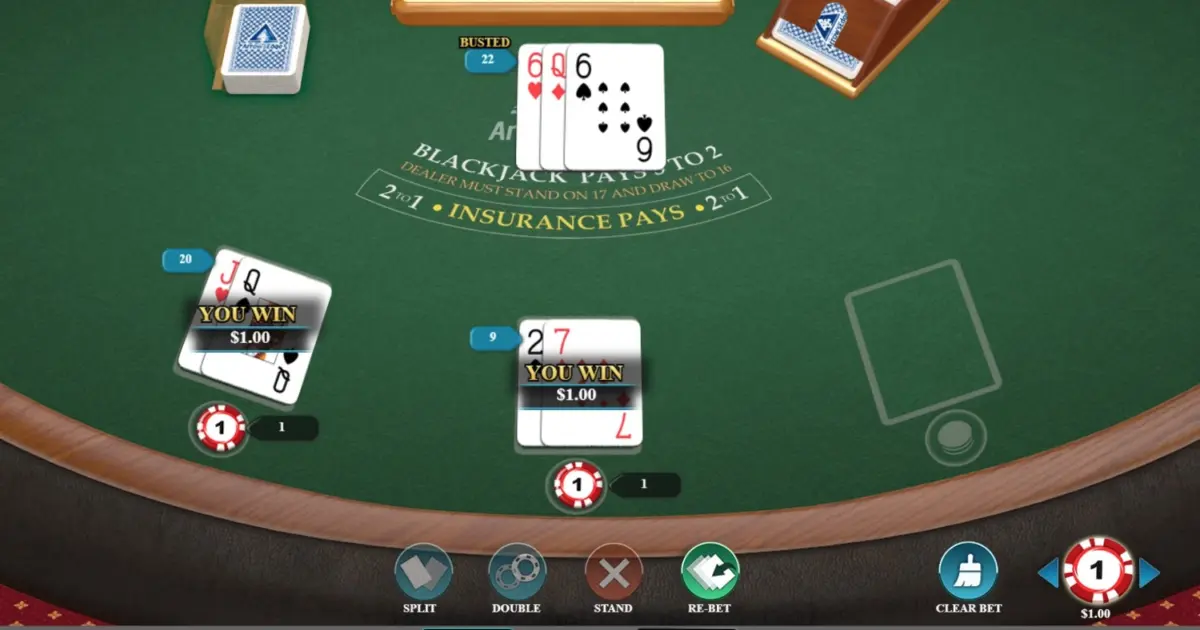
Multihand Blackjack from Arrow’s Edge sits at 99.5% RTP, matching the provider’s other blackjack releases and edging slightly above the 99.41% average across the category. The defining feature is the multi-hand format: you play several hands at once against one dealer hand, which means more decisions per round and faster movement through your session bankroll. If you want higher action density without leaving the blackjack ruleset, this table delivers it. If you prefer a slower pace to think through marginal plays, a single-hand game is the better fit.
Multihand Blackjack and the Arrow’s Edge table range
Arrow’s Edge publishes three blackjack variants, all rated at 99.5% RTP. Alongside Multihand Blackjack you will find Single Deck Blackjack (Arrows Edge), which uses one deck and changes the composition-dependent edge on certain hands, and Perfect Pairs Blackjack, which adds a side bet on matching card ranks or suits. The 99.5% figure for all three tables suggests a common rule foundation with tight dealer and player options, though Arrow’s Edge does not publish full rule sheets in most casino lobbies. The multi-hand mechanic on this table does not alter the mathematical edge per hand; it multiplies the number of hands you resolve in a given span of time, which increases total money at risk and accelerates both winning and losing streaks within a session.
The 99.5% figure, and the assumption behind it
The published 99.5% RTP translates to a house edge of 0.5%, and that figure assumes you play perfect basic strategy on every decision: hit, stand, double and split according to the solved chart for the rule set in force. Any deviation from basic strategy—standing on 16 against a dealer 7 because you “feel” a bust coming, or doubling soft 18 against a 10 when the chart says stand—hands back edge to the house. Casual players who rely on intuition or simplified rules of thumb typically realize an RTP several percentage points lower than the published figure. The 99.5% number is not a promise; it is the ceiling you approach as your play approaches perfection. For context, blackjack tables in the wider catalog range from around 99.0% up to 99.65%, depending on deck count, blackjack payout ratio, whether the dealer hits or stands on soft 17, and availability of surrender and double-after-split. A half-point edge places this table in the middle of that range—not the absolute tightest variant available, but comfortably better than 6:5 blackjack or tables that force unfavorable doubling restrictions.
| Attribute | Value |
|---|---|
| RTP | 99.5% |
| House Edge | 0.5% |
| Provider | Arrow’s Edge |
| Format | Multi-hand |
| Free Demo | Available |
Rules to confirm before you bet real money
Arrow’s Edge does not publish the full rule matrix for Multihand Blackjack in most partner casinos, so you must open the game’s own rules or paytable screen before wagering real money. The items that matter most to the house edge are the blackjack payout ratio (3:2 is standard; 6:5 adds roughly 1.4 percentage points to the house edge and is the single most damaging rule change you can encounter), whether the dealer hits or stands on soft 17 (hitting soft 17 costs the player about 0.2%), the number of decks in the shoe (fewer decks favor the player by a few hundredths of a percent per deck removed), and whether you can double after splitting, re-split aces, or take late surrender. Each of these rules shifts the edge by tenths or hundredths of a percent, and together they determine whether the 99.5% figure holds or not. The multi-hand format itself does not change any of these rules or the edge; it simply allows you to wager on multiple boxes simultaneously, so the combined exposure per round is higher than at a single-hand table. Check the in-game paytable for confirmation, and walk away from any table offering 6:5 blackjack or restricting doubles to hard 9–11 only.
Strategy: the chart, not a system
Basic strategy is a solved chart that tells you the mathematically optimal play for every combination of your hand and the dealer’s upcard, given the rules in force. It is not a betting progression, not a hunch, and not a system for predicting which cards are due. The chart minimizes the house edge; it does not eliminate it. You will still lose hands, and you will still finish some sessions down, because the edge remains with the house on every hand. What basic strategy does is ensure you are not giving away additional edge through incorrect play. Learning the full chart takes a few hours of study; simplified versions that cover the most common decisions will get you most of the way there. At a multi-hand table the chart applies independently to each hand you are playing, but the dealer’s upcard is shared, so if you are playing three hands against a dealer 6, you stand on all three 12s rather than hitting. The increased decision volume at a multi-hand table makes memorizing basic strategy more valuable, because each mistake is multiplied across your boxes. Card counting does not work at an RNG table that reshuffles after every round, so do not waste time tracking cards; the penetration is zero and the deck composition resets before you can gain an edge.
Variance at the blackjack table
Blackjack carries lower variance than slots, but the swings over a session are still material, especially at a multi-hand table where you are resolving several hands per round. Over a few dozen rounds you can easily see swings of twenty or thirty units in either direction, even with perfect basic strategy. The RTP is a long-run expectation: over tens of thousands of hands your results will converge toward 99.5%, but in a single session of a few hundred hands the actual return can land well above or below that figure. The multi-hand format amplifies variance in both directions because you are wagering more per round. If you play three hands at once, you are putting three units at risk each round, so a run of dealer 20s or blackjacks will deplete your bankroll three times as fast as it would at a single-hand table, and a favorable run will build it three times as quickly. Unit sizing matters: a common guideline is to keep each hand’s wager at one to two percent of your total session bankroll, so if you are playing three hands at once, the combined exposure per round should not exceed six percent of your budget. Betting progressions—doubling after a loss, raising after a win—do not change the house edge; they reshape the variance and can blow through your budget faster if you hit a bad run early. Set a loss limit before you start, and walk away when you reach it.
Free play first
Multihand Blackjack is available in free-demo mode, and it is the correct place to start if you have not played a multi-hand table before. The demo uses the same RNG and the same rules as the real-money version, so you can confirm the rule set from the paytable, practice managing several hands at once, and verify that your basic-strategy decisions are landing correctly without risking your bankroll. Demo results do not predict real-money outcomes—the RNG does not “pay back” after a demo loss, and it does not tighten after a demo win—but the practice is valuable for building fluency with the chart and for understanding how quickly a multi-hand session moves through your stack. If you choose to play for real money, set a budget in advance, treat it as the cost of entertainment rather than a path to income, and never chase losses by increasing your unit size mid-session. Blackjack is a negative-expectation game; the house edge is small, but it is present on every hand, and no amount of skill or discipline will turn it positive at an RNG table. Only play with money you can afford to lose, take breaks, and use deposit limits and session timers if your casino offers them. 18+ only.
Who this table is for
Multihand Blackjack suits players who want more action per round without switching games, and who have the bankroll to support multiple simultaneous wagers. If you know basic strategy and want to play several hundred decisions in a short session, the multi-hand format delivers exactly that. If you are still learning the chart or prefer a methodical pace that lets you think through each decision, Classic Blackjack or another single-hand variant is a better starting point. The 99.5% RTP is competitive but not exceptional; you will find tighter edges at single-deck or European no-hole-card tables with favorable rules, but you will also encounter far worse at 6:5 games or tables with restrictive doubling. Arrow’s Edge does not publish granular rule details in most lobbies, so this table is best suited to players who are comfortable checking the in-game paytable and walking away if the rules are unfavorable. If you value transparency and want every rule spelled out before you click through, a provider that publishes full rule sheets—such as NetEnt or Microgaming—will save you the guesswork.
Frequently Asked Questions
Is Multihand Blackjack available in free demo mode?
Yes, Arrow's Edge offers Multihand Blackjack in free-demo mode. The demo uses the same RNG and rule set as the real-money version, so you can confirm rules from the in-game paytable, practice managing multiple hands simultaneously, and verify your basic-strategy decisions without risking your bankroll before committing real money.
What RTP can I expect from Multihand Blackjack and does it require perfect play?
The published RTP is 99.5%, which translates to a 0.5% house edge. That figure assumes you play perfect basic strategy on every hand: hitting, standing, doubling and splitting according to the solved chart. Any deviation from optimal play lowers your realized return, often by several percentage points for casual players relying on intuition.
Does card counting work on this multi-hand blackjack table?
No. Multihand Blackjack uses an RNG that reshuffles after every round, so deck penetration is zero and card composition resets before you can gain any edge. Card counting requires a physical shoe with meaningful penetration before the cut card; it is mathematically useless against an RNG table regardless of how many hands you play.
How does the multi-hand format affect my bankroll and session variance?
Playing multiple hands simultaneously multiplies your stake per round, which accelerates both winning and losing streaks. If you play three hands at once, you put three units at risk each round, so a bad run depletes your bankroll three times as fast as a single-hand game. A common guideline is to keep total exposure per round at or below six percent of your session budget.
How does Multihand Blackjack compare to Single Deck Blackjack from the same provider?
Both tables from Arrow's Edge publish 99.5% RTP, but Single Deck Blackjack (Arrows Edge) uses one deck, which alters composition-dependent strategy decisions on certain hands and typically offers a slightly lower house edge when other rules are equal. Multihand Blackjack lets you play several hands per round, raising action density but not the per-hand edge; single-deck plays one hand at a time with different removal effects.




