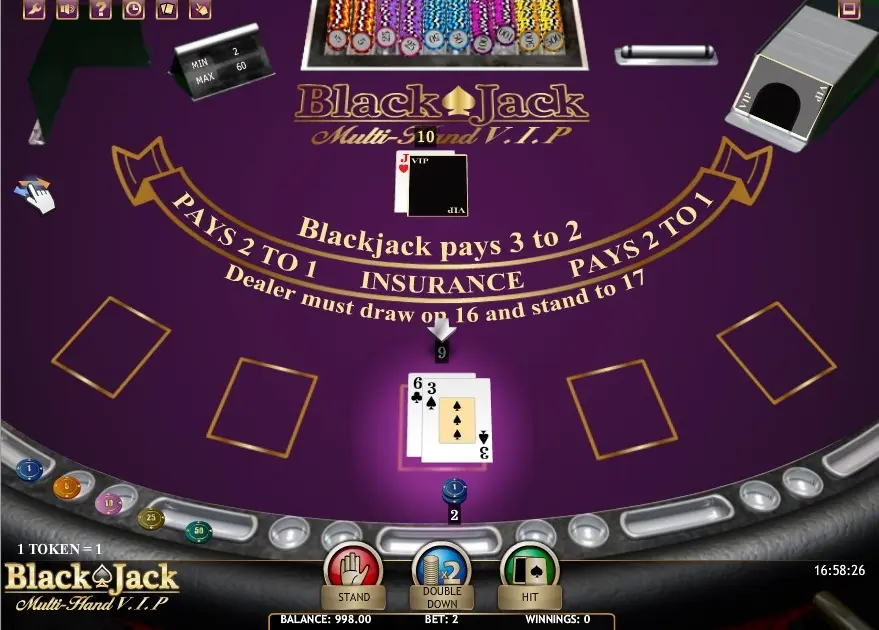
Blackjack Multihand VIP sits at 99.5% RTP, which places it among the fairest blackjack tables you can find online. That figure assumes flawless basic strategy on every decision across every hand you play; casual play or gut-feel moves will lower your realized return materially. The multi-hand format means you are betting several units per round against a single dealer hand, so your hourly stake exposure and short-term variance both climb steeply compared to single-hand tables. The VIP designation signals a much higher table minimum, so this is a session for players who know basic strategy cold and have the bankroll to support sustained multi-hand action.
Is Blackjack Multihand VIP a fair table?
The 99.5% RTP translates to a house edge of 0.5%, which is excellent and sits 0.09 percentage points above the blackjack average across this corpus. That edge holds only if you make the mathematically correct play on every hand: hit 16 against a dealer 10, split 8s against a 7, double 11 against a 6, and so on. Every deviation from the basic strategy chart costs you a slice of expected value, and over time those slices add up. A recreational player who stands on 12 against a dealer 3, takes insurance at standard odds, or doubles soft 18 against a 9 will see a realized return closer to 98% or lower.
The multi-hand mechanic does not change the per-hand mathematics, but it does change your exposure. Playing three hands per round at £10 each means you are putting £30 into action every deal, and your win rate in pounds per hour scales directly with the number of hands. Variance climbs too: a dealer blackjack wipes all your hands at once, and a bad run hits harder when you have three or five spots in play. If you are comfortable with basic strategy and have sized your session bankroll to cover the swings, the 99.5% RTP makes this table a sound choice.
iSoftBet and this table
iSoftBet offers two blackjack tables in total, and both sit at the top of the RTP range: the provider’s average blackjack RTP is 99.45%, a touch above the category norm. The studio is better known for slots, so the blackjack catalogue is small and focused. If you want to compare rule sets within the same stable, Blackjack (iSoftBet) returns 99.4% and offers a standard single-hand format with a lower minimum stake, making it the natural fallback if the VIP limits or multi-hand volatility are too steep for your session budget.
iSoftBet does not publish every rule detail for this table—deck count, whether the dealer hits soft 17, the exact blackjack payout ratio, and surrender availability are not disclosed in the public spec sheet—so you should check the in-game rules screen before you commit real money. Those missing details matter: a 6:5 blackjack payout instead of 3:2 costs you roughly 1.4% and would make the stated 99.5% RTP impossible, so the payout here is almost certainly 3:2, but confirmation is always better than inference.
Rule set: what the title implies
The “Multihand” label tells you that you can play multiple hands simultaneously against one dealer hand, typically between two and five boxes per round. Each hand plays independently—your 18 on box one does not affect whether you hit 14 on box two—but they all resolve against the same dealer upcard and final total. This format is popular with players who want more decisions per shoe and are willing to accept the higher variance and faster bankroll turnover that come with it.
The “VIP” designation normally means a higher table minimum and maximum, sometimes tenfold or more compared to the standard version. The rule set itself—deck count, double-down restrictions, dealer soft-17 behavior—is usually identical to the base table; you are paying for higher limits, not better odds. iSoftBet has not published the exact limits for this table, so check the betting panel when you load the game. If the minimum is outside your comfortable unit size, Multihand Blackjack from another provider may offer the same multi-hand format with a lower entry point.
Without confirmed details on deck count, soft-17 rules, or whether you can double after split, treat the 99.5% RTP as the headline figure and verify the specifics in-game. A six-deck shoe with dealer standing on soft 17 and standard 3:2 blackjack payout would deliver an edge very close to 0.5%, so the title and RTP are consistent, but assumptions are not facts.
The maths of a blackjack hand
Blackjack is a solved game. Basic strategy is not a system or a progression; it is a lookup chart built by running every possible hand against every dealer upcard through millions of simulations. The chart tells you the play that loses you the least money in the long run—or wins you the most—on every decision. Hit 16 against a 10 because you lose less often than you do by standing. Double 11 against a 6 because the extra bet pays off more often than a simple hit. Split 8s against a 7 because two hands starting with 8 have better equity than one hand starting with 16.
The house edge exists because the player acts first, and when you bust, you lose immediately even if the dealer busts afterward on the same round. That sequencing quirk is worth about 8% to the house before any other rules are applied. The 3:2 payout on a natural blackjack, the ability to double and split, and the fact that the dealer must hit 16 and stand on 17 with no discretion all give equity back to the player. The net result, assuming perfect basic strategy, is a house edge somewhere between 0.3% and 0.7% depending on the rule set. This table lands at the favorable end of that range.
Card counting does not work against an RNG-shuffled table that resets the deck after every hand. Counting relies on deck composition memory—tracking which cards have been removed so you know when the remaining shoe is rich in tens and aces—and that memory is erased every round in an online game. No count, no edge. Basic strategy is the only tool that applies here, and it works on every hand regardless of what came before.
Common mistakes that cost you the edge
Insurance is offered when the dealer shows an ace, and it pays 2:1 if the dealer has a ten in the hole for blackjack. At standard odds, insurance is a losing bet. Roughly 30.8% of the unseen cards are tens in a full shoe, so you win the insurance wager less than one time in three, but you need to win more than one time in three for a 2:1 payout to break even. Over time, taking insurance at 2:1 costs you money. The only exception is when you are counting and the true count is high enough to shift the ten density above the breakeven threshold, and that does not happen in an RNG game.
Deviating from basic strategy because a hand “feels” wrong is the fastest way to inflate the house edge. Standing on 16 against a dealer 10 because you are scared of busting feels safer, but the maths says you lose less often by hitting. Doubling soft 18 against a dealer 6 looks aggressive, but it is the correct play because the dealer busts often enough from 6 to make the extra bet profitable. Every gut-feel override costs you expected value, and those costs compound over a session.
Side bets such as Perfect Pairs or 21+3 carry house edges far above the 0.5% on the main game, often in the 3% to 8% range depending on the paytable. They add entertainment and the chance of a bigger single-hand payout, but they are not a sound long-term bet if you are trying to minimize the house advantage. If you play them, treat them as the price of variety, not a path to profit. The same logic applies to every hand: the main bet at 99.5% RTP is the best value on the table, and everything else is a higher-priced sideshow.
Trying it free first
Blackjack Multihand VIP is available in free demo mode, and that is the right place to start if you have not played a multi-hand table before or want to test your basic strategy recall without stake pressure. The demo uses the same RNG and rule set as the real-money version, so the dealing patterns and hand frequencies are identical; the only difference is that demo results do not predict your real-money outcomes on any individual session, because each round is an independent random event.
Use the demo to get comfortable with the speed of multi-hand play. Managing three or four decision points per round is more cognitively demanding than single-hand blackjack, and mistakes are easier to make when you are splitting one hand, doubling another, and standing a third all in the same deal. Practice until the basic strategy plays feel automatic, then move to real money with a session budget you have set in advance and are comfortable losing. Blackjack is entertainment with a cost, not an income source, and even a 99.5% RTP means the house wins more often than you do over time.
Set a budget before you start, treat any session as entertainment spend rather than investment, and stop when the budget is gone. If you are chasing losses or playing beyond your means, step back. Gambling is for players aged 18 and over, and it should always stay within limits you control.
Final take on Blackjack Multihand VIP
Blackjack Multihand VIP delivers a house edge of 0.5% under perfect basic strategy, which makes it one of the fairest tables in the iSoftBet catalogue and a solid choice for players who know the correct play on every hand. The multi-hand format raises variance and hourly exposure, so this is not a casual session table; it is built for players who are comfortable with higher stakes, sustained concentration, and the bankroll swings that come with playing multiple boxes per round. The VIP minimum will lock out smaller budgets, and the lack of published detail on deck count, soft-17 rules, and surrender means you need to check the in-game rules before you commit real money.
If you are confident with basic strategy and have the bankroll to support multi-hand action at VIP limits, the 99.5% RTP makes this table worth your time. If the stakes are too high or you want to compare rule sets, Classic Blackjack or American Blackjack offer similar RTP figures at more accessible limits. Play the demo first, confirm the rules, and bring a strategy chart until every play is second nature.
| Attribute | Value |
|---|---|
| RTP | 99.5% |
| House Edge | 0.5% |
| Provider | iSoftBet |
| Format | Multi-hand, VIP limits |
| Free Demo | Yes |
| Provider Avg RTP | 99.45% |
| Category Avg RTP | 99.41% |
Frequently Asked Questions
Can I play Blackjack Multihand VIP for free before I bet real money?
Yes, the table is available in free demo mode with the same rules and RNG as the real-money version. Use it to practice multi-hand play and basic strategy without stake pressure, but remember that demo results do not predict future real-money outcomes because every round is an independent random event.
What RTP does Blackjack Multihand VIP actually deliver, and does it depend on how I play?
The published RTP is 99.5%, which translates to a 0.5% house edge, but that figure assumes you make the mathematically correct play on every hand using basic strategy. Recreational play with gut-feel decisions, taking insurance, or misplaying soft hands will lower your realized return to 98% or less over time.
Does card counting work on this table, or is there a system that beats the house edge?
No. This is an RNG table that reshuffles after every hand, so card counting has no edge because there is no deck memory to exploit. Basic strategy minimizes the house edge to 0.5%, but no betting progression or system can eliminate it, and no hand is ever "due" after a run of losses.
How does the multi-hand format affect my bankroll and variance compared to single-hand blackjack?
Playing multiple hands per round multiplies your stake exposure and variance. Three hands at £10 each puts £30 into action per deal, tripling your hourly spend and increasing short-term swings. A dealer blackjack or a bad run hits all your hands at once, so you need a larger session bankroll to absorb the volatility than you would for single-hand play at the same unit size.
What does the VIP designation mean, and how does Blackjack Multihand VIP compare to standard iSoftBet blackjack?
VIP normally signals a much higher table minimum and maximum with the same underlying rules, so you are paying for bigger limits rather than better odds. iSoftBet's standard single-hand table returns 99.4% RTP with lower stakes, making it a better fit if the VIP minimum exceeds your comfortable unit size or you want to avoid multi-hand variance.




