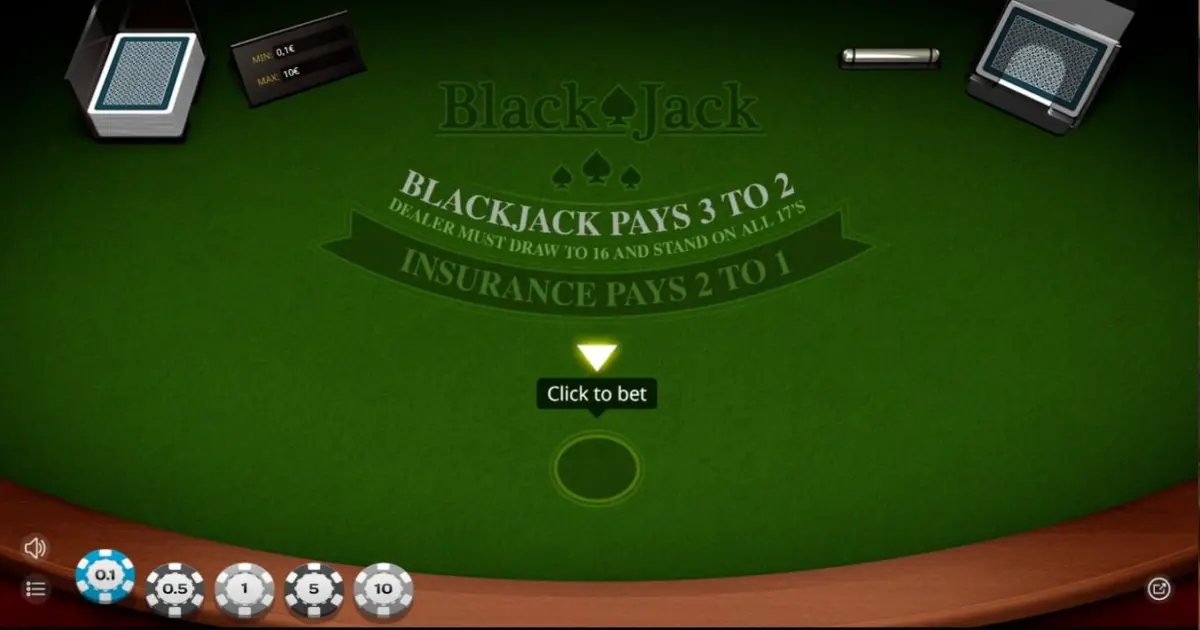
Blackjack (iSoftBet) is a competent RNG blackjack table whose 99.4% published RTP places it within a whisker of the market average. The main question for a maths-literate player is not whether the return is competitive — it is — but whether you can confirm the specific rules before sitting down, because iSoftBet does not publish them in its game metadata here.
Blackjack (iSoftBet) and the iSoftBet table range
iSoftBet currently offers two blackjack titles through this review platform, and the provider’s average published RTP across those two sits at 99.45%. That is an impressively tight spread: this table and its sibling differ by only five hundredths of a percent. If you want to compare the other one directly, Blackjack Multihand VIP reports a 99.5% RTP and lets you play several hands simultaneously, which changes the pace of your session without changing the per-hand edge.
With only two titles in the range, there is no pattern of rule innovation here to study — iSoftBet is not a provider that publishes a dozen variants with different surrender or doubling structures. You get what you get, and the onus falls on you to read the in-game rules screen carefully before you decide whether either table suits your preferences.
The 99.4% figure, and the assumption behind it
Every published blackjack RTP assumes perfect basic strategy on every hand. A 99.4% return implies a house edge of 0.6%, which is competitive for a RNG table — roughly in line with what you would expect from a four-to-six-deck game with dealer standing on soft 17 and standard doubling rules. The moment you deviate from the chart, the realised return drops. In practice, a casual player who makes a handful of errors per shoe might see a return closer to 97% or even lower depending on the mistake rate.
Against the corpus average of 99.41%, this table’s 99.4% is almost exactly at the market midpoint. You are not getting a structural advantage here, nor are you being short-changed. The figure is unremarkable in the best sense: it tells you the game is operating normally and that your own decisions will dominate the outcome.
Rules to confirm before you bet real money
Here is the critical gap: the game’s metadata does not specify the deck count, whether the dealer hits or stands on soft 17, the blackjack payout ratio, whether double-after-split is permitted, whether re-splitting aces is available, or whether late surrender is offered. Each of these rules moves the house edge by a measurable amount:
- A 6:5 blackjack payout instead of 3:2 costs roughly 1.4% of expected value — by far the largest single rule change a player can face. Confirm the payout ratio before you deposit.
- Dealer hitting on soft 17 rather than standing adds approximately 0.2% to the house edge.
- Fewer decks reduce the house edge, but only when the game compensates elsewhere. A single-deck table with dealer hitting soft 17 can still be worse than a six-deck stand-soft-17 game.
- Double-after-split and re-splitting aces each shave a few hundredths of a percent in the player’s favour when available.
- Late surrender is worth roughly 0.07% to the player and is almost never offered on RNG tables.
All of this means one thing operationally: open the game’s built-in rules or paytable screen and verify each of these before you place a real-money bet. A 99.4% headline figure is meaningless if the underlying rules are worse than you assumed.
Strategy: the chart, not a system
Basic strategy is a solved mathematical result — a fixed lookup table that tells you the highest-expected-value action for every player-dealer card combination. It minimises the house edge; it does not eliminate it. No deviation from the chart improves long-run results, regardless of how intuitive it feels in the moment.
If you are looking for a system that converts a negative-expectation game into a positive one, none exists. Betting progressions such as Martingale or D’Alembert redistribute the shape of your session variance — you will experience smaller, more frequent losses interspersed with occasional wins — but they do not alter the expected value. The house edge remains identical on every hand you play.
Card counting, which does shift the player’s edge in a live shoe game where penetration is deep enough, is completely ineffective against an RNG table that reshuffles after every hand. Each deal is statistically independent, so there is no running count to exploit. This is not a limitation of your skill — it is a structural property of the game.
Variance at the blackjack table
Blackjack has moderate session variance compared to slots, but “moderate” is relative. A single hand can be worth two units of swing when you double or split, and a blackjack pays a bonus on top. Over a short session of fifty to one hundred hands, you can easily be up or down several buy-ins purely by luck even if you play the chart perfectly.
The practical implication is simple: size your bets so that a reasonable losing streak does not exhaust your bankroll before the variance mean-reverts. A common guideline is to keep individual bets at 1-2% of your session bankroll, which gives you enough hands to encounter a representative sample of outcomes. If you find yourself increasing bet size after losses to “recover,” stop and reset — that behaviour is the progression trap in action.
Free play first
This table is available in a free demo mode, and that is exactly where you should start. Use the demo to verify the rules: deal enough hands to observe whether the dealer hits soft 17, whether blackjack pays 3:2, how many cards are visible before the shoe reshuffles, and whether the side-bet menu exists at all. The demo teaches you the rules structure, which is information you need before any real-money decision.
One important caveat: demo play does not predict your real-money results. You will not experience the emotional pressure of betting actual funds, so your decision quality in the demo is not representative of your live-session performance. Treat the demo as a rules-confirmation tool, not as a rehearsal that will carry over.
This is entertainment, not income. Set a budget before you play for money, stick to it, and treat any winnings as a windfall rather than a target. If you are 18 or over and gambling is causing stress or financial pressure, step back and seek support — every licensed jurisdiction provides free helplines for exactly this purpose.
Who this table is for
Blackjack (iSoftBet) suits a player who wants a straightforward RNG blackjack game without extra bells — no multi-hand layout, no exotic side-bet structure advertised in the metadata — and who is willing to verify the rules independently before committing funds. The 99.4% RTP is adequate but not a differentiator; it tells you the game is fair in the narrow sense that it is not rigged beyond the standard house edge.
If the provider’s two-game range feels too thin, the broader market offers alternatives worth exploring. American Blackjack publishes a 99.5% RTP and is one of the most-played tables in the corpus at rank level far above this one. For players who prefer fewer decks and are willing to accept a slightly lower published return, Classic Blackjack at 99.28% RTP is worth a look for its simpler structure.
The table below summarises what the metadata does tell you:
| Metric | Value |
|---|---|
| Published RTP | 99.4% |
| Implied house edge (perfect play) | 0.6% |
| Provider average RTP | 99.45% |
| Corpus average RTP | 99.41% |
| Market rank | 11 |
| Popularity percentile | 92.5 |
| Free demo | Available |
Everything that matters strategically — the deck count, the soft-17 rule, the payout ratio — is absent from this summary. That absence is itself the most important data point in this article.
Frequently Asked Questions
Can I play Blackjack (iSoftBet) for free?
Yes, the demo is available on this site. It lets you deal hands without risking real money, which is useful for confirming the rule set — deck count, blackjack payout, soft-17 behaviour — before you ever place a real-money wager. The demo does not predict your live-session performance because it lacks the psychological pressure of actual funds on the line.
What does the 99.4% RTP figure mean in practice?
It means the house edge is 0.6% under perfect basic strategy on every hand. If you make errors — hitting a hard 16 against a dealer 6, or splitting tens — your realised return will be materially lower. The 99.4% number is a theoretical ceiling that your actual play will fall short of unless you follow the chart without exception.
How does the house edge at this table compare to other blackjack games?
With a published RTP of 99.4%, the implied house edge of 0.6% sits almost exactly at the corpus average of 99.41%. The provider's own average is 99.45%, meaning this table is fractionally below its sibling Blackjack Multihand VIP. None of these differences are large enough to overcome rule gaps you might encounter in the in-game settings.
Does card counting work at Blackjack (iSoftBet)?
No. This is an RNG table that reshuffles the virtual deck after each hand, so every deal is statistically independent. There is no shoe penetration, no running count, and no deck composition you can track over time. Card counting requires a physical shoe with meaningful penetration, which no RNG game can replicate regardless of the deck count it claims.
How does this table compare to Classic Blackjack or American Blackjack?
Classic Blackjack publishes 99.28% RTP — about twelve hundredths of a percent lower than this table. American Blackjack publishes 99.5% — one tenth of a percent higher. Those differences are small in isolation, but combined with unverified rule sets, they are not a reliable basis for choosing one table over another. Always read the in-game rules before deciding.




