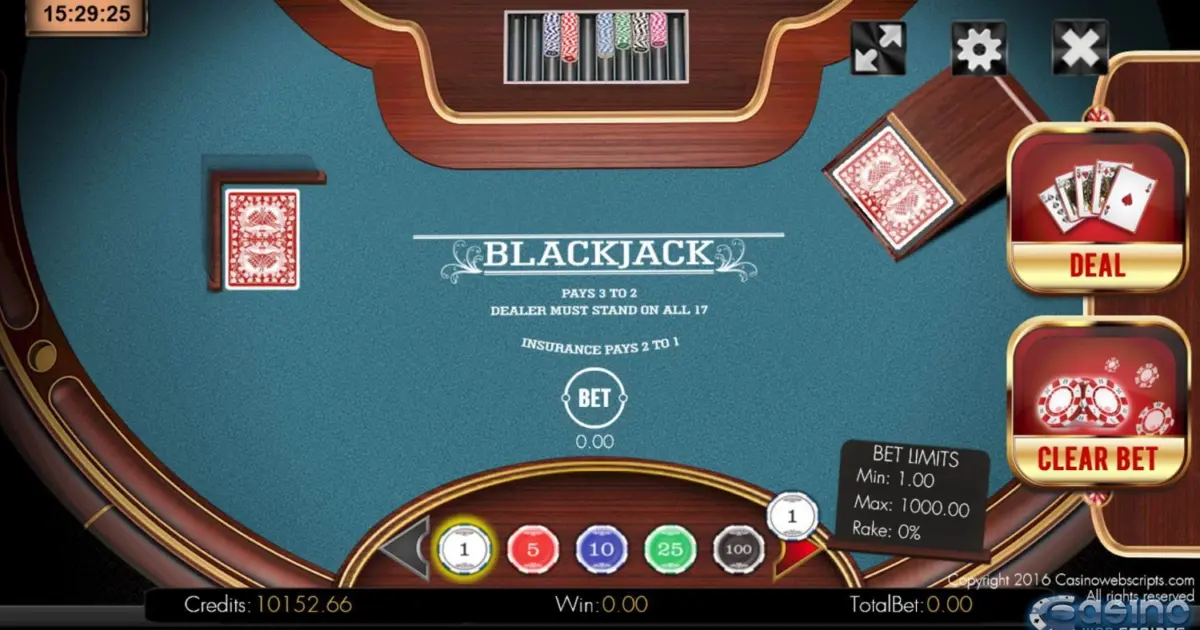
BlackJack 21 Classic sits at 99.64% RTP, which translates to a 0.36% house edge when you play perfect basic strategy on every hand. That figure places it marginally above the 99.41% corpus average for blackjack tables and signals that Casino Web Scripts has implemented a rule set without the punishing variants that inflate the edge. The “Classic” designation suggests baseline rules rather than exotic twists, making this a sensible starting point if you want your strategy chart to match the table without constant adjustments.
Casino Web Scripts publishes eight blackjack tables, averaging 98.86% RTP across the range. BlackJack 21 Classic is their highest-returning standard offering, sharing the 99.64% mark with BlackJack 21 3D Dealer. For context, BlackJack 21 FaceUp 3D Dealer sits at 99.61%, while their Ultimate variant drops to 96.54%. The consistency at the top end of their range suggests deliberate design rather than configuration drift.
| Attribute | Value |
|---|---|
| RTP | 99.64% |
| House Edge | 0.36% |
| Provider | Casino Web Scripts |
| Free Demo | Yes |
| Popularity Percentile | 61.7 |
What kind of blackjack is BlackJack 21 Classic?
The title signals a classic rule set, which in blackjack terminology means the baseline configuration most strategy charts assume: dealer stands on all 17s, 3:2 blackjack payout, standard doubling and splitting permissions, and no gimmicks. Classic does not guarantee those rules, but it strongly implies them. The 99.64% RTP supports that interpretation—a figure this favorable requires multiple player-friendly rules working in concert. A 6:5 blackjack payout alone would cost roughly 1.4 percentage points and push the RTP well below 98.5%, so that rule is almost certainly absent here.
Casino Web Scripts does not publish granular rule details in their marketing materials, so you must verify deck count, surrender availability, and double-after-split permissions in the game’s own paytable before playing for money. The name indicates a classic configuration, which normally means six or eight decks with dealer standing on soft 17, but treat that as a working assumption rather than confirmed fact. If you are accustomed to Classic Blackjack or similar tables, the strategy adjustments here should be minimal, but always check the rules screen on first load.
Return to player: 99.64%
An RTP of 99.64% assumes you execute perfect basic strategy on every decision—hit, stand, double, split—without deviation. Basic strategy is a solved chart, not a heuristic, and it minimises the house edge by dictating the mathematically optimal play for every possible hand versus every dealer upcard. The published RTP is a long-run statistical expectation, not a session guarantee. A casual player who hits 16 versus a dealer 7, stands on 12 versus a 3, or takes insurance will realise a materially lower return, often several percentage points worse.
The 0.36% house edge means the casino expects to retain 36 cents per hundred dollars wagered over millions of hands. Short sessions produce wild variance around that mean. You can lose ten hands in a row or win eight of ten; neither outcome invalidates the maths. If you play a few hundred hands with correct strategy, your results will cluster somewhere near the expected value, but the confidence interval remains wide. Demo play and real-money play share the same RNG and the same probabilities, so practice mode is a valid environment to drill your strategy chart before committing funds.
Deck count, dealer rules and the payout that matters most
Casino Web Scripts does not specify the number of decks for this table. Deck count matters: single-deck blackjack with otherwise identical rules yields a house edge around 0.15%, while an eight-deck shoe pushes it toward 0.65%. The 0.36% edge here suggests somewhere between four and six decks, but that is inference, not confirmation. Check the in-game rules display.
The blackjack payout is the single most consequential rule at any table. A natural blackjack paying 3:2 is the standard that all strategy analysis assumes. A table that pays 6:5 on blackjack—often marketed as “single deck” to distract from the payout—costs the player roughly 1.4 percentage points and turns a favorable game into a poor one. The 99.64% RTP here is impossible with a 6:5 payout, so you can be confident this table pays 3:2. That said, verify it in the paytable before your first hand.
Whether the dealer hits or stands on soft 17 shifts the edge by about 0.2%. Dealer standing on all 17s favors the player and is the more common rule at tables labeled “classic.” Again, the high RTP supports that interpretation, but the provider does not confirm it in writing. The same caution applies to double-after-split, resplitting aces, and late surrender: these are valuable player options, and their presence or absence changes optimal strategy in specific situations.
Playing your first ten hands
Load the free demo and play ten hands with a printed basic strategy chart beside you. Do not rely on intuition or patterns you think you see. On your first hand, if you are dealt 16 versus a dealer 10, the chart says hit. It feels wrong—16 busts on any card above 5—but standing loses more often in the long run. If you hold 11 versus a dealer 6, double down if the table permits it; if you cannot double, hit. These plays are counterintuitive, and that is exactly why a chart exists.
Splitting pairs trips up casual players. Always split aces and eights. Never split tens, no matter what the dealer shows; two hands of 10 are weaker than one hand of 20, and the maths is not close. Split nines versus dealer 2 through 9, except when the dealer shows 7—the reasoning involves the dealer’s bust probability, and it is worth memorising. If the table allows resplitting, the optimal play sometimes changes; check your chart.
Insurance is offered when the dealer shows an ace. At standard 2:1 odds, insurance is a losing bet unless you are counting cards and know the deck is rich in tens. This is an RNG table that reshuffles after every hand, so the deck composition never favors the player. Card counting does not work here. Decline insurance every time, even when you hold a strong hand. The two bets are independent, and insuring a 20 does not “protect” it—it simply adds a negative-expectation side wager to a winning main bet.
Side bets: the maths behind the temptation
Casino Web Scripts does not list which side bets, if any, are available on BlackJack 21 Classic. The most common are Perfect Pairs, which pays if your first two cards match in rank or suit, and 21+3, which forms a poker hand from your two cards and the dealer’s upcard. Both carry house edges between 3% and 7%, depending on paytable and deck count—an order of magnitude worse than the 0.36% edge on the base game.
Side bets are designed to lose money faster. The high payouts on rare outcomes—25:1 for a suited pair, for example—do not compensate for the frequency with which you lose the wager entirely. If you place a one-unit side bet on every hand alongside a one-unit main bet, you are doubling your total action while accepting a blended house edge above 1.5%. That erases the benefit of the favorable base-game rules and accelerates bankroll depletion.
If side bets are present and you choose to play them, treat them as entertainment with a known cost. Do not increase side-bet stakes to chase losses, and do not convince yourself a pair is “due” after a long streak without one. Each hand is independent. The RNG does not compensate. For comparison, Multihand Blackjack at 99.5% RTP offers similar base-game value without the side-bet distraction, though it introduces the complexity of managing multiple hands simultaneously.
Session limits and bankroll
A 0.36% house edge is among the lowest in the casino, but it is not zero. Over 500 hands at ten dollars per hand—a moderate evening session—the expected loss is eighteen dollars. Variance will push your actual result higher or lower, sometimes by a wide margin. A string of dealer blackjacks or a run of doubled hands that lose can cost you two or three times the expectation in a single session. That is not the RNG malfunctioning; it is the normal distribution of outcomes around a negative mean.
Set a loss limit before you start, and set it at a figure that does not change your week if you hit it. A common heuristic is fifty times your base unit: if you are betting five dollars per hand, bring 250 dollars and stop when it is gone. That stake gives you enough hands to see some reversion to the mean without risking money you need for rent. If you double your buy-in, consider stopping—variance gave you a favorable run, and the house edge will reassert itself over time. Never chase losses with bigger bets. A Martingale or any other progression changes the shape of your risk, not the expected value, and a bad run will exhaust your bankroll before the system “works.”
Blackjack is entertainment, not income. The edge is against you on every hand, and no combination of bet sizing, intuition, or pattern recognition changes that. Play for the decision-making, not the profit. Set a budget in advance, treat it as the cost of the session, and walk away when it is gone. If you find yourself playing beyond your limit, or returning after a loss to “win it back,” step back. Help is available at BeGambleAware or the National Council on Problem Gambling. You must be 18 or older to play.
Verdict on BlackJack 21 Classic
BlackJack 21 Classic earns its place in the upper tier of RNG blackjack tables. The 99.64% RTP reflects a player-friendly rule set, and the “classic” designation aligns with the maths—this is likely a straightforward table where your standard strategy chart applies without modification. Casino Web Scripts does not provide exhaustive rule documentation, which is frustrating for players who want to confirm every edge-moving detail before committing, but the RTP figure alone tells you the big decisions—blackjack payout, dealer soft-17 rule—are almost certainly in your favor.
The absence of published deck count and surrender rules is a weakness, not a dealbreaker. Load the demo, check the in-game paytable, and verify the rules match your assumptions. If they do, this table offers one of the lowest house edges you will find in an RNG game. If you are choosing between this and American Blackjack at 99.5%, the 0.14 percentage-point difference is minor but real—over 10,000 hands at ten dollars, that gap costs you fourteen dollars in expectation. For players who take the game seriously, those details matter.
If you want a no-gimmick blackjack table where correct strategy is rewarded and the rules do not punish you for basic plays, BlackJack 21 Classic delivers. Play the demo first, confirm the rules, and bring a strategy chart until the plays are automatic. The edge is small, the variance is real, and the game rewards preparation.
Frequently Asked Questions
Is BlackJack 21 Classic available in free demo mode?
Yes, BlackJack 21 Classic offers a free demo mode. The demo uses the same RNG and rule set as real-money play, so it is a valid environment to drill your basic strategy chart and verify the table's posted rules before committing funds. Demo results and real-money results share identical probabilities.
What is the RTP of BlackJack 21 Classic and what does it assume?
BlackJack 21 Classic has an RTP of 99.64%, which assumes you execute perfect basic strategy on every hand—every hit, stand, double, and split decision. A casual player who deviates from the chart, takes insurance, or misplays soft hands will realise a materially lower return, often several percentage points worse. The house edge under optimal play is 0.36%.
Does card counting work on BlackJack 21 Classic?
No. BlackJack 21 Classic is an RNG table that reshuffles after every hand, so the deck composition never favors the player. Card counting relies on tracking the ratio of high to low cards remaining in the shoe, and that information is erased with each shuffle. Counting does not work against RNG blackjack, and no betting system or progression changes the house edge.
Who is Casino Web Scripts and how does this table compare to their other games?
Casino Web Scripts is the provider behind BlackJack 21 Classic. They publish eight blackjack tables with an average RTP of 98.86%. This table, at 99.64%, is their highest-returning standard offering alongside BlackJack 21 3D Dealer. Their Ultimate variant sits at 96.54%, showing a wide range across the portfolio. The consistency at the top suggests intentional rule design rather than random variation.
Should I play the side bets on BlackJack 21 Classic?
Casino Web Scripts does not confirm which side bets, if any, are available on this table. If side bets like Perfect Pairs or 21+3 are offered, they typically carry house edges between 3% and 7%—an order of magnitude worse than the 0.36% edge on the base game. Playing side bets accelerates losses and erases the benefit of the favorable base-game rules. Treat them as entertainment with a known cost, not a strategic play.




