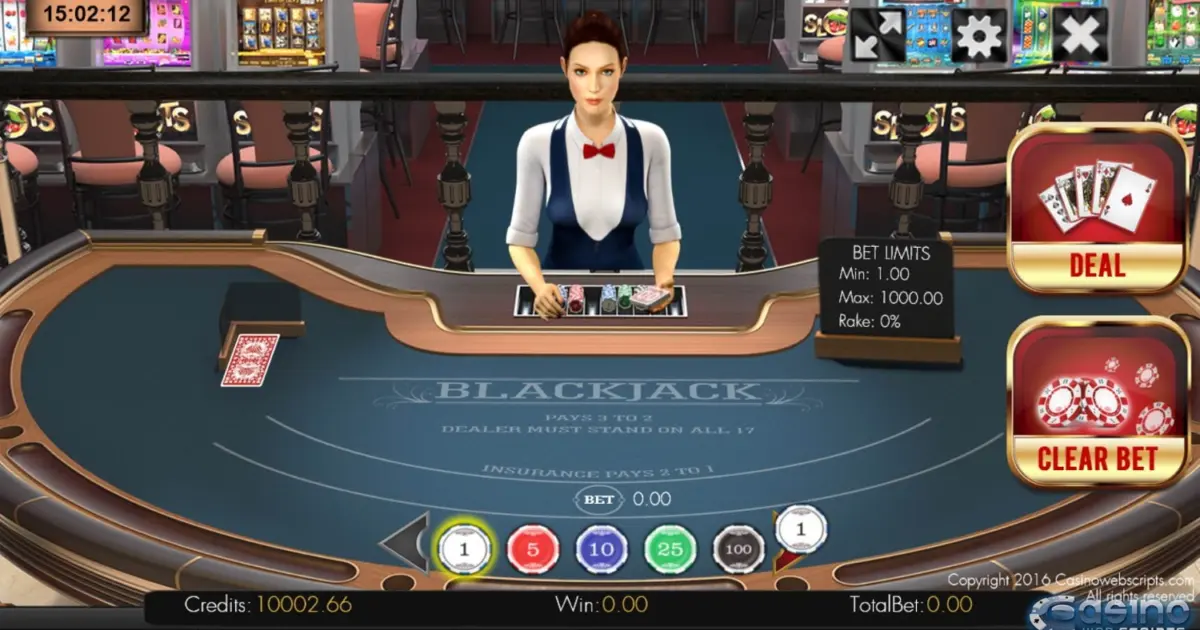
BlackJack 21 3D Dealer from Casino Web Scripts delivers a 99.64% return to player, which ranks it fractionally above the blackjack category mean and level with the provider’s BlackJack 21 Classic. That figure assumes flawless basic strategy on every decision; casual play will realise a materially lower return. The table offers free demo mode, so you can confirm the rules and test your strategy before committing a bankroll.
The missing data—deck count, dealer soft-17 behaviour, and blackjack payout—each moves the house edge by enough to matter. Casino Web Scripts does not publish these specifications outside the game client, so the first task after loading the table is to open the rules screen and check them yourself.
What kind of blackjack is BlackJack 21 3D Dealer?
This is a single-player RNG table that reshuffles after every hand, which means card counting offers no advantage. The “3D Dealer” branding suggests an animated or rendered dealer interface rather than live video, though the gameplay mechanics remain standard blackjack: beat the dealer’s total without exceeding 21, and collect even money on a win or 3:2 on a natural blackjack if the payout structure follows convention.
Casino Web Scripts operates a small portfolio of eight blackjack variants, most of which share the same 99.6% RTP baseline. The provider’s average sits at 98.86%, dragged down by BlackJack Ultimate 3D Dealer at 96.54%, so this table represents the house’s tighter offering. With no published rule sheet, you are relying on in-game disclosure to confirm whether this build matches the flagship or includes a less favourable twist.
Return to player: 99.64%
A 99.64% RTP translates to a 0.36% house edge under perfect basic strategy. That edge is competitive for online blackjack, but it is not the whole story: the figure depends entirely on flawless play—hitting 16 against a dealer 10, standing on 12 against a 4, doubling 11 against everything but an ace, and never taking insurance. Every mistake you make hands a larger slice to the house.
| Metric | Value |
|---|---|
| RTP | 99.64% |
| House edge | 0.36% |
| Provider average RTP | 98.86% |
| Blackjack category average | 99.41% |
| Free demo available | Yes |
Basic strategy is not a betting system or a hunch—it is the mathematically solved decision chart for every possible hand versus every dealer upcard. It minimises the house edge but does not eliminate it, and it cannot turn a negative-expectation game into a profitable one over the long run. Blackjack players who memorise the chart and apply it without deviation will see results closer to the published RTP than those who play by feel.
Deck count, dealer rules and the payout that matters most
The single most damaging rule variation in blackjack is the blackjack payout. A 3:2 payout—where a natural 21 on two cards pays $15 on a $10 bet—is standard and already factored into most published RTPs. A 6:5 payout, which returns only $12 on that same $10 stake, adds roughly 1.4 percentage points to the house edge in one stroke. If this table pays 6:5 on blackjack, the effective RTP collapses well below the stated 99.64%, and you should walk.
Casino Web Scripts has not published whether the dealer hits or stands on soft 17 for this variant. Hitting soft 17 costs the player around 0.2%, so it matters. The deck count—whether this is single-deck, double-deck, six-deck or eight-deck—also shifts the edge by a few hundredths of a percent, with fewer decks generally favouring the player, all else equal. Check the in-game rules screen before your first real-money hand, because these variables determine whether the 99.64% figure holds or falls apart.
Playing your first ten hands
Load the free demo and play twenty hands with the basic strategy chart open in a second window. Your goal is not to win those twenty hands—variance will scatter the results—but to confirm the game’s behaviour: does the dealer peek for blackjack under an ace or ten? Can you double after splitting? Can you re-split aces? Does late surrender appear as an option?
Once you have mapped the rules, set a unit size that keeps your session bankroll above fifty bets. If you are playing with €100, bet no more than €2 per hand. Blackjack variance is lower than slots, but it is not negligible: a bad run of twelve hands can easily halve your stack, and you need enough depth to survive it without reloading. Avoid any temptation to double your bet after a loss—Martingale and D’Alembert progressions change the shape of your risk, not your expected value, and they will drain a small bankroll faster than flat betting.
Side bets: the maths behind the temptation
Casino Web Scripts has not disclosed which side bets, if any, are available on this table. The two most common—Perfect Pairs and 21+3—typically carry house edges between 3% and 8%, an order of magnitude worse than the base game. Perfect Pairs pays out when your first two cards form a pair; 21+3 pays on poker-style three-card hands combining your two cards and the dealer’s upcard. Both look appealing because the payouts are large, but the frequency of winning is low enough that the house edge swamps any short-term luck.
Insurance, offered when the dealer shows an ace, is a separate losing proposition at standard 2:1 odds. You are betting that the dealer’s hidden card is a ten-value card, which happens one-third of the time in a fresh deck. The payout does not compensate for that frequency, so the insurance bet has a negative expectation even when your own hand is strong. Decline it every time unless you are counting cards in a live-shuffle game—and since this is an RNG table that reshuffles every hand, counting is irrelevant here.
Session limits and bankroll
Set your total loss limit before you open the table, and close the session the moment you hit it. A hundred-hand session at €2 per hand puts €200 in action, and a 0.36% house edge predicts a 72-cent average loss—but variance means your actual result will swing several standard deviations either side of that figure. You might finish up €30 or down €30, and neither outcome indicates the game is rigged or hot. Over thousands of hands, your return will converge on the RTP, but any single session is too short for that convergence to show.
Blackjack is entertainment, not income. The house edge is small, but it is always present, and no betting system or pattern-spotting will remove it. If you are chasing losses or playing with money you cannot afford to lose, stop. Set a budget, treat that budget as the cost of the session, and never reload once it is gone. Players must be 18 or older, and responsible gambling tools—deposit limits, session timers, self-exclusion—exist for a reason. Use them.
Verdict on BlackJack 21 3D Dealer
BlackJack 21 3D Dealer posts a competitive 99.64% RTP and offers free demo play, both of which are points in its favour. The house edge is tight for online blackjack, and the game sits alongside BlackJack 21 FaceUp 3D Dealer in Casino Web Scripts’ stronger lineup. The problem is the missing rule disclosure: without confirmation of the blackjack payout, dealer soft-17 behaviour, and deck count, you cannot verify that the published RTP is achievable at this table.
If the game pays 3:2 on blackjack, stands on soft 17, and offers standard double and split rules, it is a solid choice for players who have memorised basic strategy. If it pays 6:5 or hits soft 17 without offsetting rule improvements elsewhere, the edge will be wider than advertised, and better alternatives exist. Open the rules screen before betting real money, and compare the game’s actual configuration to Multihand Blackjack or other published options in the category. The RTP is promising, but only if the rules underneath it hold up.
Frequently Asked Questions
Is there a free demo version of BlackJack 21 3D Dealer?
Yes, BlackJack 21 3D Dealer offers free demo play, so you can test the rules and practice basic strategy before committing real money. Use the demo to confirm the blackjack payout, dealer soft-17 behaviour, and other rule details that Casino Web Scripts has not published outside the game client.
What is the RTP of BlackJack 21 3D Dealer and does it assume perfect play?
The RTP is 99.64%, which translates to a 0.36% house edge, but that figure assumes flawless basic strategy on every hand. Casual play—hitting when you should stand, taking insurance, or guessing at borderline decisions—will deliver a materially lower return, often several percentage points worse.
Does card counting work on this blackjack table?
No. BlackJack 21 3D Dealer is an RNG table that reshuffles after every hand, so the deck composition never changes in a way that favours the player. Card counting relies on tracking the ratio of high to low cards remaining in the shoe, and that information is reset to zero after each round, making the technique useless here.
What is the most important rule to check before playing for real money?
Confirm the blackjack payout. A 3:2 payout is standard and already reflected in the 99.64% RTP; a 6:5 payout adds roughly 1.4 percentage points to the house edge in one move, collapsing the game's value below competing tables. Casino Web Scripts does not publish this detail outside the game, so check the paytable before betting.
How does BlackJack 21 3D Dealer compare to other Casino Web Scripts blackjack games?
It shares the same 99.64% RTP as BlackJack 21 Classic, making it one of the provider's tightest-edge offerings. BlackJack Ultimate 3D Dealer sits much lower at 96.54%, while BlackJack 21 FaceUp 3D Dealer returns 99.61%. If the rule sets are identical, this table and the Classic variant are interchangeable; if not, the one with 3:2 blackjack payout and dealer standing on soft 17 wins.




