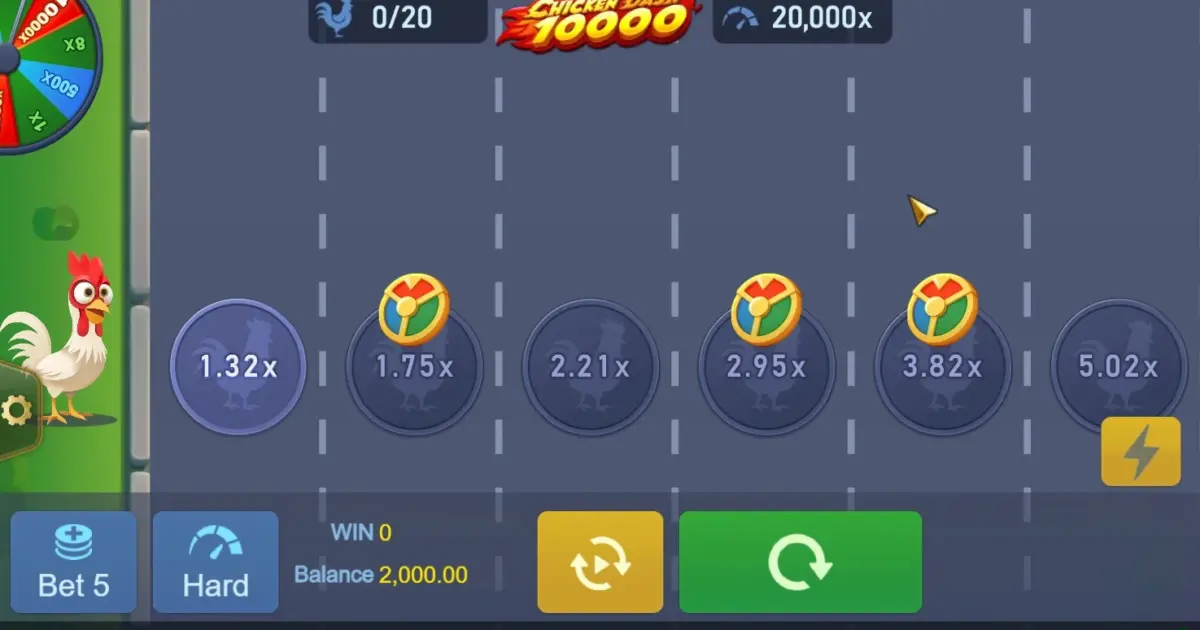
If you want a crash game with a published return figure rather than a blank space where the RTP should be, this one qualifies: TaDa Gaming states 97.0%, which sits above the 96.2% average across the crash and instant games we list. The format itself is as simple as it gets — a multiplier climbs from 1.00x and stops without warning, and your only decision is when to take the money. Whether that is worth your time depends entirely on whether you find that single decision interesting enough to repeat.
Chicken Dash 10000 in one minute
The chicken dash 10000 crash game follows the standard crash structure. A round opens at a 1.00x multiplier and rises. At some point determined before the round begins, it stops. Cash out before that moment and you are paid your stake multiplied by the figure showing when you pressed the button. Stay in past it and the stake is gone. There is no third outcome, no partial consolation, no bonus round layered on top.
TaDa Gaming publishes a 97.0% RTP for this title. The studio has eight games in our index with an average RTP of 96.96%, so this one is representative of their range rather than an outlier.
| Detail | Value |
|---|---|
| Provider | TaDa Gaming |
| Game type | Crash game |
| RTP | 97.0% |
| Free demo | Available |
A few things are not in the studio’s published information for this game, and rather than fill the gaps with guesses: there is no stated maximum multiplier cap available to us, no confirmation of whether rounds use a provably fair seed or a standard RNG, and no published bet limits. The 10000 in the name is branding. Treat it as branding until the game’s own information screen tells you otherwise.
Return to player: 97.0%
97.0% is a long-run figure. It describes what the game returns across an enormous number of rounds, not what it returns across your next twenty. Over a million rounds, the theoretical return on a million units staked is 970,000. Over fifty rounds it could be anything, and usually is.
What the number is genuinely useful for is comparison. At 97.0%, the theoretical cost of play here is 3 units per 100 staked. Against the 96.2% average across the games we list, that is 0.8 percentage points cheaper per unit wagered. Against TaDa Gaming’s own 96.96% average across eight games, it is essentially in line. Small differences like these compound with volume, and crash rounds resolve in seconds, so volume adds up faster here than in most formats.
The house edge lives in the distribution of crash points, not in any individual round. The maths that produces 97.0% works by making high multipliers rare in precisely the proportion required. That is why no cash-out strategy moves the figure: whichever multiplier you target, the chance of reaching it is already priced so that the long-run return stays at 97.0%. Cash out at 1.10x every round or at 50x every round and the expected return per unit staked is identical. Only the shape of your results changes.
Independent rounds and why streaks mean nothing
Each round’s crash point is generated independently of every round before it. This is the single most misunderstood thing about the format, so it is worth being blunt: a run of eight crashes below 1.50x does not make a high multiplier more likely on the ninth. A run of three crashes above 20x does not mean the game is now overdue for a wipeout. The generator has no memory of what it produced last time and no target to hit.
Round histories displayed in the interface encourage exactly the opposite reading. Seeing a column of red low numbers feels like evidence that something must change. It is not evidence of anything except what already happened, and what already happened has no influence on what comes next. The same applies to the reverse: a long stretch of generous rounds is not a signal to raise your stake.
Progression systems fail for the same reason. Doubling after a loss, the so-called one-third rule, waiting for a specific number of low rounds before entering — none of these change the probability of any future crash point, because the probability was fixed before you started counting. What they do change is how quickly your balance can move, usually downward, since larger stakes after losses concentrate more money into rounds that are no more likely to pay.
Setting an auto-cashout you can live with
Auto-cashout lets you pick a multiplier in advance and have the game take the money for you the instant it is reached. Auto-bet repeats your stake without you pressing anything. Both are useful. Neither improves your odds by a fraction of a percent.
What auto-cashout does is remove your reflexes and your nerve from the equation. A target of 1.30x will be hit often and pay little each time. A target of 25x will almost always end with the round crashing before you get there, and pay heavily when it does not. Same expected return, wildly different experience. The honest question is not which target is best — none is — but which pattern of results you can watch without changing your mind halfway through a session.
That last part is where the setting earns its place. Manual cash-outs invite hesitation, and hesitation in a game where the curve can stop at any instant is how a planned 2x becomes a total loss. Setting the number before the round starts, then leaving it alone, means the decision is made once by a calm version of you rather than repeatedly by a version watching a multiplier climb.
Multiplayer bet feeds and what they don’t change
Crash games commonly show a live feed of other players’ stakes and cash-outs alongside the curve. It is a genuinely good bit of presentation — it makes a solitary maths problem feel like a shared room — and it changes nothing about your odds.
Everyone in a given round is resolving against the same crash point. Someone cashing out at 40x while you are still watching does not mean you were slow, it means their target was different and that round happened to reach it. Their result is not information about yours, and it is certainly not information about the next round.
The feed’s real effect is on behaviour. Large wins are visible and small steady cash-outs scroll past unnoticed, which quietly reframes a modest 1.80x as a missed opportunity. That framing is the thing to watch. Your target should come from your budget and the variance you are comfortable with, not from what appeared in the sidebar thirty seconds ago.
Trying the demo first
A free demo is available for this game, which is the sensible starting point. In demo mode you can watch how often low crashes cluster, test an auto-cashout target across a hundred rounds, and get a feel for the pace before any real money is involved. The Chicken Dash 10000 free demo costs nothing and there is no download involved.
One caveat worth stating clearly: demo results predict nothing about real-money results. A demo session that runs hot is not a signal, and one that runs cold is not a warning. Both are just samples from the same distribution, and short samples say very little.
When you do move to real stakes, the format deserves a word of caution. This is 18+ entertainment you pay for, not income. Rounds here resolve in seconds, which means a session can cycle through more bets in ten minutes than a slot session does in an hour, and a budget you set in advance is the only thing that reliably stops that pace from outrunning your intentions. Decide the number before you start, and treat it as spent.
Who should play Chicken Dash 10000
This suits you if you like the crash format’s single clean decision and you want a published RTP behind it. 97.0% is a real figure from the studio, above the 96.2% average across the games we list, and that transparency counts for something in a category where plenty of titles publish nothing at all.
It suits you less if you were hoping the name implied a guaranteed 10,000x ceiling, or if you want features to explore. There is a curve, a cash-out button and some settings. That is the whole game.
If you want to see how TaDa Gaming handled the same idea before this version, Chicken Dash carries a 96.85% RTP for a direct comparison. For a different shape of instant game from the same studio, Mines replaces the rising curve with a grid of choices, and Go Rush is worth a look if you simply want another crash title to test your auto-cashout habits against.
Frequently Asked Questions
Can I play Chicken Dash 10000 for free?
Yes, a free demo is available and there is no download required. The demo runs the same multiplier format as the real-money version, so it is a useful way to test an auto-cashout target across a few dozen rounds. Bear in mind that demo results tell you nothing about how real-money sessions will go.
What is the RTP of Chicken Dash 10000 and what does it mean?
TaDa Gaming publishes 97.0%, meaning the theoretical long-run return is 97 units per 100 staked. That is above the 96.2% average across the games we list. The figure describes behaviour across an enormous number of rounds, not your next session, where results can land anywhere.
Does cashing out at a certain multiplier improve my odds?
No. The house edge sits in the distribution of crash points, so any target you choose is already priced to leave the long-run return at 97.0%. Cashing out at 1.20x or at 30x gives the same expected value per unit staked. Only the variance changes: frequent small wins versus rare large ones.
Is Chicken Dash 10000 provably fair?
TaDa Gaming has not published this detail for the game, so check its information screen before playing for money. In general, provably fair means each round's crash point comes from a seed you can verify afterwards. Either way, whether a crash game uses that method or a standard RNG, rounds remain independent of each other.
How does it compare to Chicken Dash?
The main published difference is the return figure. Chicken Dash carries a 96.85% RTP against 97.0% here, a gap of 0.15 percentage points, which amounts to a slightly lower theoretical cost per unit staked in this version. Both come from TaDa Gaming, whose eight listed games average 96.96%.




