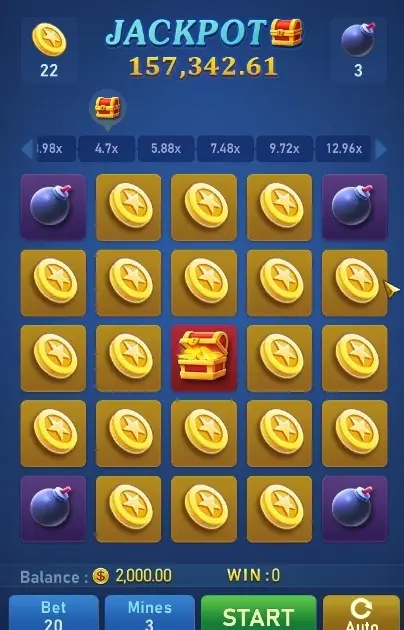
Mines is a crash game from TaDa Gaming, and it sits at number 22 in our popularity ranking, inside the top 8% of the titles we list. Whether it is worth your time depends on one thing: TaDa Gaming has not published a return-to-player figure for it, so you are betting without knowing the long-run cost. The free demo is available, which means you can learn the pacing and the cash-out controls before any money is involved.
What follows is what the format guarantees, what the provider has actually stated, and where the gaps are.
Mines and the TaDa Gaming game range
TaDa Gaming has eight games in our database, with an average published RTP of 96.96% across the titles where a figure exists. That is slightly above the 96.2% average for our whole corpus, but it is a studio-level average and it tells you nothing reliable about Mines specifically. Averages are built from other games, and an individual title can sit well above or below them.
If you want a TaDa Gaming crash game where the number is on the record, Chicken Dash 10000 lists 97.0% and Chicken Dash lists 96.85% — both are a more informed starting point than an unpublished figure. Go Rush is the third crash title in the range, though it has no published RTP either, so it shares the same blind spot as Mines.
None of this makes Mines a bad game. It makes it an unquantified one, and that is a different problem with a simple response: check the information screen inside the game itself, since studios often list the figure there even when it does not reach review sites.
| Provider | TaDa Gaming |
|---|---|
| Free demo | Yes |
| Site-wide average RTP | 96.2% |
The missing RTP figure and how the curve produces it
In a crash game, the house edge does not live in any single round. It lives in the statistical distribution of crash points across all rounds. The provider sets that distribution, and over a large enough sample it produces a fixed long-run RTP, exactly the way an RTP figure works for a slot.
Because TaDa Gaming has not published that figure for Mines, you cannot say what the long-run cost of play is. Treat any number quoted for this game elsewhere with real caution — if a site states an RTP that the studio has not, that number has no source behind it. Check the game’s own paytable or information screen before you play for money.
One thing worth being clear about: an unpublished RTP does not mean the game has no RTP. The distribution exists and is doing its work every round. You simply cannot see the number. Practically, that means you should size your session budget on the assumption that the edge is at least typical for the category, not on hope that it is generous.
What decides when the round crashes
Each round starts at 1.00x and the multiplier rises until it reaches a crash point that was determined at random for that round. Cash out before the crash and you win your stake multiplied by the figure showing at that moment. Still in when it crashes and the stake is lost. There is no third outcome.
Every round’s crash point is generated independently. Some crash games use a provably fair system, where you can verify the seed after the round; others use a standard RNG. FACTS does not state which applies to Mines, so check the game itself. Either way, independence holds: five low crashes in a row do not make a high one more likely, and a run of big multipliers does not mean a bust is coming. No round is ever “due”.
That single fact rules out every system built on reading the curve. Progressions, one-third rules and pattern-watching all rest on the idea that past rounds inform the next one. They do not.
Fast rounds and why pacing matters
Crash rounds are short. A round can resolve in a few seconds, and there is no reel spin or animation forcing a pause between them. That has a straightforward consequence: you can place far more bets per hour here than in most casino formats, and the long-run edge applies to every one of them.
Auto-cashout and auto-bet settings are the standard tools for handling this. Auto-cashout closes your position automatically at a multiplier you pick in advance; auto-bet repeats a stake without you clicking each time. Both are discipline aids — auto-cashout in particular removes the moment of hesitation where players hold on past their intended exit. Neither improves your odds by any amount. The distribution is unchanged.
If the game shows a live feed of other players’ bets and cash-outs, treat it as presentation. Seeing somebody exit at 40x is a social layer over the same maths and says nothing about your own round.
Variance in crash games versus other casino games
Crash games hand you a variance dial that most casino games do not. Setting a cash-out at 1.20x means you win small and often. Setting it at 20x means you lose most rounds and occasionally win big. Both settings sit on the same expected value — you are choosing the shape of the results, not the size of the edge.
Compare that to a slot, where volatility is fixed by the maths model and you take it as designed. In Mines you pick it round by round. That is genuine control, and it is worth using deliberately rather than drifting between targets as a session goes on.
The practical point is bankroll fit. High targets need a much larger cushion of losing rounds than most players expect, and short rounds mean that cushion gets tested quickly. A low, consistent target survives a small budget far longer, though it will not produce a headline result.
Playing responsibly
Crash games are 18+ and the fast round pacing makes a pre-set budget more important here than in slower formats. Decide the amount before you open the game, treat it as the price of entertainment rather than a way to earn, and stop when it is gone regardless of how the last few rounds went. If tracking that is hard, use the deposit and session limits your operator offers.
Demo play is a good way to learn the interface and see how the pacing feels, but it does not predict real-money results — the demo’s outcomes are its own, not a preview of yours.
Verdict on Mines
Mines is a competent crash game from a studio with a reasonable published record across its other titles, and the Mines free demo means you can try it at no cost. The unresolved issue is the missing RTP: without it, you cannot judge the long-run cost of play, and that is the single most decision-relevant number in any casino game.
The sensible approach is to run the demo, check the in-game information screen for an RTP the studio may list there, and if you want a figure on the record before you stake money, look at the TaDa Gaming crash games that publish one. Set your cash-out target in advance, use auto-cashout to hold yourself to it, and remember that no timing choice moves the odds.
Frequently Asked Questions
Can you play Mines for free?
Yes, a free demo of Mines is available, so you can try the game without staking money. The demo is useful for learning the cash-out controls, auto-cashout settings and round pacing before you commit funds. Bear in mind that demo results are not a preview of real-money outcomes — each round is generated independently either way.
What is the RTP of Mines?
TaDa Gaming has not published a return-to-player figure for Mines. Treat any RTP number you see quoted for it elsewhere with caution, and check the game's own information screen before playing for money. TaDa Gaming's other titles average 96.96%, but a studio average does not tell you what this specific game returns.
Does cashing out at the right moment improve your chances in Mines?
No. Cash-out timing changes the shape of your results, not the expected value. Exiting early locks in small, frequent wins; waiting risks the stake for a larger multiplier. The house edge sits in the distribution of crash points, so no progression, one-third rule or pattern-reading alters it.
What does provably fair mean in a crash game?
Provably fair means the crash point comes from a seed you can verify after the round, letting you confirm the result was not altered mid-round. FACTS does not state whether Mines uses this system or a standard RNG, so check the game itself. Either method produces independent rounds.
Who makes Mines and what else do they offer?
Mines comes from TaDa Gaming, which has eight titles in our database with an average published RTP of 96.96%. Their other crash games include Chicken Dash 10000 at 97.0%, Chicken Dash at 96.85%, and Go Rush, which has no published figure. Mines ranks 22nd for popularity on our site.




