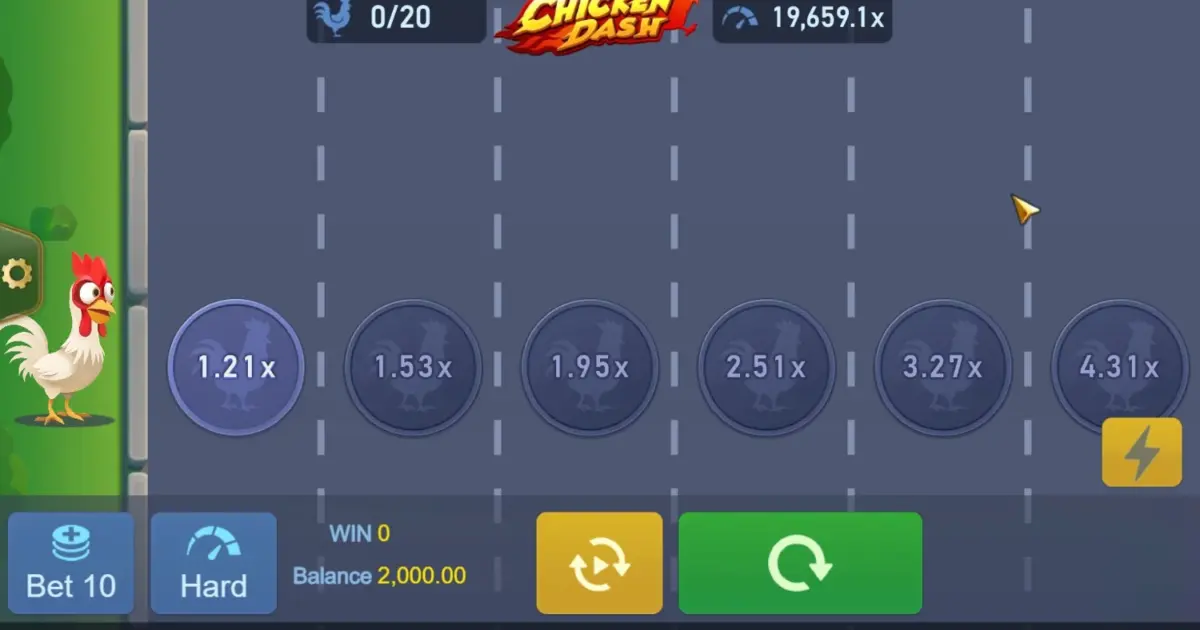
The chicken dash crash game from TaDa Gaming is a straightforward rising-multiplier title with one number worth knowing before anything else: a published RTP of 96.85%. That sits a little above the 96.2% average across the crash games catalogued here, and a free demo is available, so you can watch a few hundred rounds without staking anything. If you want a crash game where the maths is disclosed rather than guessed at, it clears that bar.
Is Chicken Dash worth your time?
It depends on what you want from the format. Crash games strip a betting round down to a single decision: a multiplier starts at 1.00x, climbs, and stops at a randomly determined crash point. Cash out before the crash and you win your stake multiplied by whatever the counter read at that instant. Stay in when it crashes and the stake is gone. There is no third outcome, no bonus round, no side feature to hunt.
What makes this one reasonable is disclosure. TaDa Gaming has published a return-to-player figure of 96.85% for it, which is more than a lot of crash titles offer. That does not mean you will see 96.85% back over a session — it is a long-run statistical figure measured across an enormous number of rounds, and short sessions swing wildly either side of it.
The free demo matters more than it sounds. Crash rounds resolve in seconds, so the format burns through a bankroll faster than almost anything else on a casino floor. Watching the curve in demo mode teaches you how quickly the tempo moves. It will not teach you anything predictive about real-money results, because each round is generated independently of the last.
| Provider | TaDa Gaming |
|---|---|
| RTP | 96.85% |
| Free demo | Yes |
| Site-wide average RTP | 96.2% |
Where the house edge is actually built in
The edge is not hidden in any single round. It lives in the statistical distribution of crash points — how often the curve dies at 1.02x versus how often it stretches to 20x or beyond. That distribution is fixed by design, and over a very large sample it produces the published RTP of 96.85%. On average, across the whole population of rounds, the game keeps roughly 3.15 units of every 100 staked.
This is the part people misread. Because you choose when to cash out, it feels like you control the odds. You do not. You control variance. Cashing out at 1.30x gives you frequent, small wins and rare losses. Waiting for 15x gives you rare, large wins and frequent losses. Both approaches sit on the same expected-value line, because the distribution of crash points was set before you placed the bet.
The same applies to every system you will find posted online. Doubling after a loss, cashing out a third of your stake early, alternating targets, tracking recent crash points for a pattern — none of it alters the maths. Each round’s crash point is generated independently. A run of five crashes below 1.20x does not make a high multiplier any more likely on the sixth, and a run of high multipliers does not borrow from the future. Auto-cashout and auto-bet tools are worth using, but only because they enforce a decision you already made while calm. They are discipline aids, not odds aids.
What the name tells you about the theme
The title points at a chicken-and-dash framing, and that is genuinely all the game-specific detail available here. TaDa Gaming has not published art direction notes, sound design details or animation specifics that could be reported accurately, so anything you read elsewhere describing the visuals in detail is someone’s guess or someone’s marketing copy.
What can be said with confidence is structural. In every crash game, presentation sits on top of the maths rather than inside it. A chicken running further as the multiplier climbs, a plane taking off, a rocket rising — these are all the same counter with different costumes. If the game shows a live bet feed with other players’ cash-outs, that is a social layer, not information you can act on. Their results are drawn from the same independent distribution as yours and tell you nothing about your next round.
The practical upshot: judge this game on the 96.85% figure and the demo availability, not on the theme. Check the in-game information screen when you load it, since that is where the studio publishes the details that actually govern play.
Reading the maximum multiplier
TaDa Gaming has not published a maximum multiplier cap for this title in the information available here. That absence is worth handling carefully rather than filling with a number from a forum post.
A cap, when a studio does publish one, is a ceiling — the highest multiplier the curve can theoretically reach. It is not a target, not a typical result, and not something a session is working towards. In practice the overwhelming majority of rounds in any crash game resolve far below whatever the cap is, because that is exactly how the distribution has to be shaped to hold the RTP at 96.85%. High multipliers are rare by mathematical necessity, not by bad luck.
Since the figure is not published for this game, treat any cap you see quoted elsewhere with real caution and check the game’s own information screen before you play for money. Worth noting: the related title Chicken Dash 10000 carries a 97.0% RTP and a name that suggests a stated ceiling, so if a specific cap matters to your decision, that is the more informative place to look.
How the chicken dash crash game compares to other crash games
On RTP, it sits modestly ahead of the field. The average across the crash games listed on this site is 96.2%, so 96.85% is roughly 0.65 percentage points better than typical. Across TaDa Gaming’s eight games here, the average is 96.96%, meaning this title is slightly below its own studio’s norm while still beating the wider corpus. It also ranks 44th by popularity, placing it in the upper band of what visitors here actually play.
Within the same studio, Go Rush and Mines are the obvious comparison points, though neither has a published RTP figure available here — which is itself a reason to prefer a title where the number is disclosed. Half a percentage point of RTP is not something you will feel in a single session; variance dominates over any realistic number of rounds. Over thousands of rounds it is the only thing that reliably matters, which is why it is the fairest single basis for comparing crash games.
Bankroll and session limits
Round length is the specific risk here. A crash round can resolve in under five seconds, which means a stake you would place ten times an hour on a table game can go out a hundred times an hour on this curve. Set your budget in stake-per-round terms and multiply by a realistic round count before you start, not after.
Auto-cashout is the most useful tool on the screen. Pick a multiplier while you are thinking clearly, set it, and let it execute. It will not improve your odds — nothing does — but it removes the in-the-moment decision that fast rounds are designed to pressure.
This is 18+ entertainment you pay for, not a way to make money. Decide what the session is worth to you before the first round, treat that figure as spent, and stop when it is gone rather than when a run feels like it is turning. The RTP of 96.85% is a long-run average, and the house holds the edge on every single round regardless of how any individual session goes.
Verdict
A competently disclosed crash game. The 96.85% RTP is above the 96.2% average across the crash titles here, TaDa Gaming has published it rather than leaving you guessing, and a free demo lets you get a feel for the tempo at no cost. That combination is more than several competitors offer.
The gaps are worth naming: no published multiplier cap and no confirmation of provably-fair verification in the information available here, so check the game’s own screens for both. And be clear-eyed about what the format is. The only decision you make is when to cash out, and that decision moves your variance, never your expected value. If you want that specific decision repeated quickly with the maths on the table, this delivers it. If you want a game where skill shifts the odds, no crash game will give you that.
Frequently Asked Questions
Can I play Chicken Dash free before betting real money?
Yes, a free demo is available for Chicken Dash, so you can run the multiplier curve without staking anything. The demo is useful for learning how fast rounds resolve and how auto-cashout behaves. It will not predict real-money outcomes, though, since every crash point is generated independently of the last.
What is the Chicken Dash rtp and what does it actually mean?
TaDa Gaming publishes a 96.85% return-to-player figure for Chicken Dash, against a 96.2% average across the crash games listed here. That means roughly 96.85 units returned per 100 staked over an enormous number of rounds. Short sessions swing far either side of it, so treat it as a long-run statistic rather than a session forecast.
Does cashing out at the right moment improve your odds in Chicken Dash?
No. Your cash-out point changes your variance, not your expected value. Cashing out early gives frequent small wins; waiting gives rare large ones, and both sit on the same 96.85% RTP line. Progression systems, one-third rules and pattern-tracking do not work either, because each round's crash point is independent.
What does provably fair mean in a crash game?
It describes a system where the crash point is derived from a seed you can verify after the round, letting you confirm the result was not altered mid-round. It is a transparency mechanism, not a better-odds mechanism. The information available here does not confirm whether Chicken Dash uses it, so check the game's own information screen.
How does Chicken Dash compare to Chicken Dash 10000?
Chicken Dash 10000 carries a slightly higher published RTP at 97.0% versus 96.85% for Chicken Dash. That 0.15-point gap is invisible across a single session, where variance dominates completely, but it favours the 10000 version over thousands of rounds. Both come from TaDa Gaming, whose eight games here average 96.96%.




