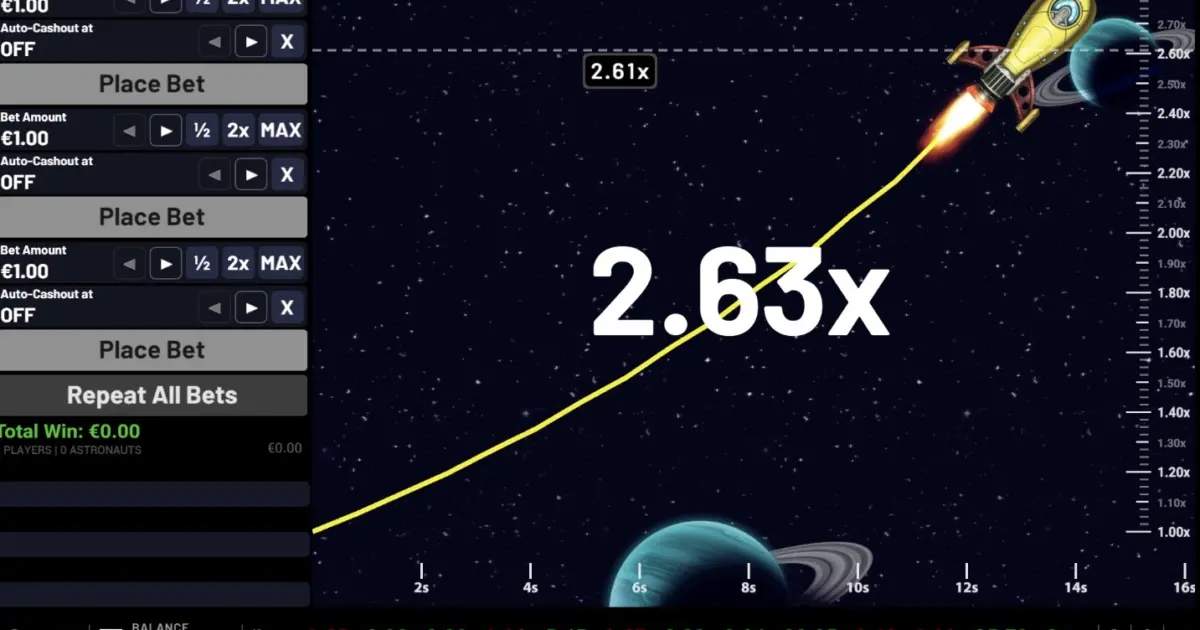
If you want a crash game where the published numbers are actually on the record, triple cash or crash is a reasonable place to start: Betsoft Gaming states a return-to-player figure of 96.0%, and a free demo is available so you can watch several dozen rounds resolve without staking anything. It sits 36th by popularity on this site, in the 87th percentile, so it is well known without being the default pick.
What it will not do is give you a way to beat the curve. The decision you make each round is when to cash out, and that changes how often you win versus how much you win, never the long-run maths. Read on if that framing suits you.
Triple Cash or Crash at a glance
The facts Betsoft Gaming has published for this game are short, and it is worth knowing exactly where the published record stops.
| Detail | Value |
|---|---|
| Provider | Betsoft Gaming |
| Game type | Crash game |
| RTP | 96.0% |
| Free demo | Available |
| Popularity rank on this site | 36 (87th percentile) |
Note what is not in that table. Betsoft Gaming has not published a maximum multiplier cap for this game, has not stated bet limits, and has not documented a provably-fair verification system for it. That does not mean those things are absent, only that no figure is on the record to quote. If you see a maximum multiplier or a minimum stake quoted on a third-party page, treat it as unverified and check the game’s own information screen before you play for money. Betsoft Gaming lists two crash titles in total, averaging 96.13% RTP between them, so this is a small corner of their catalogue rather than a specialism.
How the multiplier and crash point actually work
A crash round is mechanically simple. The multiplier opens at 1.00x and climbs. At some point it stops, and the round is over. If you cashed out before that instant, you are paid your stake multiplied by the figure showing when you pressed the button. If you were still in, the stake is gone. There is no third outcome, no partial refund, no consolation tier.
The stopping point, the crash point, is drawn independently for every round. Some crash games publish a seed you can verify after the fact; others use a standard certified RNG. Either way the consequence is the same and it is the single most important thing to understand: the previous round tells you nothing about the next one. Five crashes under 1.50x in a row do not make a big multiplier more likely on the sixth. A run of 20x results does not mean an early crash is queued up. Each round is drawn fresh from the same distribution, and the distribution has no memory of what it produced a moment ago.
That is why chart-reading does not transfer here from other formats. There is no trend in the history strip to follow, only a record of independent draws.
What a 96.0% figure means for a crash game
The 96.0% return-to-player figure describes the long run, not your session. Over a very large number of rounds the game is designed to return about 96 units for every 100 staked, with roughly 4 units retained as house edge. The edge lives in the shape of the crash-point distribution, not in any individual round, which is why no single round is “the one where the house takes its cut”.
Against the wider field, 96.0% is slightly below par. The average across the crash and instant games listed on this site is 96.2%, putting this game 0.2 percentage points under, and Betsoft Gaming’s own two-game average is 96.13%. For comparison, Aviator publishes 97.0% if a higher headline RTP is your deciding factor, while Mines sits lower at 95.0%.
Keep the size of that gap in perspective. A 0.2-point difference is real but small, and it is a statement about millions of rounds. Across a hundred rounds on a Friday evening, variance will swamp it entirely. RTP is a useful tiebreaker between games, not a prediction of your afternoon.
Cash-out timing: the real trade-off
Timing is the only lever you have, and it is worth being precise about what it does. Cashing out at 1.30x wins often and pays little. Holding for 20x pays well and almost never lands. Both approaches run into the same expected value, because the game’s distribution of crash points already accounts for how often each target is reached.
What changes is variance, and that genuinely matters to how a session feels. Low targets produce a long sequence of small wins broken by occasional losses, and a bankroll that drifts rather than lurches. High targets produce long dry stretches punctuated by rare large hits, and they can empty a budget quickly on a bad run even when the maths is unchanged.
What does not work: any progression, any “wait for three low rounds then go high”, any rule about doubling after a loss. These feel like structure and they are structure, but they are structure imposed on independent random draws. Doubling stakes after losses does not improve the odds of the next round, it just concentrates more money into fewer outcomes and shortens the time it takes to reach the bottom of your budget. Pick a target range you can live with and stop looking for the pattern.
Auto-cashout, auto-bet and what they change, and don’t
Crash games commonly offer an auto-cashout setting, where you nominate a multiplier in advance and the game exits for you the moment it is reached, and an auto-bet setting that repeats a stake across a set number of rounds. Both are useful. Neither is an edge.
Auto-cashout removes reaction time from the equation. Rounds resolve in seconds and a manual press at 2.00x can easily land at 1.90x or miss entirely on a fast crash. Setting the target in advance means you get the multiplier you actually chose. It also removes the in-the-moment temptation to hold on for one more tick, which is where most sessions go wrong.
Auto-bet is a discipline tool with a sharp edge. Set to 50 rounds at a fixed stake, it enforces a plan. It also runs through your balance while your attention is elsewhere, so set a loss limit alongside it if the game offers one.
Neither feature alters the 96.0% figure or the crash-point distribution. They change how reliably you execute a decision, not what that decision is worth.
Playing the Triple Cash or Crash demo
A free demo is available for this game, which is the sensible starting point. Play money lets you see how quickly rounds cycle, how often the curve dies below 2.00x, and whether the pace suits you before your own money is involved. Set an auto-cashout target, run 50 rounds, then run 50 more with a target ten times higher and compare how the two feel. That is a genuinely informative experiment and it costs nothing.
One clear limit: demo results do not predict real-money results. Fifty good rounds in play money is a small sample of independent draws, nothing more, and a rough demo run says equally little. The distribution is the same in both modes; short sequences simply vary.
Worth stressing here because rounds repeat so fast: this is an 18+ product, and the money you put in is money you have decided in advance you are willing to lose for entertainment. It is not income and it is not a strategy for making any. Set a budget before you open the game, not after a losing run, and treat the number as fixed. If chasing a loss starts feeling reasonable, that is the moment to close the tab.
Verdict: who should play Triple Cash or Crash
This suits you if you want a fast crash game from a recognised studio with a published RTP, and you are comfortable that the 96.0% figure is a shade under the 96.2% field average. The free demo lowers the cost of finding out to zero, which counts for a lot when so much of the appeal comes down to whether the round pace agrees with you.
Look elsewhere if you specifically want a documented maximum multiplier cap or a stated provably-fair verification method, because Betsoft Gaming has not published either for this title. If a higher headline number is the priority, the 97.0% on Aviator is the better-documented option, and if you want something from the same studio in the instant-game space, Diamond Mines publishes 96.27%.
Approach it as entertainment with a known, small built-in cost and a pace you control through your cash-out target. Approach it as a puzzle to solve and the format will disappoint you, because there is nothing behind the curve to solve.
Frequently Asked Questions
Can I play Triple Cash or Crash free with no download?
Yes. A free demo is available for this game and runs in the browser, so no download or account is needed to try it. Play money lets you see how fast rounds cycle and how the multiplier behaves. Bear in mind that demo results are a small sample and do not predict real-money outcomes.
What is the Triple Cash or Crash RTP and what does it mean?
Betsoft Gaming publishes a 96.0% return-to-player figure. Over a very large number of rounds the game is designed to return around 96 units per 100 staked, with about 4 retained as house edge. That is slightly under the 96.2% average across crash games listed here. It says nothing about any individual session.
Does cashing out at a certain multiplier improve my odds?
No. Cash-out timing changes variance, not expected value. Low targets win small amounts often, high targets win large amounts rarely, and both run into the same underlying maths because the crash-point distribution already accounts for how often each target is reached. No progression or waiting rule changes that.
Is Triple Cash or Crash provably fair?
Betsoft Gaming has not published provably-fair documentation for this specific game, so no verification method can be confirmed here. In general, provably fair means the game commits to a seed in advance that you can check after the round to confirm the crash point was not altered. Check the game's information screen for details.
How does it compare to Aviator?
Aviator publishes a higher 97.0% RTP against 96.0% here, a one-point gap that matters over the long run rather than a single session. Both work identically: a multiplier climbing from 1.00x to an independently drawn crash point. The practical differences come down to presentation, round pace and which studio you prefer.




