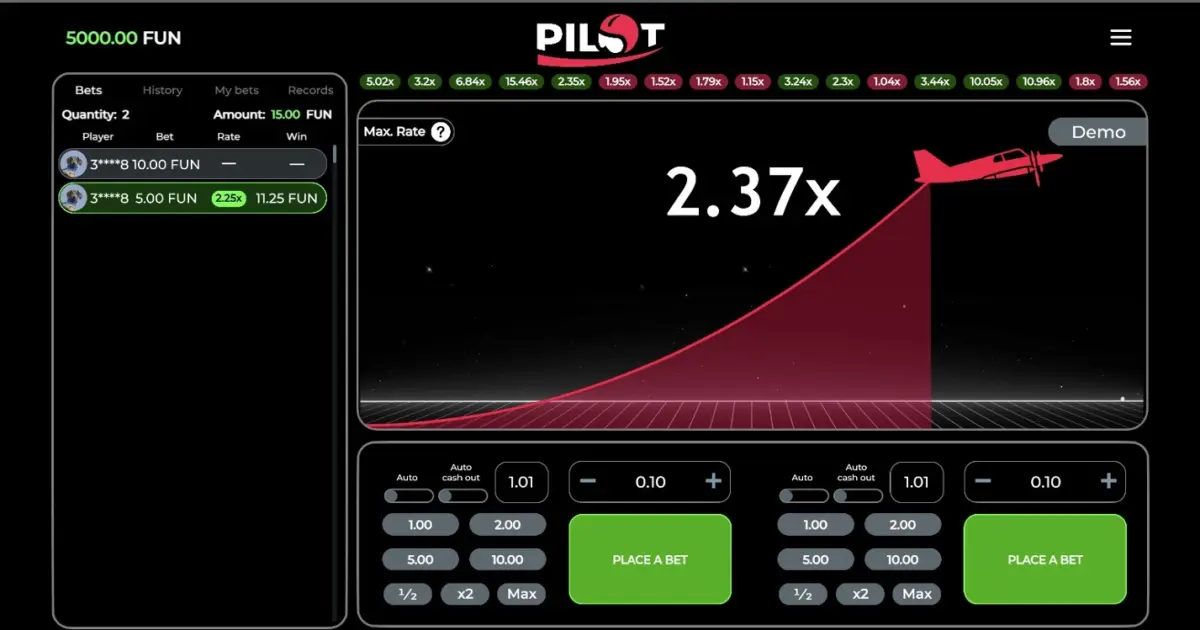
Pilot by Gamzix is a straightforward crash game that does not try to reinvent the format. A multiplier starts at 1.00×, climbs until it randomly stops, and you decide when to cash out. With a published RTP of 96.5% and a free demo available, it gives you the essentials without clutter. Whether it is worth your time depends on how much you value simplicity in a genre where the core mechanic never changes between titles.
Pilot in one minute
Each round of Pilot begins with a multiplier at 1.00×. It rises in real time — 1.20×, 1.50×, 2.00× and so on — until a randomly determined crash point ends the round. If you cash out before that point, your stake is multiplied by whatever the counter showed when you clicked. If the crash happens first, you lose the stake. There is no third outcome, no bonus round, and no side bet that alters the maths. The crash point is generated independently for every round using an algorithm the studio publishes for verification. A streak of five low crashes tells you nothing about the sixth round, and a run of high multipliers does not make a crash “due”. The only decision you make is when to collect, and that is a variance choice, not an edge you can tilt.
| Provider | Gamzix |
|---|---|
| RTP | 96.5% |
| Free demo | Yes |
| Site-wide average RTP | 96.2% |
Return to player: 96.5%
The RTP of 96.5% means that over a very large number of rounds, the game is designed to return 96.5 cents for every dollar wagered on average. That figure is slightly above the corpus average of 96.2% across crash games in this database, so Pilot sits roughly in the middle of the pack. It is close to Aviator’s 97.0% RTP and above Mines at 95.0%, but the differences are small enough that RTP alone should not be the reason you pick one over the other. What the RTP does not tell you is how the returns are distributed: Pilot could pay out many small wins with occasional total losses, or the reverse. The single number hides the variance. For context, compare it with Aviator, which publishes a slightly higher RTP and uses a similar multiplier curve, to see whether the marginal percentage matters to you in practice.
Independent rounds and why streaks mean nothing
Every round in Pilot is generated independently. The crash point for round 47 has no mathematical connection to round 46. This is not a caveat buried in the terms — it is the fundamental design of every crash game. The studio uses a provably-fair algorithm or a standard RNG to produce each result, and in either case the output of one draw does not influence the next. This means a run of ten crashes below 1.50× does not make a 10× multiplier more likely on the next round. The probability distribution is the same every time. Players who track streaks on the bet feed and adjust their cash-out targets accordingly are reacting to noise, not signal. The expected value of your next bet is identical whether the last five rounds crashed at 1.01× or paid out at 50×. Understanding this is the single most useful thing you can take away from any crash game review.
Setting an auto-cashout you can live with
Pilot offers an auto-cashout feature: you pick a multiplier target, and the game cashes you out automatically if the counter reaches it. This is a discipline tool, not an odds improvement. Setting auto-cashout at 1.50× means you lock in a 50% profit on winning rounds but collect less often, because the multiplier must reach 1.50× before crashing. Setting it at 2.00× doubles your stake on wins but hits less frequently. Neither setting changes the expected value — the 96.5% RTP applies regardless of your target. What auto-cashout does change is your experience: it removes the temptation to chase higher multipliers in the heat of the moment. If you find yourself repeatedly letting a 3× multiplier slip past and then crashing at 1.20×, a fixed auto-cashout eliminates that pattern. It does not make you more likely to profit, but it does make your session more predictable.
Multiplayer bet feeds and what they don’t change
Like most modern crash games, Pilot displays a live feed of other players’ bets and cash-outs. You can see someone else collect at 4.50× while another player loses at 1.10×. This is a social layer on top of the same maths — it does not change your odds by a fraction of a percent. The bet feed can create the impression that certain strategies “work” because you see other players succeeding with them, but every player’s round is independent. Someone cashing out at 10× on the same round you crashed at 1.10× simply means they started a different round or made a different timing choice. The feed is entertainment and context, not data you can act on. If watching other players’ results influences your own cash-out timing, the feed is working against you — it nudges emotional decisions rather than rational ones.
Trying the demo first
Pilot is available as a free demo, which means you can play rounds without risking real money. This is the best way to get a feel for how fast the multiplier moves and how the interface works. The demo uses the same algorithm as the real-money version, so the RTP and variance are identical — but remember that demo results do not predict your real-money session, because every round is independent. Use the demo to decide whether the pace and simplicity suit you, not to build a “system” based on patterns you noticed. Set a budget before you switch to real money, treat the cost as entertainment you pay for, and stop when it is gone. Crash games repeat rounds quickly — a session can consume a budget faster than a slot — so decide in advance how long you want to play and how much you are willing to lose. You must be 18 or older to play for real money.
Who should play Pilot
Pilot is best suited to players who want a clean crash game without extra features cluttering the screen. If you have played Chicky Run and wanted something more minimal, Pilot strips the format down to its essentials. The 96.5% RTP is competitive, the interface is simple, and the free demo lets you test the waters. Players who prefer complex bonus mechanics or varied bet types should look elsewhere — Pilot does not try to be anything other than a standard crash game. If you value transparency, want to verify results with a provably-fair system, and appreciate a game that does not pretend to offer strategic depth where none exists, Pilot delivers exactly that. It ranks 33rd in popularity in this database, which suggests a solid player base without the overcrowded bet feeds you see in the biggest titles. For a similar experience with a marginally higher RTP, you might also compare it with Aviator before committing.
Frequently Asked Questions
Can I play the Pilot crash game for free?
Yes. Pilot by Gamzix offers a free demo that lets you play unlimited rounds without spending money. The demo uses the same algorithm as the real-money version, so the RTP of 96.5% and the variance are identical, but demo results do not predict real-money outcomes because every round is independent.
What is the RTP of Pilot and how does it compare to other crash games?
Pilot has a published RTP of 96.5%. This is slightly above the corpus average of 96.2% across crash games in this database, close to Aviator's 97.0%, and above Mines at 95.0%. The differences are small; RTP alone should not be the sole factor in choosing a crash game.
Does cashing out earlier or using a pattern change my odds in Pilot?
No. Cashing out earlier locks in a smaller multiplier and reduces variance, but it does not change the expected value. No timing rule, streak-tracking method, or progression system alters the underlying 96.5% RTP. Every round is independent, so past results have zero influence on future crash points.
What does "provably fair" mean in the context of crash games like Pilot?
Provably fair means the game generates each crash point from a seed that you can verify after the round using a published algorithm. This lets you confirm the result was not manipulated in real time. It does not give you an advantage — it simply provides transparency that the outcome was predetermined and untampered.
Who is the provider behind Pilot and how popular is the game?
Pilot is developed by Gamzix, a studio with one crash game in this database. The game ranks 33rd in popularity with an 88.3rd percentile rating, indicating a solid player base. Gamzix's average RTP across its crash portfolio is 96.5%, matching the figure for Pilot itself.




