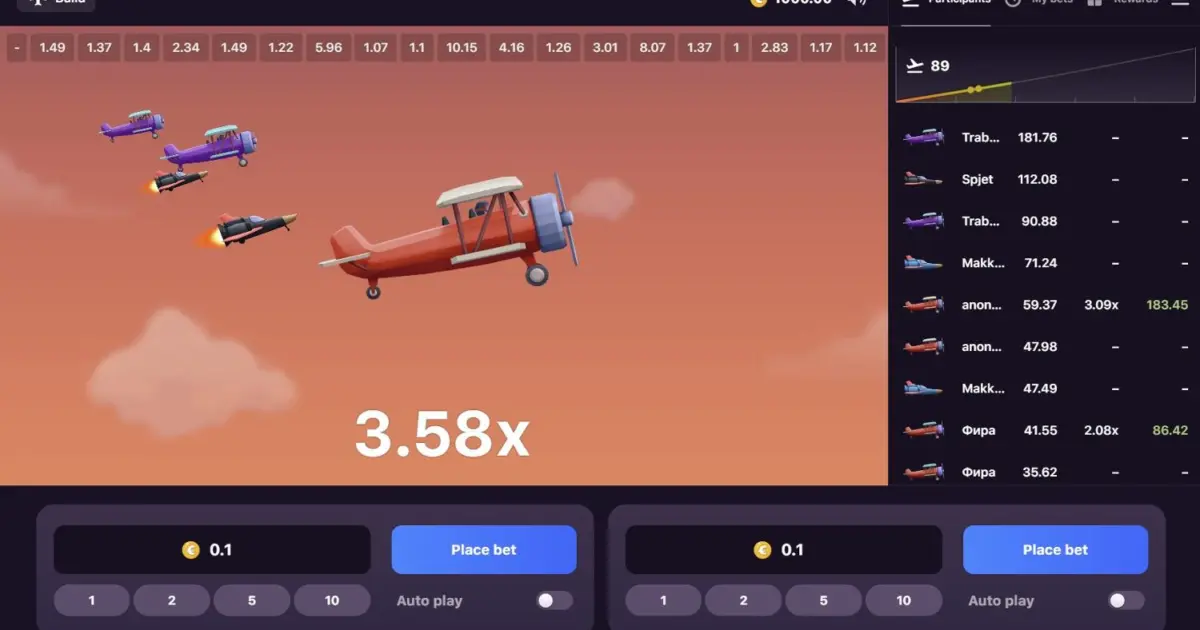
The Aviatrix crash game belongs to a format that rewards patience in small doses and punishes it in large ones: a multiplier climbs from 1.00x until a randomly generated crash point ends the round, and everything you win depends on whether you locked in a cash-out before that invisible line. If you have played Aviator — the genre’s most recognisable title — you will find the core loop identical here, wrapped in an aviation theme and a different visual presentation. This review answers the question most readers actually have: does this game offer anything the maths does not?
How Aviatrix plays
Each round begins at a 1.00x multiplier. A curve on screen rises — in this game themed as a plane climbing through the sky — and at some unpredictable moment it crashes. You place a stake before the round starts. At any point while the curve is alive you may press cash-out; if you do, you receive your stake multiplied by whatever value the curve has reached at that instant. If you are still in the round when the crash hits, the stake is lost entirely. There is no partial recovery, no bonus feature, no scatter that saves you.
Most implementations of this format also offer an auto-cashout toggle, letting you pre-select a multiplier target so the game exits for you automatically. This removes the manual timing decision but does not alter the probability of the curve reaching any particular number. The round result is fixed before the animation begins — your only input is where you choose to stop.
Some versions layer a multiplayer presentation on top: a live feed showing other players’ stakes and cash-out points scrolling down the side of the screen. This is cosmetic and social. Your odds are identical whether you watch the feed or ignore it.
| Provider | Aviatrix |
|---|---|
| Free demo | Yes |
| Site-wide average RTP | 96.2% |
The Aviatrix provider and this game
The studio behind this title publishes under the name Aviatrix, and within our tracked catalogue it carries exactly one game — this one. That single-title footprint makes it harder to judge the provider’s overall reliability, because there is no second data point: no other released game against which to compare return-to-player honesty, feature completeness, or support quality.
This does not automatically indicate a problem. Small studios sometimes concentrate development effort on a single product, iterating on it over time rather than spreading resources across a portfolio. What it does mean is that when evaluating whether to play Aviatrix for real money, you should seek independent verification beyond the provider’s own marketing — checking whether the game is licensed by a recognised gambling authority, whether its random-number generator has been tested by an accredited lab, and whether the operator hosting it holds a valid jurisdictional licence. None of those checks are unique to this game; they apply to every crash title from a single-product developer.
Reading the RTP figure
The Aviatrix provider has not published a return-to-player percentage for this crash game in any material available to us. That absence matters more than it might seem, because RTP is the single most useful number a player can have: it tells you what proportion of staked money the game is designed to return over a large number of rounds.
For context, the corpus average across the crash games we track sits at 96.2% RTP. A well-known comparable, Aviator, publishes 97.0%. Mines, which uses a different mechanic but shares the instant-reveal psychology, sits lower at 95.0%. If Aviatrix falls within a similar band, the long-run house edge would be between 3% and 5% — meaning a theoretical 96.2% RTP corresponds to the casino retaining roughly €3.80 for every €100 staked across thousands of rounds.
Until the provider confirms a figure, open the game’s information screen (usually an “i” or gear icon) and look for the stated RTP before depositing real money. If it is absent there too, that is a signal worth heeding.
Provably fair, explained in general terms
“Provably fair” is a cryptographic mechanism, not a marketing label. In crash games that use it, the outcome of each round is determined by a random seed generated before the round begins. The server commits to that seed in hashed form and reveals the original after the round ends. A player can then verify, independently, that the crash point displayed on screen matches what the seed mathematically produces — and that the server could not have changed the target mid-round to catch late cash-outs.
Not every crash game is provably fair. Some rely on conventional RNGs certified by testing labs like eCOGRA or iTech Labs — equally random, but without the player-side verification step. The Aviatrix provider has not published information confirming which approach this game uses. If you see the term claimed on an operator’s page, look for the verification tool (often a hash field and a seed reveal in the round history) and test a few rounds yourself.
Provably fair or not, the principle is identical: each round is independent. A streak of high multipliers does not mean a crash is “due,” and a streak of low ones does not mean a big curve is coming.
Why no cash-out system changes the odds
Crash game forums circulate “strategies” with confidence that would surprise a statistician: cash out at 1.33x every time, double your stake after each loss, wait for two low rounds then go big. None of these alter the game’s expected value, and the reason is structural.
The crash point is a single random number fixed before the animation starts. Your cash-out moment does not influence what that number is. Cashing out at 1.33x every round simply converts the game into a binary bet with a higher win rate and a lower payout — the product of probability times payout equals the same house edge the game was designed to deliver. Martingale-style doubling recovers losses on paper until you hit a losing streak long enough to exhaust your balance or reach the table maximum, at which point one catastrophic loss wipes every small gain and more.
Auto-cashout is a discipline tool, not an edge. If you know you will panic and hold too long, setting the multiplier at which you want to exit is genuinely useful. It is not the same thing as a mathematical advantage.
Free play before real money
If you want to play Aviatrix free of charge, a demo mode is available at no cost and with no download requirement. The Aviatrix free demo lets you observe the round pacing, test how the auto-cashout toggle behaves, and get a feel for the animation speed without risking a cent. Use it to confirm the interface works on your device and that you understand when the cash-out button registers versus when a round has already crashed.
One honest limitation: demo play does not teach you how the odds feel when they turn against you. Watching ten low crashes in a row on imaginary money is not the same as watching ten low crashes in a row on a Friday evening with rent due. The maths is identical, but your decision-making under real financial pressure will not be.
Crash rounds repeat every few seconds. That speed is the format’s greatest risk: a single session can cycle through hundreds of rounds before you register how much you have staked. Set a hard budget before you open the game, treat the entire amount as money already spent on entertainment, and stop when it is gone regardless of where the curve sits. This applies whether you are 18 or 80, and it matters more in fast-cycle formats than in slower ones.
Final take on Aviatrix
The Aviatrix crash game does not reinvent the format. It applies an aviation theme to the same rising-curve mechanic that powers dozens of titles on the market, with no published RTP and no confirmed provably-fair implementation that we can verify from available information. Compared to Chicky Run, another thematically distinctive entry with a published 96.0% RTP, Aviatrix asks you to trust the provider without giving you the number first.
That does not make it dishonest — absence of publication is not evidence of a bad game. But it means the onus falls on you: check the in-game information screen, confirm the licensing of whichever operator hosts it, and treat any RTP figure quoted in third-party articles as unverified. If the provider eventually publishes a number and it sits within or above the 96% band, Aviatrix becomes a reasonable choice within the genre. Until then, the demo is the only play that costs nothing.
Frequently Asked Questions
Is the Aviatrix crash game free to play?
Yes. The Aviatrix free demo is available without a deposit or download. You can explore the round pacing, test auto-cashout settings, and observe the multiplier curve using virtual credits. However, demo outcomes are generated by the same random process and carry no predictive value for real-money sessions.
What is the RTP of the Aviatrix crash game?
The Aviatrix provider has not published a return-to-player figure for this specific title in any material we can verify. The average across tracked crash games is 96.2%. Before playing for real money, open the game's own information screen to check whether an RTP is stated there, and treat any number quoted elsewhere with caution.
Can any cash-out strategy improve the odds in Aviatrix?
No. The crash point in each round is a random number fixed before the animation begins, and your cash-out timing does not influence it. Strategies like cashing out at a fixed multiplier or doubling after losses redistribute how quickly you win or lose but cannot change the game's built-in house edge. Auto-cashout is a discipline aid, not a mathematical edge.
Who makes the Aviatrix crash game?
Aviatrix is both the studio name and the product name, and within our tracked catalogue the provider offers exactly one game. This single-title portfolio means there is no second product against which to independently cross-check the provider's RTP accuracy or feature reliability, so verifying licensing and RNG certification separately is advisable.
How does Aviatrix compare to Aviator?
Aviator publishes a 97.0% RTP, while Aviatrix has no confirmed figure in available materials. Both use the same rising-multiplier core mechanic: a curve climbs from 1.00x to a randomly set crash point, and your only input is cash-out timing. The practical difference for players is transparency — Aviator gives you a number to evaluate against; Aviatrix currently leaves that to you.




