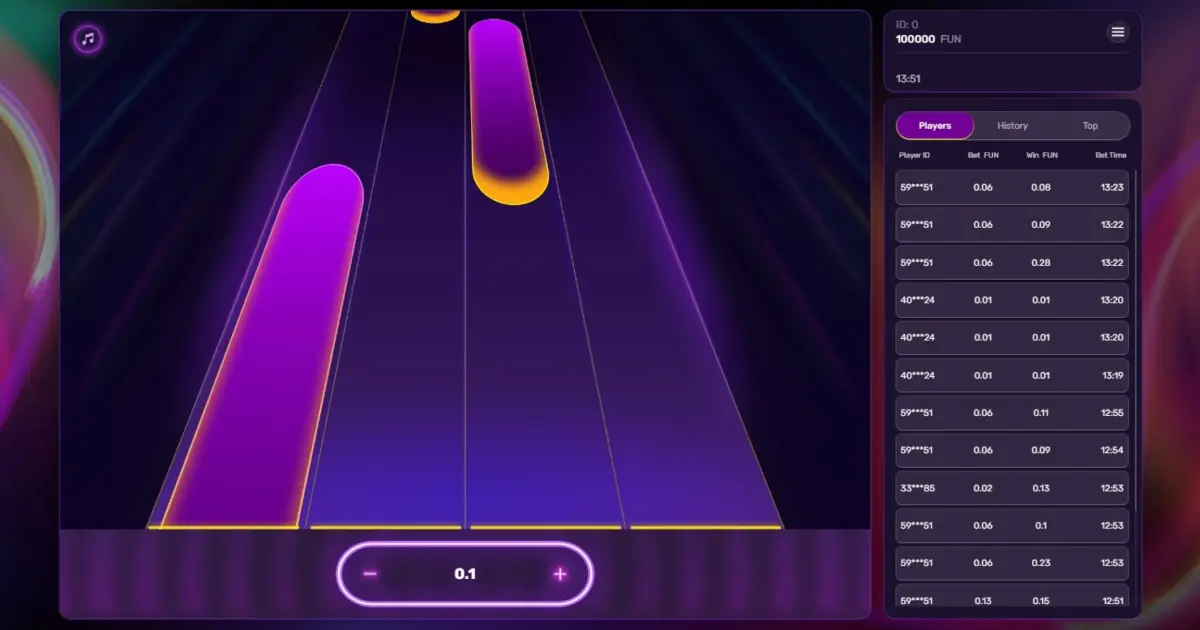
If you want a rising-multiplier game with a published RTP you can actually check, the Play Me crash game is a reasonable place to look: Galaxsys states a return of 97%, and a free demo is available so you can watch several dozen rounds before deciding whether the format suits you at all.
What it will not give you is anything to outsmart. The only decision in front of you is when to press cash out, and that decision changes how often you win versus how much you win, not the long-run maths. Everything below is written around that distinction.
Play Me at a glance
Here is the game-specific information Galaxsys has published. Anything not listed here — a maximum multiplier cap, bet limits, or whether the crash point is generated by a verifiable provably-fair seed — has not been confirmed for this title, so check the in-game information screen before you play for money rather than trusting a figure quoted on a third-party page.
| Detail | Value |
|---|---|
| Game name | Play Me |
| Provider | Galaxsys |
| Category | Crash games |
| RTP (stated) | 97.0% |
| Free demo | Available |
Galaxsys is a small studio in this listing with three crash titles, averaging 96.91% RTP across them. Play Me sits at the top of that range alongside Figoal, which carries the same 97% figure if you want a second Galaxsys round in the same RTP bracket.
How the multiplier and crash point actually work
Every round follows the same shape. The multiplier starts at 1.00x and climbs. At some point it stops, and the round is over. If you cashed out before that moment, you keep your stake multiplied by the number on screen when you pressed the button. If you were still in, the stake is gone. There is no partial loss and no third outcome.
The moment it stops — the crash point — is decided for each round independently, before the curve starts climbing. That independence is the part worth internalising. Five crashes below 1.50x in a row do not make a high multiplier more likely on the sixth round, and a 40x round does not need to be “paid back” by a string of instant crashes. The game holds no memory of what came before, so no amount of watching the history strip tells you anything about the next round.
The house edge lives in the distribution of those crash points across thousands of rounds, not in any individual one. That is the same mechanism as a slot’s RTP: a long-run average that no single spin or round is obliged to reflect.
What a 97% figure means for a crash game
Over a very large number of rounds, a 97% RTP means the game returns 97 units for every 100 staked, leaving a 3% house edge. That is a statistical average measured across far more rounds than any one person plays, not a prediction for your session. A hundred rounds can land well above or well below it.
Where it does matter is comparison. The average RTP across the crash games listed on this site is 96.2%, so Play Me sits 0.8 percentage points above it. On paper that is roughly a third less edge working against you than a typical listing, which is a genuine reason to prefer it over a similar game at 96% or lower — provided you treat the difference as marginal rather than transformative.
One caveat specific to this format: crash rounds resolve in seconds, so it is easy to stake far more per hour here than on a slower game. A better RTP applied to a much higher volume of stakes does not protect you. Total amount staked matters more than the percentage.
Cash-out timing: the real trade-off
Cashing out at 1.30x wins often and wins small. Holding for 20x wins rarely and wins big. Both sit under the same 97% return, because the distribution of crash points is built so that the higher target’s lower hit rate cancels out its larger payout. What you are choosing is variance, not expected value.
That is worth saying plainly because crash games attract more “systems” than almost any other format. Doubling after a loss, holding for a fixed multiplier until it hits, cashing out a third of the way to your last crash point, splitting a stake across two cash-out targets — none of these change the odds of any round. Some redistribute your results into a different shape, which can feel like an edge for a while. Progressions in particular concentrate a large loss into one bad round instead of spreading small losses out, which is why they look effective right up until they are not.
The one thing timing genuinely controls is how long your bankroll lasts and how it feels while it does. Decide your target before the curve starts, not while you are watching it climb.
Auto-cashout, auto-bet and what they change, and don’t
Crash games in this format typically offer auto-cashout, which exits automatically at a multiplier you set in advance, and auto-bet, which places the next stake without you pressing anything. Both are worth using, for one reason only: they remove the moment where you talk yourself into holding a little longer.
Neither improves your odds. The result of a round is already determined before you see the curve, so an automated exit at 2.00x and a manual one at 2.00x are identical outcomes reached by different routes. What automation buys you is consistency — the target you chose calmly is the target that actually gets executed.
The risk runs the other way. Auto-bet makes it trivially easy to play far more rounds than you intended, at a pace that removes the natural pause between decisions. If you use it, set a round count or a loss limit alongside it, and treat the session as ending when that limit is reached rather than when you feel like stopping.
Playing the Play Me demo
A free demo is available, which is the sensible starting point. Play Me free demo mode runs the same round structure with no stake attached, so you can sit through fifty or a hundred rounds and see for yourself how often the curve dies below 2x compared with how often it runs long. That distribution is the single most useful thing to understand before money is involved, and it is far more informative than any strategy article.
What the demo cannot do is predict a real-money session. It runs the same independent-round maths, but your specific results in it carry no information about what happens afterwards. A good demo run is not a signal.
Crash games are 18+, and the speed here is the thing to respect. Rounds resolve in seconds, so decide your budget before you open the game, treat it as money spent on entertainment rather than money at work, and stop at the number you set. If a session stops being fun, close it — the next round is not owed to you.
Verdict: who should play Play Me
Play Me suits someone who already enjoys the rising-multiplier format and wants a version with a published RTP toward the better end of what is available. The 97% figure, 0.8 points above the site average, is a real if modest advantage, and the free demo means the cost of finding out whether you like it is zero.
It is a poor fit if you are looking for depth. There are no features to unlock, no bonus rounds, and one decision per round. If you want a like-for-like comparison at the same RTP, Aviator is the most widely played game in this category and a useful benchmark, while Rocketon gives you a slightly lower 96.72% from the same studio. Whichever you land on, the maths is the constant — your cash-out button changes the shape of your results, never the odds behind them.
Frequently Asked Questions
Can I play Play Me for free without downloading anything?
Yes, a free demo is available for Play Me, and it runs in the browser with no download needed. It uses the same round structure and the same independent crash points as the real-money version, so it is a genuinely useful way to see how often the multiplier ends early before you stake anything.
What is the Play Me RTP and what does it actually mean?
Galaxsys states an RTP of 97% for Play Me, meaning a 3% house edge. That is a long-run average across an enormous number of rounds, not a forecast for your session. For context, the crash games listed here average 96.2%, so Play Me sits 0.8 percentage points above that benchmark.
Does cashing out at the right moment improve my chances in Play Me?
No. The crash point for each round is set independently before the multiplier starts climbing, so your cash-out timing changes how often you win and how much, never the expected return. Early exits win small and often, late exits win big and rarely, and both fall under the same 97% RTP.
Is Play Me provably fair?
Galaxsys has not published confirmation of provably fair mechanics for Play Me, so check the game's own information screen. In general, provably fair means the round uses a cryptographic seed you can verify afterwards to confirm the crash point was not altered mid-round. Without that, the game relies on standard certified RNG instead.
Who makes Play Me and how does it compare to Figoal?
Galaxsys develops Play Me, one of three crash titles from the studio listed here, averaging 96.91% RTP between them. Figoal is the closest sibling, carrying the same stated 97% RTP as Play Me, so the choice between the two comes down to presentation and pacing rather than any difference in house edge.




