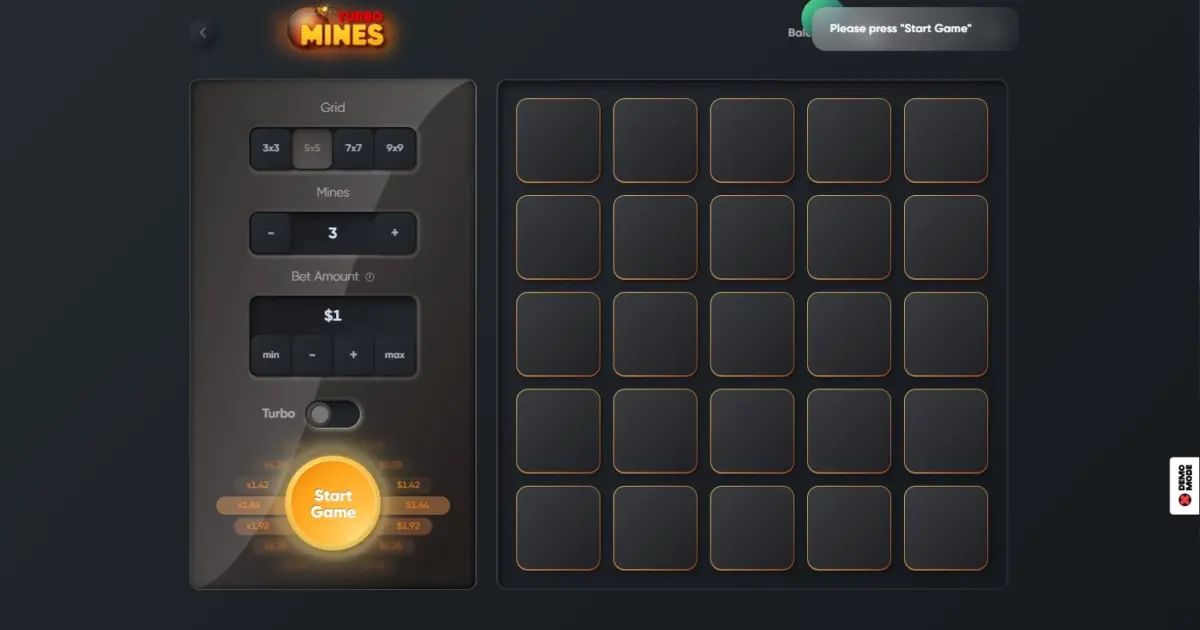
Turbo Mines is a crash game from Turbo Games with a published return to player of 95.0% and a free demo you can open without registering. It sits in the top 3% of crash titles by traffic in our index, which tells you the format is popular — not that the odds are generous. The honest summary: the maths is slightly below average for the category, the demo is genuinely free, and nothing you do with cash-out timing changes either fact.
Turbo Mines in one minute
A round opens at a 1.00x multiplier and climbs. At some point it stops — the crash point — and anyone still holding a live bet loses their stake. Cash out one tick before that and you are paid your stake multiplied by the number on screen. There is no third outcome.
What the turbo mines crash game adds is pace and presentation, not a different payoff structure. Turbo Games publishes 16 titles in this catalogue with an average RTP of 95.58%; this one is set at 95.0%, so it sits at the lower end even of its own provider’s range.
| Attribute | Detail |
|---|---|
| Provider | Turbo Games |
| Category | Crash games |
| Published RTP | 95.0% |
| Free demo | Available, no download |
| Provider average RTP | 95.58% |
| Index average RTP | 96.2% |
Two fields are absent from the provider’s published information: there is no stated maximum multiplier cap, and no confirmation of a provably-fair implementation. Treat both as unknown until you check the in-game information screen yourself.
Return to player: 95.0%
RTP is a long-run figure, not a per-session one. At 95.0%, the statistical expectation across a very large number of rounds is that 95 units are returned for every 100 staked, with the remaining 5 units forming the house margin. That margin is baked into the distribution of crash points — it is not deducted from any individual round, and it is not something a clever exit point can dodge.
For context, the crash games in our index average 96.2%, and Turbo Games’ own catalogue averages 95.58%. Turbo Mines is 1.2 percentage points below the index figure. On a 100-unit turnover that difference is small per session but compounds over volume — it is the single most decision-relevant number on this page.
If you see a different figure quoted elsewhere, check the game’s own information panel before staking anything. RTP variants exist across markets and builds.
Independent rounds and why streaks mean nothing
Each round’s crash point is generated independently. Whether that uses a verifiable seed published after the round or a standard random number generator, the outcome of the previous round has no influence on the next one. A run of crashes at 1.1x does not make a 10x round “due”. A run of high multipliers does not make a low one “due” either.
This is where most crash-game folklore falls apart. The curve looks like a pattern because it is drawn as a continuous line, but each round is a fresh draw from a fixed distribution. Charting previous crash points, watching for “cold” tables, or switching games after three low rounds are all reactions to noise.
What the distribution does tell you is shape: low crash points are common, high ones are rare, and the frequency of each is calibrated to produce that 95.0% long-run return. You are choosing where on that distribution to exit, not changing it.
If you want a comparison point inside the same provider, Mines runs on the same 95.0% figure with a different reveal mechanic, and Crash X is the straightest version of the format.
Setting an auto-cashout you can live with
Auto-cashout lets you pre-set a multiplier — say 1.5x or 2x — and the game exits for you the instant the curve reaches it. Auto-bet does the same for staking, running consecutive rounds without you clicking.
Be clear about what these tools are. They are discipline and risk-management instruments. They do not improve expected value by a single decimal point. An auto-cashout at 2x does not “lock in” a better return than a manual exit at 2x; it only removes the possibility that you freeze and ride the curve past your own plan.
The real trade-off is variance, and it is yours to choose. A low auto-cashout target hits often and pays small — but the crash point still eventually lands below it. A high target pays large and misses most rounds, and when it misses you lose the whole stake. Neither end of that spectrum changes the 95.0% expectation; they change how bumpy the road to it is.
Because rounds here resolve in seconds, the number of decisions per hour is far higher than in a slot. Set the auto-cashout before the round starts, not while the curve is moving.
Multiplayer bet feeds and what they don’t change
Crash games typically show a live feed of other players’ bets and cash-outs in real time. It is a social layer: you can see that someone exited at 1.8x while someone else is still riding at 4x, and the feed scrolls fast.
None of it is information. The other players’ exits are not predictions, and a large visible cash-out does not signal anything about the current round’s crash point — that value was already fixed when the round began. The feed is entertainment, and it is specifically designed to make waiting feel active.
It also creates a social pressure that costs money: watching someone else hold to 5x makes holding feel normal. Their bankroll, their stake size and their tolerance for losing it are not yours. If the feed is pushing your decisions, that is a reason to use auto-cashout and stop watching it.
Trying the demo first
Turbo Mines has a free demo, and it needs no download. That is worth using for one specific purpose: learning the interface and the timing of the curve so the real-money version holds no surprises. It is not a forecasting tool. Demo rounds are drawn from the same kind of distribution as paid rounds, so a good demo session says nothing about what a paid session will do.
Use the demo to find the auto-cashout level you are actually comfortable with, then treat that level as fixed.
One more thing, and it matters more here than in slower games. Crash rounds repeat every few seconds, which means the rate at which you can lose money is unusually high. Set a budget before you open the game, not after. 18+. This is entertainment you pay for, not income, and no cash-out strategy turns it into either.
Who should play Turbo Mines
Turbo Mines suits players who want fast, simple rounds, a clear single decision per round, and who are comfortable with a 95.0% RTP that trails the 96.2% category average. The demo makes it easy to find out whether the pace suits you before any money is involved.
It suits you less if you are looking for the best available return in the crash category — Towers is another Turbo Games title at the same 95.0%, and the wider index has games above both. And it suits you not at all if you are hoping to find a timing pattern, because there isn’t one.
Play it as a fast, cheap-entertainment format with a fixed exit rule and a pre-set budget, and the maths will do exactly what it says it does.
Frequently Asked Questions
Can I play Turbo Mines for free?
Yes. Turbo Mines has a free demo available with no download or registration required, so you can learn the interface and test auto-cashout settings without staking anything. Demo rounds use the same kind of crash-point distribution as paid rounds, which means a strong demo session tells you nothing about how a real-money session will go.
What is the RTP of Turbo Mines and what does it mean?
Turbo Games publishes a 95.0% return to player for Turbo Mines. That means across a very large number of rounds, 95 units are returned per 100 staked, with the 5-unit margin built into the distribution of crash points. It is 1.2 percentage points below the 96.2% average across crash games in our index.
Does cash-out timing or any system change the odds in Turbo Mines?
No. Cashing out earlier locks in a smaller multiplier more often; waiting risks the whole stake for a bigger one. That is a variance trade-off you control, not an edge. Auto-cashout enforces discipline but does not alter the 95.0% expected return, and no timing rule or pattern does either.
Is Turbo Mines provably fair?
The provider's published information for Turbo Mines does not confirm a provably-fair implementation, so treat that as unverified. In general, provably fair means the round's result is generated from a seed you can check afterwards to confirm the crash point was not altered after you placed your bet. Check the in-game information screen for specifics.
Who is the provider behind Turbo Mines?
Turbo Games, a studio with 16 titles in our index and an average RTP of 95.58% across them. Turbo Mines is set at 95.0%, slightly below that provider average. If you want a same-provider comparison, Mines runs on the same 95.0% figure with a different reveal mechanic.




