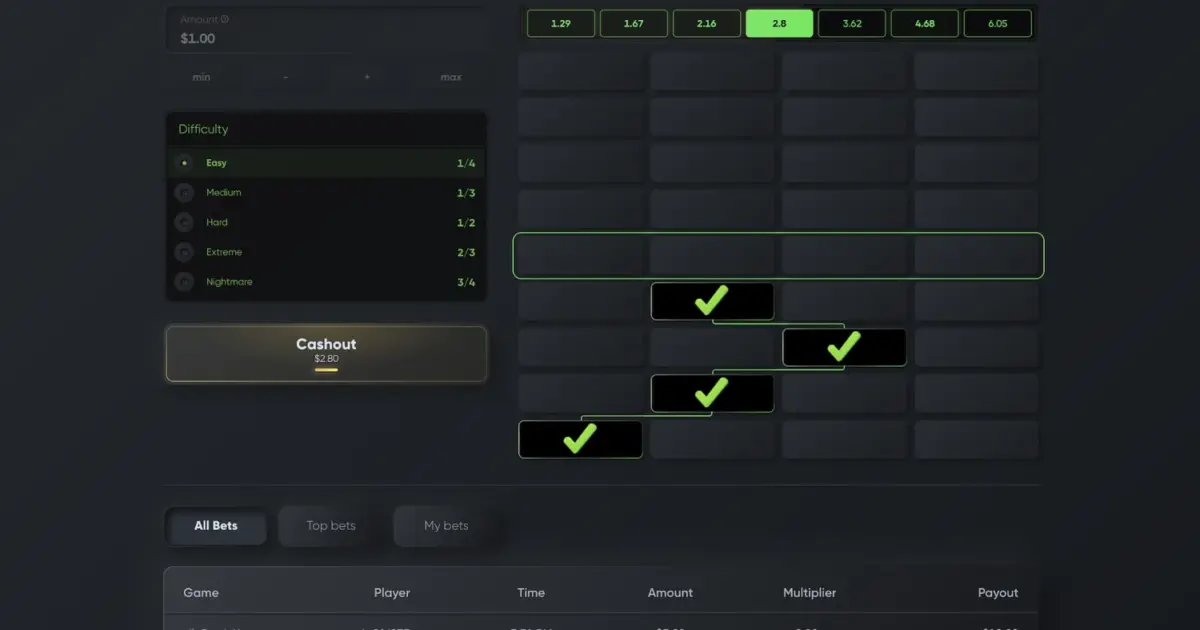
Towers is a crash game from Turbo Games that sticks to the format’s core loop: a rising multiplier you can cash out of at any moment, or lose your stake if the round crashes first. With a published RTP of 95% and a free demo available, it gives you a straightforward way to experience the mechanic without risking money. Here is what matters before you play.
How Towers plays
Every round of Towers starts at a 1.00x multiplier and begins climbing. At a randomly determined point — the “crash point” — the round ends. If you have cashed out before that moment, you win your stake multiplied by the number on screen when you clicked. If the round crashes while you are still in, you lose the entire stake. There is no third outcome.
The crash point for each round is generated independently. A run of low crashes does not make a high crash more likely next round, and a string of high crashes does not make a low crash “due.” Each round is a fresh, unconnected event. You can set an auto-cashout to automatically leave at a chosen multiplier, which enforces discipline on your timing, but it does not change the underlying odds. Seeing other players’ cash-outs in a live bet feed is a social layer on top of the same maths — it does not affect your individual result.
| Provider | Turbo Games |
|---|---|
| RTP | 95.0% |
| Free demo | Yes |
| Site-wide average RTP | 96.2% |
Turbo Games and this game
Towers comes from Turbo Games, a provider with 16 games in its portfolio and an average published RTP of 95.58% across those titles. That average sits slightly below the broader crash-game corpus average of 96.2%, which means Towers, at its 95% RTP, is on the tighter side of what you will find across the category. The difference is small in absolute terms — about 1.2% below the corpus average — but it is worth knowing if you are comparing options.
If you want to explore other Turbo Games titles with the same 95% RTP, both Mines and Crash X use the same published return figure. Turbo Mines is another option from the same provider with the same RTP, giving you a consistent baseline if you want to compare different game formats within the Turbo Games library.
Reading the 95% figure
The 95% RTP (Return to Player) means that, over a very large number of rounds, the game is designed to return 95 cents of every dollar wagered back to players collectively. This is not a promise for any individual session. In the short term, results will swing wildly above or below that number. You could hit a big multiplier early and walk away ahead, or you could lose your session budget before anything notable happens.
What the 95% figure tells you concretely is the house edge: Towers retains 5% of all money wagered over time. Compared to the corpus average RTP of 96.2% for crash games, Towers’ 95% RTP means the house keeps an extra 1.2 cents per dollar wagered on average. That is a real difference if you plan to play a large volume of rounds, but for a casual session it is dwarfed by the natural variance of the crash mechanic.
Provably fair, explained in general terms
Many crash games, including titles from Turbo Games, use a provably fair system. In general terms, this means the crash point for each round is determined by a combination of a server seed, a client seed, and sometimes a nonce, all of which are committed to before the round starts. After the round, you can verify that the result was not altered after you placed your bet.
Provably fair does not mean the game is more likely to pay out. It means the outcome was locked in before you acted and you can check that fact yourself. It is a transparency mechanism, not an advantage play tool. If Towers offers provably fair verification, you will find the details and seed information in the game’s own interface — check there before relying on any third-party claims about how the system works.
Why no cash-out system changes the odds
You will encounter claims that cashing out at a specific multiplier — say, always at 1.5x or using a one-third rule — somehow shifts the odds in your favor. It does not. Every round’s crash point is independently determined. Your cash-out timing controls your variance: cashing out early gives you smaller, more frequent wins, while waiting for higher multipliers gives you bigger but rarer payouts. The expected value remains the same regardless of your strategy.
Auto-cashout and auto-bet settings are tools for managing that variance and enforcing consistency, not for improving your edge. The same applies to any progression system you might see recommended — increasing your bet after a loss or following a pattern does not change the underlying 5% house edge. The only decision that is truly yours is how much risk you are comfortable with on each round.
Free play before real money
Towers offers a free demo, so you can experience the crash mechanic without spending anything. This is useful for getting a feel for how fast rounds move, how the multiplier climbs, and how it feels when a round crashes at a low number. It is not useful for predicting real-money outcomes — the demo uses the same independent randomness, and any streak you see in free play has no predictive power.
Set a budget before you switch to real money, and treat every session as entertainment you are paying for, not a source of income. Rounds in crash games repeat quickly — faster than most casino games — which means your bankroll can move fast in either direction. Stick to what you planned to spend, and stop when it is gone. You must be 18 or older to play for real money.
Final take on Towers
Towers is a clean, no-frills crash game with a published 95% RTP and a free demo for trying the mechanic risk-free. It does not reinvent the format: you get the standard rising multiplier, the same independent round randomness, and the same house edge built into the distribution of crash points. What you see is what you get.
The 95% RTP is slightly below the crash-game average of 96.2%, so if RTP is your primary comparison point, there are options that return a fraction more over time. But the difference is small, and Towers’ simplicity and Turbo Games’ track record — 16 titles with a consistent 95.58% average RTP — make it a reliable choice for the format. Use the free demo to see if the pace and feel suit you, and remember that no timing strategy changes what the maths already decided before the round started.
Frequently Asked Questions
Can I play Towers for free before betting real money?
Yes, Towers offers a free demo that lets you experience the crash mechanic without risking any money. The demo uses the same random system as real-money play, so it is a good way to get comfortable with the pace and interface, but results in free play do not predict real-money outcomes.
What is the RTP of Towers and what does it mean?
Towers has a published RTP of 95%, meaning the game is designed to return 95 cents per dollar wagered over a very large number of rounds. This implies a 5% house edge. In any single session, actual results will vary significantly above or below that figure due to the natural randomness of crash points.
Does cashing out at a specific multiplier improve my chances?
No. Each round's crash point is independently determined, so your cash-out timing controls your variance — smaller, more frequent wins versus larger, rarer ones — but does not change the expected value. No pattern, progression, or timing rule shifts the underlying 5% house edge in your favor.
What does "provably fair" mean for a crash game like Towers?
Provably fair means the crash point for each round is locked in before you place your bet, using a combination of server and client seeds that you can verify after the round. It is a transparency mechanism that proves the result was not manipulated, not a system that makes the game more likely to pay out.
How does Towers compare to Crash X from the same provider?
Both Towers and Crash X are published by Turbo Games with the same 95% RTP, so the long-run house edge is identical. The difference is in presentation and feel rather than maths — try both in free demo to see which format you prefer. Other Turbo Games titles like Mines also share the same 95% RTP.




