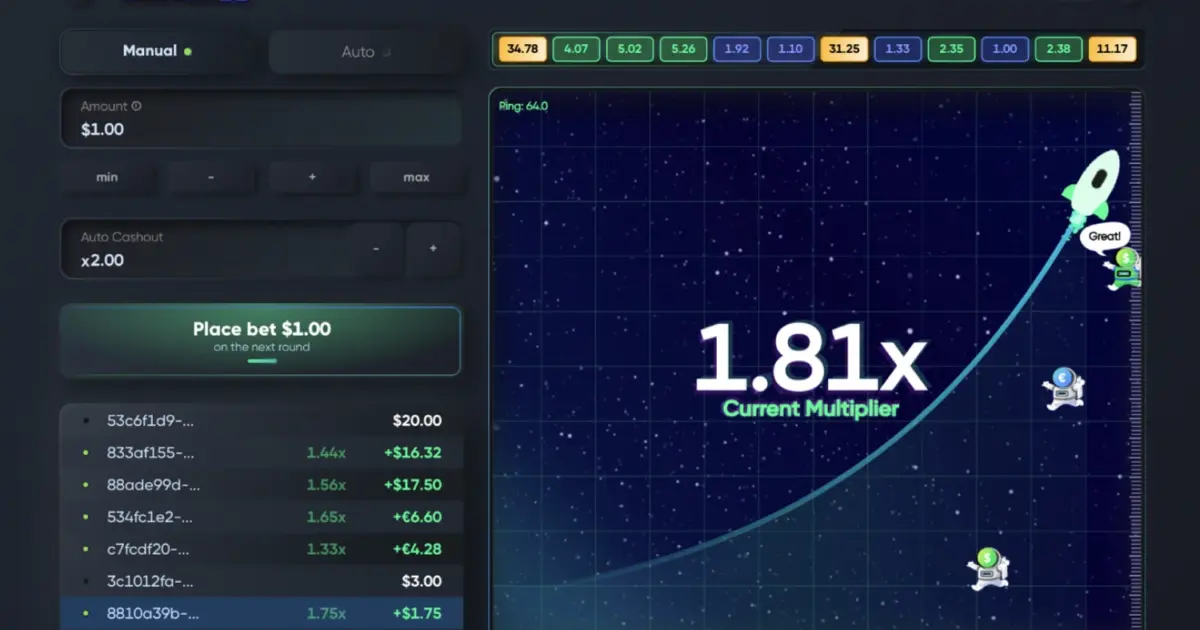
If you want a crash game with a published RTP figure and a free demo to try first, crash x from Turbo Games covers both. The number that matters most is the one the studio states: 95%, which is below the 96.2% average across the crash and instant games reviewed here. Everything else about the game is the standard crash format, and that format is worth understanding before you put money behind it.
The short answer: it is a reasonable pick if you already enjoy the rising-multiplier format and want short rounds you control, and a poor pick if you are hunting for the highest published return you can find.
Crash X at a glance
Here is what Turbo Games has actually published about this game, and nothing beyond it.
| Detail | Value |
|---|---|
| Provider | Turbo Games |
| Game type | Crash game |
| RTP | 95% |
| Free demo | Available |
Turbo Games has 16 titles in our database, averaging 95.58% RTP, so 95% is a little under even its own house average. Note what is not in that table. The studio has not published a maximum multiplier cap for this game in the information available here, and there is no confirmation either way as to whether rounds are generated with a verifiable provably-fair seed or a standard RNG. If either of those matters to you, check the game’s own information screen inside the client before you bet real money, and treat any cap or fairness claim you see quoted on a third-party page with suspicion.
It ranks sixth in this section and sits in the 98.2nd percentile for popularity, so plenty of people are playing it. Popularity is not a quality signal, though. It tells you the game is easy to find and quick to understand, not that it pays better than anything else.
How the multiplier and crash point actually work
Every round follows the same shape. The multiplier starts at 1.00x and climbs. At some point it stops, and that stopping point, the crash point, was decided the instant the round began. If you cashed out before it, you win your stake multiplied by the figure showing at that moment. If you were still in, the stake is gone. There is no third outcome, no partial refund, no consolation.
The crash point for each round is generated independently of every round before it. This is the single most important thing to internalise, because the presentation works against it. You will watch a sequence of rounds ending at 1.1x, 1.03x, 1.4x and feel that a big one has to be coming. It does not. The next round has exactly the same distribution of possible crash points as the one before, regardless of what just happened. The reverse holds too: a run of 20x and 50x crashes does not mean the game is about to turn cold.
The house edge lives in that distribution, not in any individual round. Low crash points are far more common than high ones, and the shape of that curve is what produces a fixed long-run return over a very large number of rounds. No single round is rigged for or against you. The maths simply does not need any single round to be.
What a 95% figure means for a crash game
Read 95% as a long-run average, not a promise about your session. Across a very large number of rounds, the game is designed to return 95 units for every 100 staked, meaning the built-in house edge is 5%. That figure is a property of the crash-point distribution over an enormous sample, and it says nothing whatsoever about the next hour of play.
Over a short session, results scatter widely in both directions. That scatter is the whole reason the format is entertaining, and also the reason a session outcome tells you nothing about whether the stated RTP is accurate.
For context, the average across the games in this section is 96.2%, so the Crash X rtp is 1.2 percentage points below it. On a 100-unit turnover that is a difference of just over one unit in expected cost, which sounds small and compounds quickly across a format where rounds finish in seconds. If published return is your main filter, there are better-priced crash games. If you like this particular one, at least go in knowing you are paying slightly above the going rate for it.
Cash-out timing: the real trade-off
Timing is the only decision you make, and it is genuinely a decision, but it is a decision about variance, not about odds. Cashing out at 1.2x wins often and wins little. Holding for 10x wins rarely and wins a lot. Both settings, played long enough, grind toward the same 95% expected return, because the distribution of crash points is doing the work either way.
This is where most crash-game advice goes wrong. Progressions that double your stake after a loss, rules about cashing out a third of your position, patterns based on the last ten rounds, none of them shift expected value by a fraction of a percent. They redistribute your outcomes. A doubling progression converts many small wins into one rare, very large loss. That can feel like an edge for a long stretch, right up until it does not.
What timing genuinely controls is how long your budget lasts and how bumpy the ride is. Low targets stretch a session with frequent small returns. High targets burn through a balance faster with occasional big returns. Pick the one you would rather sit through and stop trying to solve the curve, because there is nothing in it to solve.
Auto-cashout, auto-bet and what they change, and don’t
Crash games generally offer auto-cashout, which exits automatically at a multiplier you set in advance, and auto-bet, which repeats a stake across a set number of rounds. Both are useful. Neither is an advantage.
Auto-cashout removes your reaction time from the equation. If your plan is to take 1.5x consistently, setting it means you actually take 1.5x rather than freezing and watching the curve die at 1.48x. That is worth something in a format where rounds resolve in a couple of seconds. Auto-bet does the same for stake discipline, since a fixed stake across a fixed round count is much harder to drift away from than manual clicking.
What they do not do is change the crash-point distribution. An automated 2x target and a hand-clicked 2x target face identical odds. The same applies to any live bet feed showing other players cashing out around you. That is a social layer over the same maths, and someone else taking 40x on the round you lost has no bearing on your own next round.
Playing the Crash X demo
A free demo is available, which makes it worth ten minutes before any deposit. Use it to learn the interface, find out where the cash-out button sits, and test whether auto-cashout behaves the way you expect. That practical familiarity matters when rounds last seconds.
What demo play cannot do is forecast real-money results. Demo rounds are independent of each other and independent of anything that happens later with real stakes, so a lucky demo streak is information about nothing at all. Treat it as a tutorial, not a trial run.
Crash games are 18+ and are entertainment you pay for, never income. Decide what you are willing to lose before your first round, treat that figure as spent, and walk away when it is gone. Rounds this short make it unusually easy to lose track of both time and turnover, so a limit set in advance does more work here than in most formats.
If you want to compare Turbo Games’ other instant titles, Mines and Towers both publish the same 95% figure with a different decision structure, and Turbo Mines is the faster variant of the same idea.
Verdict: who should play Crash X
Play it if you like the format, want short rounds where you control the exit, and are comfortable with a 95% published return. The demo makes the decision cheap, and the mechanics are transparent enough that you will understand the game fully within a few rounds.
Skip it if you are optimising for return, since 96.2% is the section average and options above it exist. Skip it too if you have been reading about cash-out systems, because there is nothing here for a system to work on. The multiplier curve is the same for everyone, every round.
Before depositing, check the game’s information screen for the maximum multiplier and any fairness verification, since neither is confirmed in the published data available here.
Frequently Asked Questions
Can I play Crash X for free?
Yes. A free demo of Crash X is available, so you can learn the interface and test auto-cashout settings without staking money. Use it to get comfortable with how fast rounds resolve. Demo results are independent of real-money results, though, so a good run in the demo predicts nothing about later play.
What is the Crash X RTP and what does it actually mean?
Turbo Games publishes 95% for Crash X, meaning a 5% house edge built into the distribution of crash points. That is a long-run average over an enormous number of rounds, not a session forecast. It sits 1.2 points below the 96.2% average across the crash games reviewed here.
Does cashing out at a set multiplier improve my odds in Crash X?
No. Cash-out timing changes your variance, not your expected value. Taking 1.2x wins small and often, holding for 20x wins big and rarely, and both trend toward the same 95% return. Progressions, doubling systems and patterns based on recent rounds do not alter the underlying maths at all.
Is Crash X provably fair?
The published data available here does not confirm it either way, so check the game's own information screen before playing for money. Provably fair generally means each round's crash point derives from a seed you can verify afterwards. The alternative, a standard RNG, still produces independent rounds and the same stated RTP.
Who makes Crash X and how does it compare to Mines?
Turbo Games develops Crash X and has 16 titles in our database, averaging 95.58% RTP. Mines carries the same 95% figure but a different decision structure, since you reveal tiles rather than watch a rising multiplier. Choose between them on which type of decision you prefer, not on published return.




