Spaceman is worth your time if you want a fast, single-decision game and you understand that the decision is about variance, not about odds. It is a Pragmatic Play release with a published RTP of 96.5%, and a free demo is available, which is the sensible place to start. If you are hoping to find a cash-out pattern that beats the maths, this is not the game for that, and neither is any other crash game.
What kind of crash game is Spaceman?
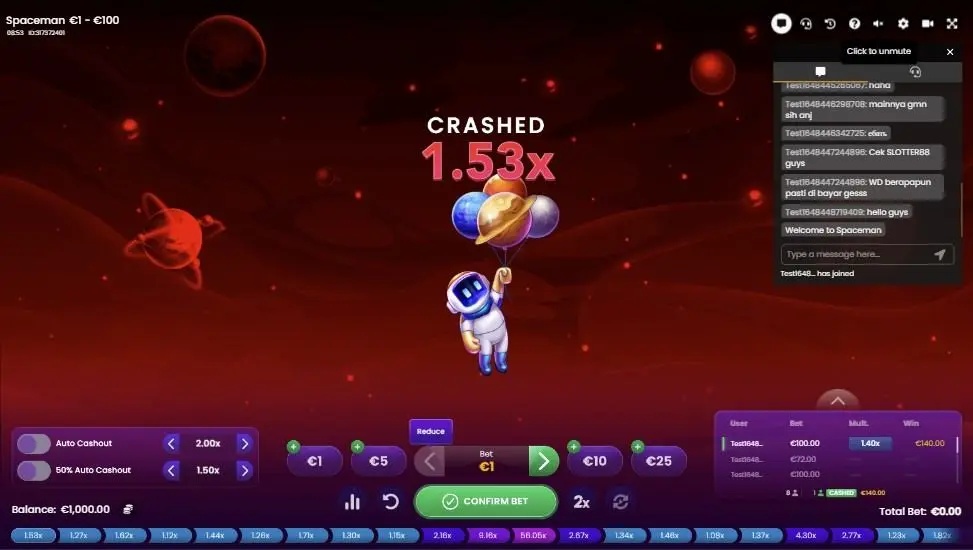
The spaceman crash game belongs to the crash format rather than the reel-spinning one. A round begins at a 1.00x multiplier and that number climbs. At some point, decided before the climb is displayed, the round ends. You have one job: press cash out before it does. Cash out in time and your stake is returned multiplied by whatever the counter read at that instant. Stay in when the round ends and the stake is gone. There is no third outcome, no partial consolation, no bonus round waiting behind the multiplier.
That makes it a very short game loop. Rounds finish in seconds, which is why the format tends to see far more bets per hour than a slot does. It also means the game gives you almost nothing to learn beyond risk tolerance. There are no paylines to study and no feature to trigger. What you are choosing, every round, is how much multiplier you are willing to chase against how often you are willing to lose the stake outright.
Pragmatic Play is a large, widely licensed studio, and Spaceman is one of two crash titles listed for them here. Beyond the theme label, this article will not describe the visuals or the interface, because FACTS does not cover them and guessing would not help you.
| Provider | Pragmatic Play |
|---|---|
| RTP | 96.5% |
| Free demo | Yes |
| Site-wide average RTP | 96.2% |
The maths of a single round
Each round’s end point is generated independently of every round before it. Crash games typically do this with either a provably fair scheme, where a seed is published afterwards so you can verify the result was not altered mid-round, or a standard certified RNG. FACTS does not state which method Spaceman uses, so check the game’s own information screen before you assume either one.
Independence is the part players most often get wrong. Five rounds ending below 1.50x does not make a high multiplier more likely on the sixth. Five rounds ending above 20x does not make a crash overdue. The counter has no memory, and no sequence you observe carries information about what comes next. Language like hot, cold or due describes a feeling, not a mechanism.
The cash-out decision is a genuine trade-off, but a narrow one. Taking 1.30x every round wins often and pays little. Waiting for 15x wins rarely and pays a lot. Both choices sit on the same expected-value line: you are moving along a distribution, not shifting it. A one-third rule, a doubling progression after losses, or cashing out manually rather than automatically does not alter that line by any amount. Progressions in particular change how quickly your balance can swing, which is not the same as changing what it is worth.
Where the 96.5% comes from
Pragmatic Play publishes a return-to-player figure of 96.5% for Spaceman. That number is a long-run average across an enormous number of rounds, and it is built into the statistical distribution of end points rather than into any individual round. In other words, the edge is in how often high multipliers appear relative to low ones, not in a hidden adjustment applied while you are watching the counter rise.
Read the figure the way you would read a slot’s RTP. Over millions of rounds, the game returns about 96.5 cents per unit staked, leaving roughly 3.5% as house edge. Over your own session of a few dozen rounds, the outcome can sit far above or far below that, in either direction. RTP tells you what the game costs to play over time. It does not tell you what tonight will look like.
For context, the crash games covered on this site average about 96.2% RTP, so 96.5% is marginally above that midpoint. Pragmatic Play’s two crash titles here average 96.75%. These are small gaps in percentage terms, but they compound with volume, and volume is exactly what a game with seconds-long rounds produces. Your total stake per hour matters more here than in almost any other format.
Reading the rules and max multiplier before you bet real money
FACTS does not include a maximum multiplier for Spaceman, and it does not confirm bet limits, a release date or whether the game runs a provably fair verification system. That is a gap worth closing yourself rather than filling with a number from a third-party page. Any maximum-win figure you see quoted elsewhere for this title should be treated as unverified until you see it on the game’s own information screen.
When a crash game does publish a cap, remember what it is: a ceiling the studio has set on the highest multiplier the counter can display, not a typical result and certainly not a promise. Caps sit far out in the tail of the distribution, which is precisely why they get advertised.
Before staking money, open the rules panel and check four things: the RTP the game itself states, the minimum and maximum bet, whether auto-cashout and auto-bet are available, and how the provider describes the fairness method. Auto-cashout is genuinely useful, because it commits you to a multiplier before the round starts and removes hesitation from the moment that matters. It is a discipline tool. It does not improve your odds by a single fraction of a percent.
How Spaceman compares to other crash games
Within the same studio, High Flyer is listed at 97.0% RTP, half a point above Spaceman, which is the more meaningful comparison if you are choosing between two Pragmatic Play titles rather than two themes. Half a percentage point sounds trivial and is trivial over ten rounds; across thousands of fast rounds it is the difference you are actually paying.
Outside the provider, Aviator is the format’s most familiar reference point and also sits at 97.0%, so it is worth a look if headline RTP is your main filter. Mines takes a different route to the same kind of decision, at 95.0% RTP, with a grid you reveal step by step instead of a multiplier that climbs on its own clock. Its lower figure and slower pace change the shape of a session more than they change the underlying logic.
The honest summary is that these games differ mainly in RTP, pace and presentation. None of them gives you a lever that moves the odds, and switching between them is a preference decision rather than a strategic one.
Free demo and staying in control
A Spaceman free demo is available, and it is the right way to get familiar with the cash-out timing, the auto-cashout controls and how quickly rounds cycle. Use it to find out whether you actually enjoy the loop before money is involved. What the demo cannot do is predict real-money results: it runs the same independent rounds, so a good demo run tells you nothing about a paid one.
Play only if you are 18 or older, and decide before you start what you are willing to lose that evening. That figure is the price of the entertainment, not an investment or a source of income. Fast rounds make it unusually easy to stake far more than intended in a short stretch, so set a deposit limit and a time limit and treat both as fixed. If chasing a loss ever starts feeling like a plan, stop the session.
Final verdict
Spaceman is a competent, straightforward entry in a format that rewards clear thinking over pattern-hunting. The 96.5% RTP is slightly above the average for crash games covered here but below both High Flyer and Aviator, so if RTP is your deciding factor there are better numbers available. The free demo removes any reason to learn the timing with real stakes.
What FACTS does not give us is the maximum multiplier, bet limits or a confirmed fairness method, and those blanks are worth checking in the game itself rather than trusting a figure from elsewhere. Go in understanding that every round is independent and that your only real control is how much variance you accept, and the game does what it says it does.
Frequently Asked Questions
Can I play Spaceman for free without downloading anything?
Yes. A free demo of Spaceman is available, so you can try the cash-out timing and the auto-cashout controls without staking money and without installing software. Treat it as a way to learn the pace, not as a preview of paid results, since demo rounds are generated independently just like real ones.
What does Spaceman's 96.5% RTP actually mean for me?
Pragmatic Play publishes a 96.5% return-to-player figure, meaning the game returns roughly 96.5 cents per unit staked averaged over an enormous number of rounds, leaving about 3.5% house edge. Your own session can land well above or below that. RTP describes long-run cost, not what any single evening will do.
Does cashing out at a set multiplier improve my chances in Spaceman?
No. Cash-out timing changes variance, not expected value. Taking 1.30x wins often for little; waiting for 15x wins rarely for more. Auto-cashout enforces discipline and removes hesitation, which is genuinely useful, but it does not shift the odds. No progression or one-third rule changes the underlying maths.
What does provably fair mean, and is Spaceman provably fair?
Provably fair means the round's outcome comes from a seed you can verify afterwards, confirming nothing was altered mid-round. FACTS does not state whether Spaceman uses that method or a standard certified RNG, so check the game's own information screen before assuming either. Both approaches produce independent rounds.
How does Spaceman compare to Aviator?
Aviator is listed at 97.0% RTP against Spaceman's 96.5%, so the headline figure favours Aviator by half a percentage point. Both follow the same rising-multiplier logic with independent rounds and a single cash-out decision. The difference is small per round but compounds across the high volume these fast games produce.




