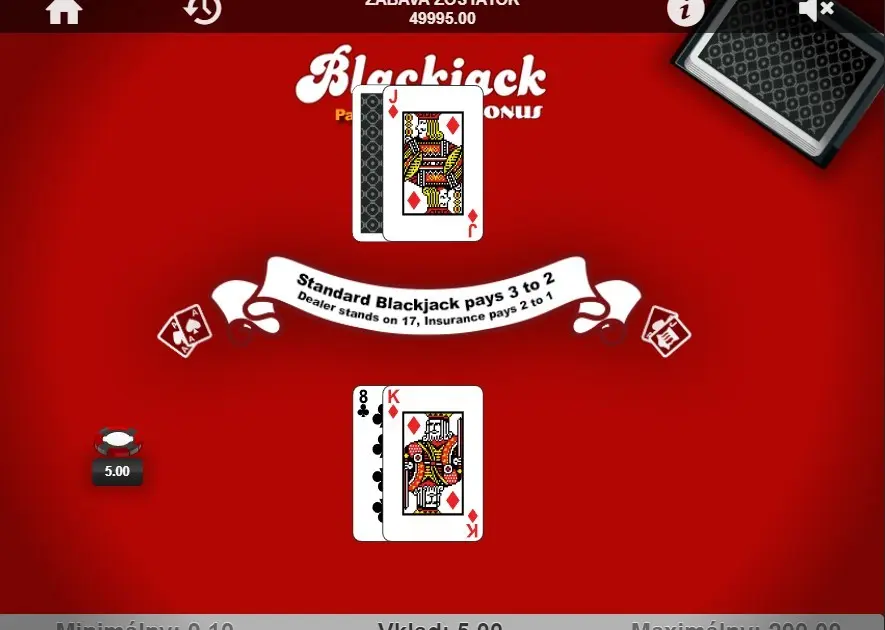
Blackjack Bonus sits in the upper tier of available RTP figures at 99.8%, but 1X2 Gaming leaves several weight-bearing rules unstated in public materials. Before you commit real money, open the in-game paytable and confirm the blackjack payout ratio, deck count, and whether the dealer hits soft 17. Those three variables alone can swing the house edge by more than a full percentage point.
What kind of blackjack is Blackjack Bonus?
The title suggests the table includes a side-bet or bonus-payout feature, a common structure in single-table releases from smaller studios. 1X2 Gaming’s catalogue carries only two blackjack titles, and both post the same 99.8% RTP, indicating a shared ruleset or at least a consistent house-edge target. The name itself offers no detail about deck count, hole-card procedure, or split rules. Treat “Bonus” as a marketing label rather than a rules family—European Blackjack and Atlantic City both describe codified rulesets, but “Bonus” does not. You will need to check the game’s own rules screen to see which variant this actually is and whether the bonus feature takes the form of a separate side bet, an enhanced payout for specific outcomes, or simply a branding choice with no mechanical difference from standard blackjack.
Return to player: 99.8%
A 99.8% RTP translates to a 0.2% house edge, which ranks among the lowest you will find in any casino category. For context, the average blackjack table in this corpus sits at 99.41%, so Blackjack Bonus delivers 0.39 percentage points more than the benchmark. That gap sounds modest, but over a hundred-hand session it means giving back £20 per £10,000 wagered instead of £59, assuming you play every decision according to basic strategy. The published RTP is not a forecast of your session result—it is the long-run theoretical return when you make the mathematically optimal play on every hand. Any departure from basic strategy, whether through guesswork, intuition, or a progression system, increases the house edge and lowers your realised RTP. Casual play typically costs an additional 1–2% in errors, so a player unfamiliar with the strategy chart will see an effective RTP closer to 98% or lower, erasing most of the advantage this table offers.
| Attribute | Value |
|---|---|
| Provider | 1X2 Gaming |
| RTP | 99.8% |
| House edge | 0.2% |
| RTP versus category average | +0.39% |
| Free demo available | Yes |
Deck count, dealer rules and the payout that matters most
1X2 Gaming does not publish the deck count for Blackjack Bonus, and that omission matters. A single-deck game with otherwise identical rules carries a house edge roughly 0.5% lower than an eight-deck shoe, because the removal of each card has a larger effect on the remaining composition. Similarly, whether the dealer stands or hits on soft 17 shifts the edge by about 0.2%—standing favours the player. You must check the in-game rules to find these details before you can calculate the true house edge for your session.
The blackjack payout ratio is the single most critical rule. A 3:2 payout is standard and factored into every published RTP figure; it means a £10 bet on a natural blackjack returns £15 in profit. A 6:5 payout returns only £12, and that change alone costs you roughly 1.4% in edge, turning a competitive 99.8% RTP into an unattractive 98.4%. Some tables advertise player-friendly rules—liberal doubling, surrender, re-split aces—then bury a 6:5 blackjack payout in the fine print, and that single rule wipes out every other concession. If Blackjack Bonus uses 6:5, walk away. If it pays 3:2, confirm it in writing in the paytable before you fund the session. No other rule comes close to this impact.
Other variables worth checking: whether you can double after split, how many times you can re-split, whether surrender is available, and whether the dealer takes a hole card or uses European no-hole-card procedure. Each one moves the edge by a few hundredths of a percent, and together they determine whether the 99.8% figure is achievable or optimistic.
Playing your first ten hands
Basic strategy is a solved chart, not a heuristic. It tells you the mathematically optimal play for every possible two-card hand against every dealer upcard, and it exists because blackjack is a finite-state game with known probabilities. The strategy does not eliminate the house edge—no legal play does—but it minimises it to the figure published as RTP. If you deviate from the chart, you hand back edge to the house. There is no room for intuition, and there is no such thing as a hand being “due.”
For your first ten hands, expect normal variance. You might win seven and lose three, or lose six and win four. A ten-hand sample tells you nothing about the table’s fairness or the RTP’s accuracy. Blackjack variance is moderate compared to slots—your bankroll will not double or halve in ten hands unless you are betting a reckless fraction of your roll—but short-term swings in either direction are structurally inevitable. If you are learning basic strategy, print the chart and keep it visible. The demo mode on Blackjack Bonus exists precisely so you can rehearse decisions without cost. Use it until you can play a twenty-hand sequence without hesitation, then consider real money.
One mechanical note: if Blackjack Bonus uses an RNG rather than a live shoe, the deck reshuffles after every hand. That means card counting does not work. Counting relies on depletion—tracking which cards have left the shoe to infer what remains—but if the deck resets each round, no information carries forward. State this plainly to anyone who suggests otherwise: counting is not viable against an RNG table, and any system that claims to beat this game is selling you a loss.
Side bets: the maths behind the temptation
If Blackjack Bonus includes a side bet—Perfect Pairs, 21+3, or a proprietary bonus wager tied to the title—approach it with clarity: side bets carry a materially higher house edge than the base game, often in the range of 3% to 8%, and sometimes higher. A 0.2% edge on the main bet and a 5% edge on a side bet are not compatible in the same session strategy. You cannot offset a high-edge wager by playing the low-edge game well; each bet resolves independently, and the side bet’s cost accumulates every time you place it.
Insurance is the most common side bet, offered when the dealer shows an ace. At standard 2:1 odds, insurance carries a house edge around 7% in a multi-deck game, far worse than the main bet. It is not a hedge, and it is not a safety play—it is a separate wager with poor value. Decline it unless you are counting in a live shoe with a demonstrated surplus of tens, which does not apply here if the table uses an RNG.
If you want to play a side bet for entertainment, budget it as a separate cost and do not include it in your RTP expectation. The 99.8% figure applies only to the main blackjack bet, and mixing side bets into your strategy will lower your session return, sometimes dramatically. For a similar single-provider experience with transparent rules, try Red Queen Blackjack, which shares the same 99.8% RTP from 1X2 Gaming. If you prefer a more common variant with published rules, Multihand Blackjack offers 99.5% RTP and the ability to play multiple hands simultaneously, smoothing variance.
Session limits and bankroll
A 0.2% house edge means you are expected to lose £2 per £1,000 wagered over the long run, but individual sessions will deviate widely from that figure. Variance ensures that some sessions end in profit and others in loss, regardless of perfect play. Your bankroll should absorb a realistic losing streak without forcing you to stop mid-session or chase losses with larger bets. A common rule of thumb is to bring at least 50 times your base unit—if you are betting £5 per hand, carry a £250 session roll. That gives you room to weather a bad run without reloading impulsively.
Set your budget before you open the table, and treat it as the cost of entertainment, not as investment capital. Blackjack is a negative-expectation game even at 99.8%, and no staking system—Martingale, D’Alembert, or any other progression—changes the expected value. Progressions alter the shape of variance, usually by trading frequent small wins for infrequent large losses, but they do not reduce the house edge. If you double your bet after a loss, you will either recover quickly or exhaust your roll before the streak ends. Neither outcome improves your long-term return.
Set a win target and a loss limit, and enforce both. If you decide to stop at a £100 profit or a £150 loss, leave the table when you hit either mark. Playing longer does not improve your odds—it only exposes you to more edge. This is entertainment with a cost. Keep it affordable, never gamble with money you cannot lose, and never frame any session as income or a solution to financial pressure. 18+ only.
For a well-documented alternative with a strong reputation, Classic Blackjack posts a 99.28% RTP and clear rule disclosure. If you want a more volatile American-rules experience, American Blackjack delivers 99.5% RTP with hole-card play and broader double-down permissions.
Verdict on Blackjack Bonus
Blackjack Bonus offers an excellent 99.8% RTP, among the best in the category, but 1X2 Gaming’s decision not to publish deck count, dealer soft-17 behaviour, or the blackjack payout ratio creates unnecessary friction. Those details are not optional—if the table pays 6:5 on blackjack instead of 3:2, the effective RTP drops to roughly 98.4%, erasing the advantage entirely. If the dealer hits soft 17 in an eight-deck shoe, the edge shifts again. You cannot verify the published RTP without knowing the rules, and you should not play for real money until you do.
The free demo is available, which removes the barrier to testing the interface and rehearsing basic strategy. Use it to confirm the rules, check the paytable for the blackjack payout, and assess whether the table’s feature set—whatever “Bonus” actually means in this context—justifies the session cost. If the rules check out and the payout is 3:2, this is a solid choice. If any critical rule is absent or unfavourable, there are better tables with transparent disclosure and proven track records.
Frequently Asked Questions
Is there a free demo of Blackjack Bonus available?
Yes, a free demo is available. Use it to confirm the blackjack payout ratio, deck count, and dealer soft-17 rules before committing real money, because 1X2 Gaming does not publish these figures in external materials and they directly affect whether the 99.8% RTP is achievable.
What is the RTP of Blackjack Bonus and does it assume perfect play?
The RTP is 99.8%, translating to a 0.2% house edge. That figure assumes you play perfect basic strategy on every hand—any deviation from the solved chart increases the house edge and lowers your realised return, often by 1–2% for casual players unfamiliar with optimal decisions.
Does card counting work on Blackjack Bonus?
No, if the table uses an RNG and reshuffles after every hand, card counting does not work. Counting relies on tracking deck depletion across multiple hands, and a reset after each round eliminates any information advantage. The house edge remains fixed at 0.2% when you play basic strategy, and no system can reduce it further.
How does the blackjack payout affect the house edge?
A 3:2 blackjack payout is standard and built into the 99.8% RTP; a £10 natural returns £15 profit. A 6:5 payout—returning only £12—costs you roughly 1.4% in edge, dropping the effective RTP to 98.4%. That single rule change is more damaging than any other variable, so confirm the payout in the game's paytable before playing for real money.
How does Blackjack Bonus compare to other 1X2 Gaming tables?
1X2 Gaming offers two blackjack titles, and both post the same 99.8% RTP, suggesting a shared ruleset or edge target. Red Queen Blackjack is the other title and matches this table's return. If you want a well-documented alternative from a different provider, Classic Blackjack offers 99.28% RTP with transparent rule disclosure, and Multihand Blackjack delivers 99.5% across multiple simultaneous hands.




