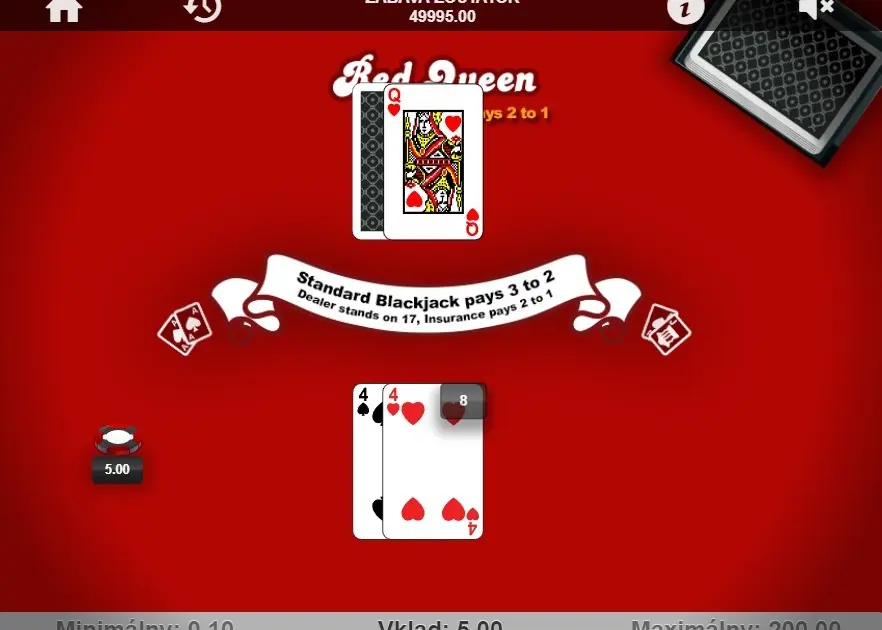
Red Queen Blackjack is the highest-RTP title in 1X2 Gaming’s small blackjack catalogue, and the headline 99.8% figure places it 0.39 percentage points above the corpus average. Whether that translates to a genuinely competitive edge depends entirely on rules the provider has not made public, so treat this review as a guide to what is known rather than a recommendation to sit down.
The table is available as a free demo, which is the fastest way to inspect its rules screen. That screen is your only reliable source for the questions this article cannot answer.
What the provider tells you
1X2 Gaming lists exactly two blackjack titles in its portfolio, and this is one of them. The second is Blackjack Bonus, which carries the same published RTP of 99.8%. That parallel suggests a shared engine and rule set across the provider’s blackjack offering, but 1X2 has not confirmed this in any document accessible to us.
What is missing from the public data is equally important. There is no stated deck count, no confirmed blackjack payout ratio, no indication of whether the dealer hits or stands on soft 17, and no listing of side bets. For a table positioned as a high-return product, that transparency gap matters: each of those variables moves the house edge by several tenths of a percent.
The absence of a variant hint in the title also means you cannot infer the rule family from the name alone. Unlike tables branded “European Blackjack” or “Single Deck,” Red Queen gives you no structural clue before you open the in-game rules panel.
Reading the 99.8% return figure
RTP on a blackjack table is simply 100% minus the house edge, assuming perfect basic strategy on every decision. At 99.8%, the stated edge is 0.2%. That is competitive for a digital blackjack game, but it is the theoretical floor — not the realistic expectation.
A player who deviates from basic strategy even occasionally will realise a materially lower return. Mistakes like standing on a hard 16 against a dealer’s 10, splitting a pair of tens, or doubling a soft 12 each carry their own cost, and those costs compound over a session. Industry estimates commonly place the average casual player 1-2 percentage points below optimal return, which would push the effective RTP down toward 98% or lower.
The figure is also provider-published. Independent audits of RNG tables sometimes recalculate RTP after accounting for rounding in the payout schedule, so the number 1X2 reports is the one to anchor to but not to trust blindly across thousands of hands.
Where the house edge actually comes from
Because 1X2 has not disclosed the specific rules for this table, the following table lists only the figures we can confirm from FACTS, alongside the general impact of unknown variables on edge:
| Known parameter | Value | Significance |
|---|---|---|
| Published RTP | 99.8% | Assumes perfect basic strategy |
| Provider | 1X2 Gaming | Two blackjack titles in catalogue |
| Free demo | Yes | Only way to inspect rules before depositing |
| Deck count | Not published | Each additional deck adds roughly 0.02-0.05% |
| Blackjack payout | Not published | 6:5 costs approximately 1.4% versus 3:2 |
| Soft 17 rule | Not published | Dealer hitting soft 17 adds roughly 0.2% |
That last row deserves emphasis: the single most damaging rule change in modern blackjack is a shift from 3:2 to 6:5 on a natural. A table can advertise a high RTP and still carry a hidden 6:5 payout that wipes out the advantage. Always confirm the payout in the rules screen before wagering real money on Red Queen Blackjack.
Does card counting work here?
Not on this table. Red Queen Blackjack runs on a random-number generator, which means the deck composition is reset to a fresh, uniformly shuffled state every single hand. A count requires continuity of deck composition across hands to accumulate a signal, and an RNG eliminates that continuity.
This is not a limitation of 1X2’s implementation — it applies to every fully digital, software-driven blackjack game. There is no shuffle tracking opportunity, no cut-card effect, and no penetration to exploit. The only strategic tool available to you is basic strategy itself, which tells you the mathematically optimal play for each hand given the dealer’s upcard.
If you enjoy counting, live dealer tables using physical shoe games with finite penetration remain the only environment where the technique has mathematical validity, and even there casinos use continuous shufflers and frequent reshuffles specifically to blunt it.
Bankroll and unit sizing
With the rules undisclosed, you cannot calculate precise session variance for this table. A general guideline: divide your total blackjack session bankroll into at least 200 units. If your session budget is $100, bet no more than $0.50 per hand. At a true edge of 0.2%, you are essentially breaking even over thousands of hands, and short-term swings will be dominated by volatility rather than by the expected value.
Betting progressions such as Martingale or D’Alembert change the distribution of wins and losses but never shift the expected value. They do not overcome a house edge on an RNG table, and a long losing streak at any fixed bet size carries the same risk as doubling your unit after a loss. If you set a stop-loss before opening the game, honour it.
This is entertainment, not income. Set your budget in advance, treat any amount as fully spent when you sit down, and stop when it is gone. You must be 18 or older.
Verdict
Red Queen Blackjack earns a look from maths-aware players specifically because of its published 99.8% RTP, which matches or beats every blackjack title in 1X2’s portfolio and exceeds the corpus average by a clear margin. If the rules behind that figure are as favourable as the number implies — 3:2 payout, dealer stands on soft 17, late surrender available — then the table genuinely competes with the best digital blackjack products available today.
The practical problem is that 1X2 has not published the details to confirm any of those assumptions. Until you open the in-game rules screen and verify deck count, soft-17 handling, and blackjack payout, the RTP figure is a promise without a contract. The free demo lets you check those parameters before depositing, and for comparison, Classic Blackjack from a different provider publishes 99.28% RTP with more commonly documented rule sets, while Multihand Blackjack at 99.5% offers a multi-hand structure you can evaluate more easily.
Play it for free, read every line of the rules panel, and only commit money once the numbers on screen justify the RTP on the listing.
Frequently Asked Questions
Can I play Red Queen Blackjack for free without depositing?
Yes. 1X2 Gaming provides a free demo of Red Queen Blackjack with no deposit or account registration required. The demo uses the same RNG engine as the real-money version, so you can inspect the in-game rules screen — including deck count, soft-17 handling, and blackjack payout — before staking any money. Demo play does not predict real-money outcomes, but it is the only reliable way to verify the rules 1X2 has not published externally.
Is 99.8% RTP on this table accurate for casual players?
No. The 99.8% figure assumes you play perfect basic strategy on every single hand. A casual player who makes occasional mistakes — hitting a hard 16 against a 6, failing to split eights, or standing on a soft 18 versus a dealer 6 — will realise a return closer to 97-98%. That gap is not a provider failure; it is the mathematical cost of imperfect play. The published number is a ceiling, not an expectation.
What specific rules drive the house edge on Red Queen Blackjack?
1X2 Gaming has not published the deck count, blackjack payout ratio, soft-17 rule, or double-and-surrender options for this table. Each of those variables moves the edge: 6:5 instead of 3:2 costs roughly 1.4%, dealer hitting soft 17 adds about 0.2%, and each additional deck in the shoe contributes a few hundredths of a percent. Until the rules screen confirms them, the 0.2% theoretical edge cannot be verified.
Does card counting help at this RNG blackjack table?
No. Red Queen Blackjack runs on a random-number generator that resets the deck to a fresh, uniformly shuffled state every hand. Card counting depends on tracking composition across a shoe with finite penetration, and an RNG eliminates that continuity entirely. The only exploitable strategy is memorising and applying the basic strategy chart, which minimises the edge to the provider's stated level but never removes it.
How does Red Queen Blackjack compare to other 1X2 or classic tables?
Within 1X2 Gaming's portfolio, Red Queen Blackjack shares the same 99.8% RTP with Blackjack Bonus — both are the highest-return blackjack titles the provider offers. Against external options, Classic Blackjack (99.28%) and Multihand Blackjack (99.5%) both publish lower RTP figures but from providers with more transparent rule documentation. If you cannot verify Red Queen's specific rules in-game, the higher stated RTP may not translate to a better real-world outcome.




