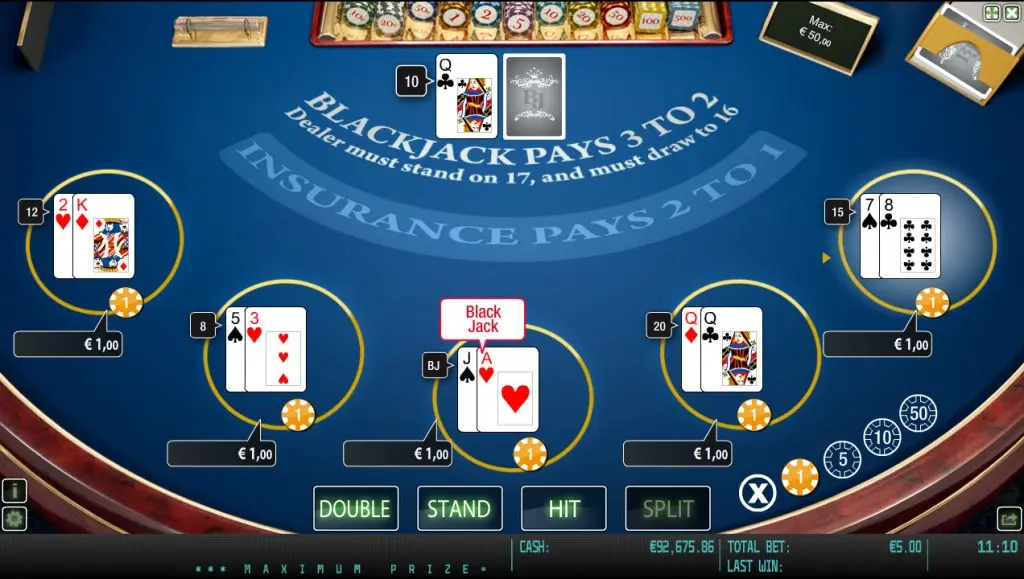
BlackJack Pro is a single-hand blackjack table from Worldmatch, and its headline RTP of 99.44% puts it just a touch above the corpus average of 99.41%. If you are looking for a no-frills blackjack seat with a competitive return-to-player figure and a free demo available, this is worth a look. The table’s exact rule set is not fully detailed in the published information, which means some edge-relevant details need checking in-game before you commit real cash.
BlackJack Pro and the Worldmatch table range
Worldmatch is a smaller provider with eight games in the blackjack category, and BlackJack Pro sits at their average RTP of 99.44%. That means this table is representative of the provider’s blackjack output rather than an outlier. If you want to compare it against sibling titles, Black Jack Single carries the same 99.44% RTP and a similar single-hand format. Black Jackpot also shares that RTP but introduces a progressive jackpot side bet, which changes the overall value proposition entirely. A third option, Black Jack Single Privee, rounds out the provider’s range at the same headline figure.
Across the broader theme of cards games, there are 35 tables listed. Compared to neighbours like Classic Blackjack at 99.28% RTP, BlackJack Pro holds a small mathematical edge. But tables like Multihand Blackjack at 99.5% and American Blackjack at 99.5% nudge ahead slightly on paper, assuming comparable rules. The differences are small enough that your decision should come down to rule specifics rather than RTP decimals.
| Provider | Worldmatch |
|---|---|
| RTP | 99.44% |
| Theme | Cards |
| Free demo | Yes |
The 99.44% RTP figure, and the assumption behind it
An RTP of 99.44% implies a house edge of just 0.56%. That is a competitive number in online blackjack, but it comes with a critical caveat: it assumes perfect basic strategy on every single hand. Basic strategy is the mathematically optimal set of decisions for every possible player and dealer hand combination. It is a solved chart, not a hunch or a feel, and it reduces the house edge to its minimum without ever eliminating it.
A player who deviates from basic strategy — taking insurance, standing on stiff hands against low dealer cards, or hitting when the chart says stand — will experience a materially lower return. The gap between basic-strategy play and casual play can easily be 0.5% to 1.5% in additional house edge, depending on the mistakes. If you are not confident in basic strategy, the 99.44% figure is aspirational for your session, not guaranteed.
The RTP is also a long-run expectation. Over millions of hands, the house will retain roughly 0.56 cents of every dollar wagered. Over a single session, variance dominates. You can win big, you can lose big, and neither outcome tells you whether the game is “loose” or “tight.”
Rules to confirm before you bet real money
The published information for BlackJack Pro does not specify several rule details that materially affect the house edge. The deck count is not listed. Whether the dealer hits or stands on soft 17 is not confirmed. The blackjack payout, double-after-split permissions, re-splitting rules, and surrender availability are all unspecified. Each of these moves the edge by hundredths or even tenths of a percent.
For context, here are general rules of thumb. A 3:2 blackjack payout is standard and fair; a 6:5 payout costs the player roughly 1.4% and is the single most damaging common rule change. Dealer standing on all 17s is more favourable to the player than hitting on soft 17. Fewer decks generally help the player. Late surrender and double-after-split both reduce the house edge slightly. European no-hole-card (where the dealer does not take a second card until all players have finished) costs the player the ability to double or surrender on certain hands where they would otherwise be able to.
Before you place a real-money bet, open the in-game rules or paytable and confirm these details. The RTP of 99.44% likely assumes a specific combination of rules, and if the table you are playing uses a different set, the actual edge will differ. This is not unusual — many providers do not publish full rule breakdowns in marketing materials.
Strategy: the chart, not a system
Basic strategy for blackjack is a lookup table. Given your two cards and the dealer’s visible card, there is one correct play that maximises your expected value. There are no streaks to ride, no patterns to exploit, and no “gut” calls that outperform the maths. Memorising the chart is the single most effective thing you can do to improve your results at this table.
Card counting does not work here. BlackJack Pro is an RNG table, meaning the deck is reshuffled to a full shoe after every hand. A card counter’s edge depends on the shifting composition of a physical deck, and that information does not exist in a digital reshuffle. Any advice you have read about counting online blackjack is irrelevant to this game.
Betting progressions — Martingale, D’Alembert, or any “double after a loss” scheme — do not change the expected value either. They change the shape of your variance: you win more often in smaller amounts, but when a losing streak hits, it hits hard. The house edge stays exactly where it was. If you use a progression, understand that you are choosing a risk profile, not a winning strategy.
Variance at the blackjack table
Blackjack has one of the lowest variances among casino games, but “low variance” does not mean “no variance.” In a typical session, you will see swings of several percent above or below the long-run RTP. With a 0.56% house edge, the standard deviation per hand is roughly 1.1 units. That means over 100 hands at 1 unit per hand, a one-standard-deviation swing is about 11 units in either direction — a meaningful range for most bankrolls.
Session results are dominated by short-term luck, not by the RTP figure. A player who sits down for 50 hands and walks away ahead has not beaten the house; they have experienced positive variance. A player who sits for 500 hands will tend to see results closer to the expected value, but even then, the sample is small enough that outcomes can diverge from expectation.
For bankroll planning, a common guideline is to bring at least 50 to 100 betting units for a session, so that a normal losing streak does not end your play prematurely. This is about risk management, not profit generation. The house edge grinds slowly; a sufficient bankroll keeps you in the game long enough for the entertainment value you are paying for.
Free play first
BlackJack Pro has a free demo available, and you should use it. The demo lets you practise basic strategy without risking money, confirm the table’s actual rules, and get a feel for the interface and pace of play. You can test whether the game fits your style before committing a deposit. The RTP figures apply to real-money play, but the demo is identical in its mechanics — it uses the same RNG and the same rules. Card counting remains pointless regardless of whether you are in demo or real-money mode, since the deck reshuffles every hand.
When you do move to real money, set a budget before you start and stick to it. Blackjack is entertainment, not income. Only wager what you can afford to lose, be 18 or older, and stop playing if it stops being fun. Responsible gambling means deciding your limits in advance and respecting them, win or lose.
Who this table is for
BlackJack Pro is best suited to players who want a straightforward single-hand blackjack experience without side bets or multi-hand complexity. If you are comfortable with basic strategy and you want a table that sits near the top of the RTP range — 99.44% is slightly above the corpus average — this fits the bill. Players who prefer multi-hand action or progressive side bets should look elsewhere, like Multihand Blackjack, which offers simultaneous hands at a comparable RTP.
If you are new to blackjack, the free demo makes this a reasonable learning table. The lack of confirmed rule details is the main drawback: an experienced player who cares about edge optimisation will want to verify the deck count, dealer soft-17 rule, and blackjack payout before switching from demo to real stakes. For casual play at modest unit sizes, the differences are small, but knowing what you are playing is always worth the thirty seconds it takes to open the rules screen.
Frequently Asked Questions
Can I play BlackJack Pro for free?
Yes, Worldmatch provides a free demo for BlackJack Pro. The demo uses the same RNG and rules as the real-money version, so it is a reliable way to practise basic strategy and confirm the table's rule details before committing any cash.
What is the RTP of BlackJack Pro and does it apply to every player?
BlackJack Pro has a published RTP of 99.44%. That figure assumes perfect basic strategy on every hand. Players who deviate from the chart — standing on stiff hands, taking insurance, or making other suboptimal calls — will experience a lower return in practice.
Does card counting work on BlackJack Pro?
No. BlackJack Pro is an RNG table that reshuffles the virtual deck after every hand. Card counting depends on the changing composition of a physical shoe over multiple hands, and that information does not exist in a digital reshuffle. No counting system provides an edge here.
What rules should I check before playing for real money?
The published facts do not specify the deck count, dealer soft-17 rule, blackjack payout, or double-after-split permission. Each of these affects the house edge. Open the in-game paytable or rules screen before betting real money and confirm these details, since the 99.44% RTP assumes a specific rule combination.
How does BlackJack Pro compare to Classic Blackjack or Multihand Blackjack?
BlackJack Pro's 99.44% RTP is slightly above Classic Blackjack's 99.28% but below Multihand Blackjack's 99.5%. The differences are small enough that your choice should depend on whether you prefer single-hand simplicity or multi-hand action, and on the specific rules each table offers.




