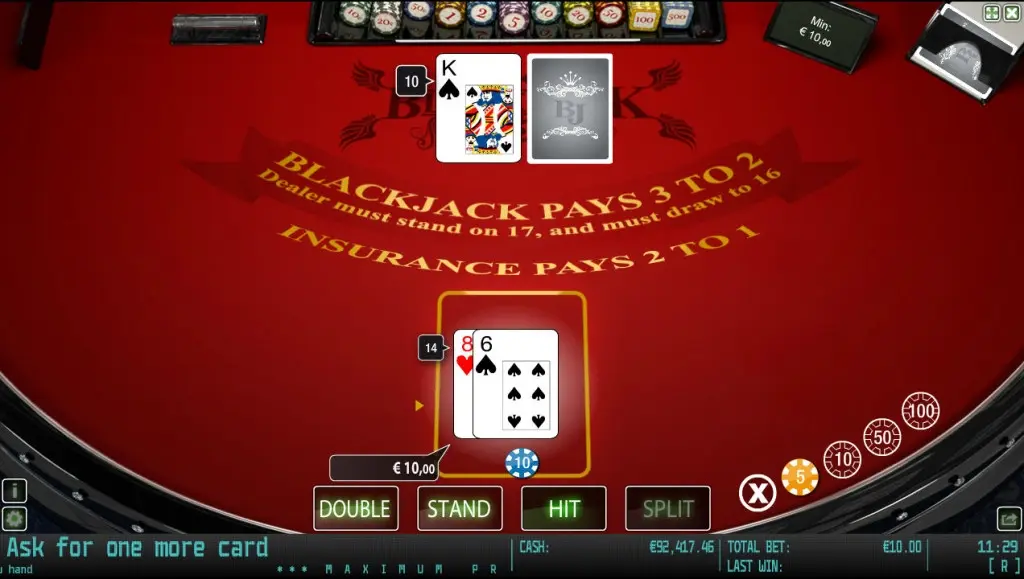
If you want a straightforward one-hand table to drill basic strategy on, this one is worth your time. Worldmatch publishes a 99.44% RTP for black jack single privee blackjack, which is a competitive number for the format, and a free demo is available so you can check the rules screen and your decision-making before any money is at stake. The catch is that Worldmatch does not publish the detailed rule set here, so several of the figures that actually move the edge have to be confirmed in-game.
How Black Jack Single Privee plays
The name points to a single-hand, private-table format: you play one betting box against the dealer rather than spreading across several seats. That has practical consequences. One hand per round means fewer decisions per session, which makes it easier to play accurately and harder to make the compounding errors that creep in across three or four simultaneous boxes. It also means a slower burn on your bankroll at the same stake, since you are risking one unit per round instead of several.
Beyond that, Worldmatch does not publish the table’s specifics — deck count, whether the dealer hits or stands on soft 17, the blackjack payout, doubling and splitting permissions, surrender, or table limits. None of that is guesswork you should accept from a review. Open the in-game rules or paytable screen before your first real-money hand and read it in full. Every one of those items shifts the return, and some shift it a lot.
If you want a multi-box comparison from the same theme, Multihand Blackjack runs a 99.5% listed return and lets you see how much faster a session moves when you cover several hands at once.
| Provider | Worldmatch |
|---|---|
| RTP | 99.44% |
| Theme | Cards |
| Free demo | Yes |
Single-hand privee rules and what the name tells you
Treat the title as a hint, not a rule sheet. “Single” in a blackjack title usually signals either one hand or a single deck, and those are very different things for the maths. A single-deck game reduces the house edge relative to six or eight decks, all else equal, but operators almost always claw that back by paying 6:5 on a natural blackjack instead of 3:2. That one change costs the player roughly 1.4% — the single most damaging rule in the game, and enough to wipe out every other favourable rule combined.
“Privee” conventionally means a private or higher-limit table rather than a rule variation, so it tells you more about presentation and stakes than about strategy. Because none of this is confirmed in Worldmatch’s published data, the only reliable move is to read the paytable. Check the blackjack payout first, then the soft 17 rule, then deck count. If the payout line says 6:5, no other rule on the screen will rescue the return.
Reading the 99.44% return figure
A 99.44% RTP means a theoretical house edge of 0.56%, expressed the other way round. It sits marginally above the average across the blackjack tables in this catalogue, and it matches the figure listed for every other Worldmatch blackjack table here, including BlackJack Pro — which suggests Worldmatch is quoting a house standard rather than a table-specific simulation.
The critical caveat is what that number assumes. Published blackjack RTP figures are calculated on perfect basic strategy applied to every hand, without a single deviation. Stand on a 16 you should hit, decline a double you should take, or split a pair the chart says to leave alone, and your realised return drops below the headline. A casual player working from instinct will typically give up somewhere between half a percent and two percent on top of the house edge, which can more than triple the cost of playing.
The figure also describes long-run expectation across an enormous number of hands. Over a single session of a few hundred hands, your actual result will land somewhere well either side of it. Demo results tell you nothing about how a real-money session will go, in either direction.
Where the house edge actually comes from
The edge is built from a stack of individual rules, each worth a fraction of a percent. As general rules of thumb: a 6:5 blackjack payout costs about 1.4%; a dealer who hits soft 17 rather than standing costs roughly 0.2%; moving from single deck to six or eight decks costs a few tenths; no double-after-split costs around 0.14%; no re-splitting aces costs a small fraction; and a European no-hole-card rule, where the dealer draws no second card until you have acted, costs about 0.11% because you can lose doubled and split money to a dealer blackjack.
Pushing the other way, late surrender gives back roughly 0.07% if you use it correctly, and generous doubling rules return a similar amount. Since Worldmatch does not disclose which of these apply, the 0.56% implied edge is your only anchor.
Side bets, if this table offers any, sit in a different category. Perfect Pairs and 21+3 typically run house edges of several percent — an order of magnitude worse than the base game. Insurance is the same story: at the standard 2:1 payout it is a losing bet, and basic strategy declines it every time.
Does card counting work here?
No. This is an RNG table, and the deck is reshuffled before every hand, so no information carries from one round to the next. Counting works by tracking how the composition of a shoe drifts as cards are removed. When the shoe resets each hand, there is no drift to track and every round starts from an identical distribution.
The same applies to any pattern-reading approach. A run of dealer wins does not make your next hand more likely to land, and no hand is ever “due”. Betting progressions like Martingale or D’Alembert are worth naming only to dismiss: they redistribute variance into rarer, larger swings, and they leave expected value exactly where the rules put it. The only lever that genuinely reduces the house edge on an RNG table is accurate basic strategy, which is a solved chart rather than a system — and it minimises the edge without ever erasing it.
Bankroll and unit sizing
Single-hand play makes sizing simple. Pick a unit you are willing to lose several dozen times over, and remember that doubles and splits can put two or three units at risk in a single round, so your effective exposure per hand is higher than your base bet. A common approach is a session bankroll of 40 to 50 base units, which absorbs ordinary swings without forcing you to cut a session short. Set a stop-loss and a session length before you sit down, not while you are in it.
Play only if you are 18 or over, set a budget in advance that you can afford to lose entirely, and treat blackjack as entertainment rather than income. If the stakes stop feeling optional, stop playing and use the deposit and time limits your operator provides.
Verdict
The listed 99.44% return is solid for the format and the free demo is genuinely useful — it costs nothing to load the rules screen, learn the interface and run a few hundred hands of basic-strategy practice. The reservation is disclosure: without a published deck count, soft 17 rule or blackjack payout, you are trusting a headline RTP without being able to verify the rules that produce it.
Do the paytable check first. If the natural pays 3:2, this is a reasonable low-edge table for one-hand play. If it pays 6:5, the real return is well below the quoted figure and you would be better off on a table with confirmed rules, such as Classic Blackjack.
Frequently Asked Questions
Can I play Black Jack Single Privee for free?
Yes. A free demo is available, so you can load the table with no deposit and no download. Use it to read the in-game rules screen, confirm the blackjack payout and deck count that Worldmatch does not publish, and practise basic strategy decisions before committing real money to a session.
What is the Black Jack Single Privee RTP?
Worldmatch lists 99.44%, which implies a house edge of 0.56%. That figure assumes perfect basic strategy on every single hand. Deviating from the chart — standing when you should hit, skipping a correct double — pushes your realised return lower, often by a full percent or more for casual play.
What rules affect the house edge on this table?
Worldmatch does not disclose them, so check the paytable. As rules of thumb, a 6:5 blackjack payout costs roughly 1.4%, a dealer hitting soft 17 about 0.2%, and no double-after-split around 0.14%. Late surrender and liberal doubling give back small amounts in the other direction.
Does card counting work on Black Jack Single Privee?
No. It is an RNG table that reshuffles every hand, so no card information carries between rounds and there is no shoe composition to track. Betting progressions do not help either — they reshape variance into larger, rarer swings without changing expected value. Accurate basic strategy is the only real lever.
Who makes this table and how does it compare to other Worldmatch blackjacks?
Worldmatch, which has eight blackjack tables in this catalogue. All of them list the same 99.44% return, including Black Jack Single and Black Jackpot, so the choice between them comes down to format and confirmed table rules rather than the published RTP figure.




