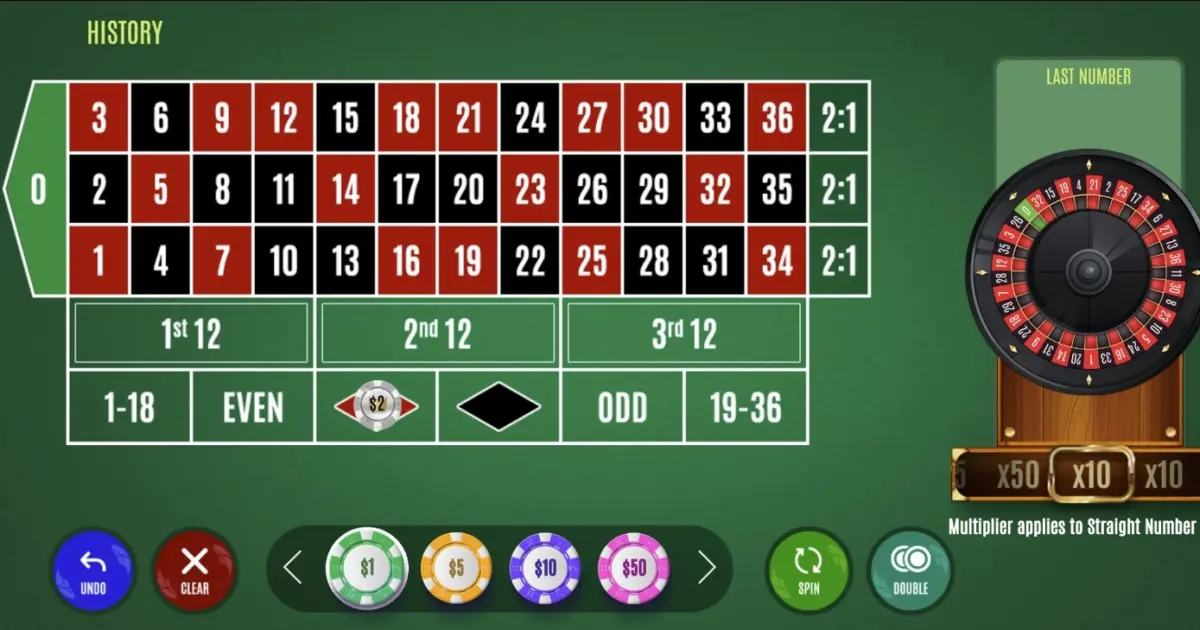
Platinum chip roulette arrives with a 97.3% RTP figure from FlipLuck Games and a free demo you can open without depositing. That RTP sits just above the 96.97% average across the roulette tables catalogued here, which is a mild positive rather than a reason to get excited.
The catch is that the name tells you nothing about the wheel. “Platinum Chip” is decoration, not a variant label, and until you read the game’s own rules screen you do not know whether you are betting into 37 pockets or 38. That is the single most consequential fact about any roulette table, and it is absent here.
How Platinum Chip Roulette plays
The mechanics of every RNG roulette table are the same. You place chips on the layout, the wheel spins, a random number generator selects the winning pocket, and losing chips are cleared. There is no dealer to read, no wheel bias to exploit, no physical deflector pattern to time. Each spin is generated independently of the last.
What varies between titles is the interface and the extras: whether there is a racetrack for call bets, whether you can save favourite bet patterns, whether statistics panels are displayed, and what the minimum and maximum stakes are. None of that information is available for this table, so treat the layout as unknown until you load it.
FlipLuck Games has four roulette titles in this catalogue, all listed at the same 97.3% RTP. If you want a table where the wheel type is stated in the name, European Roulette (Flipluck) removes the ambiguity before you place a chip.
The pocket count is the whole story
Roulette maths is short and exact. A single-zero European wheel has 37 pockets. A straight-up number pays 35:1 when the true odds against it are 36:1, and that one-pocket gap produces a house edge of 2.70% on every standard bet on the layout.
A double-zero American wheel has 38 pockets. The payouts do not change, so the gap widens and the house edge becomes 5.26% on every standard bet, with the five-number basket bet worse still at 7.89%. Same game, nearly double the cost per unit staked.
French rules change the picture again. Where La Partage or En Prison apply, half your even-money stake comes back when zero lands, dropping the even-money house edge to roughly 1.35% — the best standard bet available anywhere in roulette.
Nothing in the available information for Platinum Chip Roulette confirms which of these three you are looking at. That matters more than any other detail on this page, and it takes about five seconds to check in the game’s rules panel.
Reading the 97.3% figure
A 97.3% RTP implies a 2.70% house edge, which lines up exactly with the European single-zero figure. That is a strong hint, and it is worth noting that all four FlipLuck roulette tables carry the same 97.3% number — including their American Roulette listing, where the standard figure would be 94.74%.
That inconsistency is a reason for caution, not confidence. The 97.3% may be a provider-level default applied across the range rather than a per-table measurement. Read the paytable and the rules screen and confirm the pocket count yourself.
One more note on how RTP works: it is a long-run average across enormous spin counts. It does not describe your session, your hour, or your first fifty spins. Over any short run, the spread of outcomes swamps the average completely.
| Wheel type | Pockets | Straight-up payout | True odds | House edge |
|---|---|---|---|---|
| European (single zero) | 37 | 35:1 | 36:1 | 2.70% |
| French (La Partage, even-money) | 37 | 1:1 | 18:19 (approx.) | 1.35% |
| American (double zero) | 38 | 35:1 | 37:1 | 5.26% |
| American basket bet | 38 | 6:1 | 33:5 | 7.89% |
Choosing bets for the session you want
Here is the part most guides get wrong. On a standard wheel, every bet on the layout carries the same house edge. A straight-up number and a red/black wager cost you the same percentage of your stake over time. Switching between them does not improve or worsen your expected result.
What changes is variance — the shape of the ride. Even-money bets win close to half the time, so your balance moves in small steps and a session lasts longer on a fixed budget. Straight-up numbers hit roughly once every 37 spins on a single-zero wheel, so you will sit through long dry stretches punctuated by a 35:1 return.
Choose based on what you want from the session, not on any belief that one bet is smarter. Want a long, slow session on a small budget? Outside bets. Want short bursts with the chance of a big swing? Inside bets. Neither is a better wager; they are different experiences at identical cost.
If double-ball formats appeal for their different variance profile, Double Ball American Roulette from the same studio spreads outcomes across two balls per spin.
Martingale and friends: the honest answer
No betting system changes expected value. Not Martingale, not Fibonacci, not D’Alembert, not Labouchere, not waiting for five reds before backing black. This is not a matter of opinion or of finding the right variation. It follows directly from the fact that spins are independent.
The wheel has no memory. After ten reds in a row, the probability of red on the next spin is exactly what it was on the first spin. Any system that assumes otherwise is built on the gambler’s fallacy.
What progressions actually do is redistribute variance. Martingale converts many small wins into one eventual large loss, and it runs into two hard walls: your bankroll and the table maximum. Doubling from a one-unit base, the eighth loss in a row requires 128 units and you are 255 units down. Losing runs of that length are not rare over a few thousand spins.
If a system is being sold to you as low-risk, that description is wrong. It has the same expected loss as flat betting, delivered in a lumpier shape.
Bankroll and table limits
Table limits are not published in the available information for this table, and they matter. The ratio between minimum and maximum stake determines how many progression steps a system could physically take, and it also determines whether your intended stake size fits the game at all. Check both numbers on the game screen.
A workable approach: decide your total session budget before you open the game, divide by the number of spins you want, and stake accordingly. At 2.70% edge, a 100-unit budget staked at one unit per spin has an expected cost of roughly 2.7 units over 100 spins — but the actual result will land well either side of that.
Roulette is for players aged 18 or over. Set your budget in advance, treat it as the cost of entertainment rather than a route to income, and stop when it is gone rather than reaching for more. If play stops feeling like a choice, the operator’s deposit limits and self-exclusion tools exist for that reason.
Demo play uses the same RNG but carries no financial consequence, so it will not tell you anything about how real-money results will go.
Verdict on Platinum Chip Roulette
The 97.3% RTP figure is fine and the free demo means you can inspect the table at zero cost, which is the sensible first move. Load it, open the rules, count the zeros. If it is a single-zero wheel your bets cost 2.70%; if there are two zeros, 5.26%, and you should look elsewhere.
Without the pocket count, table limits, or racetrack availability confirmed, this is a table to verify rather than a table to recommend. For a comparison where the variant is stated upfront, American Roulette (Flipluck) shows what the same studio does with the double-zero format.
Frequently Asked Questions
Can I play Platinum Chip Roulette free with no download?
Yes. A free demo is available for this table, and browser-based roulette games do not require a download. The demo runs the same random number generator as the real-money version, so it is the right way to check the pocket count, table limits and layout before deciding whether to stake anything.
What is the Platinum Chip Roulette RTP?
FlipLuck Games lists 97.3%, which sits 0.33 percentage points above the 96.97% average across the roulette tables catalogued here. Worth noting: all four FlipLuck roulette titles carry the same 97.3% figure, which suggests a provider-level default. Confirm it against the game's own paytable.
Is this a European or American wheel?
The available information does not say, and the name gives no clue. This matters a lot: a single-zero wheel with 37 pockets costs 2.70% per bet, while a double-zero wheel with 38 pockets costs 5.26%. Check the rules screen and count the zeros before placing chips.
Does the Martingale system work on this table?
No. Martingale does not change expected value on any roulette wheel, because spins are independent and the wheel has no memory. It converts frequent small wins into occasional large losses and hits your bankroll or the table maximum. Doubling from one unit, eight consecutive losses leaves you 255 units down.
Who makes Platinum Chip Roulette?
FlipLuck Games, a studio with four roulette titles in this catalogue, all listed at 97.3% RTP. The others are European Roulette, American Roulette and Double Ball American Roulette. The named variants are more transparent about what wheel you are getting, which is useful if you want the maths confirmed upfront.




