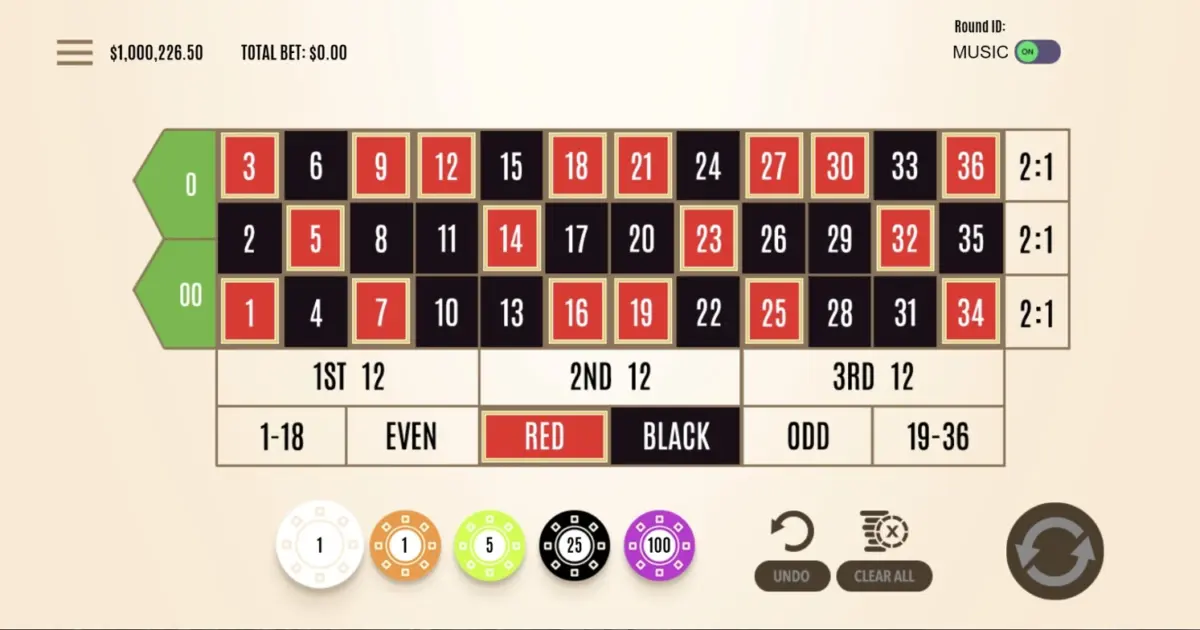
American Roulette (Flipluck) is a straightforward digital roulette table from FlipLuck Games that sticks to the classic American format. With an RTP of 97.3% and a familiar 38-pocket layout, it does not try to reinvent the wheel — literally. If you want to know exactly what this table costs per spin, how the bets compare, and whether any strategy can change that, this review covers all of it.
American Roulette (Flipluck) at a glance
FlipLuck Games keeps the interface clean here: a standard betting grid, an American wheel with both 0 and 00, and the usual inside and outside bet options. The stated RTP is 97.3%, which translates to a house edge of 2.7% — a figure that normally belongs to European single-zero wheels, not American double-zero ones. That discrepancy is worth scrutinising, and we will get to it below.
The game is available as a free demo with no download, so you can test the interface and bet placement without spending anything. FlipLuck Games has a small portfolio of four roulette titles, and this sits alongside options like European Roulette (Flipluck) and Double Ball American Roulette in their lineup.
Which wheel is this, and what it costs you
The name says “American,” which points to a 38-pocket wheel: numbers 1–36, a single zero, and a double zero. On that wheel, the standard house edge on nearly every bet is 5.26%. That means for every $100 wagered over time, the expected loss is about $5.26. The only exception on a standard American table is the five-number basket bet (0, 00, 1, 2, 3), which carries a worse edge of 7.89%.
But the listed RTP of 97.3% implies a house edge of only 2.7% — the figure you would normally see on a European single-zero wheel with 37 pockets. That is a significant gap. It is possible this title uses modified payouts, a different wheel configuration than the name suggests, or that the RTP figure reflects something other than the standard American ruleset. The honest advice: open the game’s own rules or paytable screen and check the wheel layout and payouts yourself before placing real bets. The name alone is not enough to confirm the maths.
For reference, French roulette rules like La Partage or En Prison can cut the even-money house edge to roughly 1.35% on a European wheel — the best standard bet in roulette. There is no indication those rules apply here.
What a 97.3% RTP means per spin
Return to Player is a long-run statistical average, not a session guarantee. At 97.3% RTP, the house edge is 2.7% (assuming the figure is accurate for this specific table). On a $10 straight-up bet, you would expect to lose about 27 cents on average over thousands of spins. On a $10 even-money bet, the same 27 cents applies.
Over a single session of 100 spins at $10 per spin ($1,000 total wagered), the expected loss is roughly $27. But variance means you could win big, lose big, or land near that average. The RTP tells you the price of playing; it tells you nothing about what any individual session will look like. This is not a prediction — it is the mathematical floor that no strategy can breach.
Inside versus outside bets
The core difference between inside and outside bets is variance, not value. Every standard bet on a properly configured American wheel has the same expected loss. The table below shows how the payouts and true odds compare.
| Bet type | Payout | True odds (38 pockets) | House edge |
|---|---|---|---|
| Straight up (1 number) | 35:1 | 37:1 | 5.26% |
| Split (2 numbers) | 17:1 | 18:1 | 5.26% |
| Street (3 numbers) | 11:1 | 11.67:1 | 5.26% |
| Corner (4 numbers) | 8:1 | 8.5:1 | 5.26% |
| Five-number basket | 6:1 | 6.6:1 | 7.89% |
| Six line (6 numbers) | 5:1 | 5.33:1 | 5.26% |
| Dozen / Column (12 numbers) | 2:1 | 2.17:1 | 5.26% |
| Even-money (Red/Black, Odd/Even, High/Low) | 1:1 | 1.11:1 | 5.26% |
Straight-up bets give you the wildest ride: long losing streaks punctuated by 35:1 payouts. Even-money bets produce steadier results with smaller swings. Neither changes what you pay to play. If you prefer longer sessions with less volatility, outside bets are the practical choice. If you want the chance at a big single-spin win, inside bets deliver that — at the cost of faster bankroll swings.
Why no betting system changes the maths
Every roulette system — Martingale, Fibonacci, D’Alembert, or “wait for five reds then bet black” — runs into the same wall: spins are independent. The wheel has no memory. A string of ten reds does not make black more likely on the next spin. The probability stays exactly the same.
The Martingale system, which doubles your bet after every loss, looks appealing on paper because you eventually win back your losses plus one unit. In practice, a losing streak of eight or nine bets at a $10 base means you are risking $1,020 or $2,040 to win $10. Table limits exist precisely to stop this progression, and they will hit you before the maths does. The house edge applies to every single bet regardless of what came before it. No progression, pattern, or “system” changes the expected value. This is not opinion — it is arithmetic.
Playing the American Roulette (Flipluck) demo
The free demo of American Roulette (Flipluck) requires no download and no deposit. It uses the same RNG and paytable as the real-money version, so it is a useful way to learn the interface, test bet placement, and see how different bet types feel over a session. What the demo cannot do is replicate the psychological pressure of real money on the table — which is, arguably, the most important part of the experience.
Play responsibly. Set a budget before you start, treat every session as entertainment, and stop when the budget is gone. Roulette is a game with a built-in house edge: over time, the casino wins. You must be 18 or older to play for real money.
Verdict
American Roulette (Flipluck) is a clean, no-frills take on the double-zero format from a small provider. The listed RTP of 97.3% is unusually generous for an American wheel — worth confirming in the game’s rules screen before you commit real money. The interface is simple, the demo is free, and the maths is the maths: every standard bet costs the same per dollar wagered, and no system changes that. If you are comfortable with the American wheel’s higher house edge compared to European alternatives like European Roulette (Flipluck), this does the job without surprises. Players looking for lower house edges might also explore Platinum Chip Roulette for a different take on the format.
Frequently Asked Questions
Is there a free demo of American Roulette (Flipluck)?
Yes. The game is available as a free demo with no download required. You can play it directly in your browser to test the interface and bet types before wagering real money.
What is the RTP of American Roulette (Flipluck)?
The listed RTP is 97.3%, which implies a house edge of 2.7%. This is unusually low for an American wheel — check the game's own rules screen to confirm the exact wheel configuration and payouts.
What house edge does an American roulette wheel normally have?
A standard American wheel with 38 pockets (0 and 00) carries a house edge of 5.26% on nearly every bet. The five-number basket bet is worse at 7.89%. This is roughly double the edge of a European single-zero wheel.
Can any betting system beat this game?
No. Spins are independent and the wheel has no memory. Martingale, Fibonacci, and all other progressions redistribute variance but do not change the expected value. The house edge applies to every bet, every time.
Who makes American Roulette (Flipluck)?
It is developed by FlipLuck Games, a provider with a small portfolio of four roulette titles including European Roulette (Flipluck) and Double Ball American Roulette.




