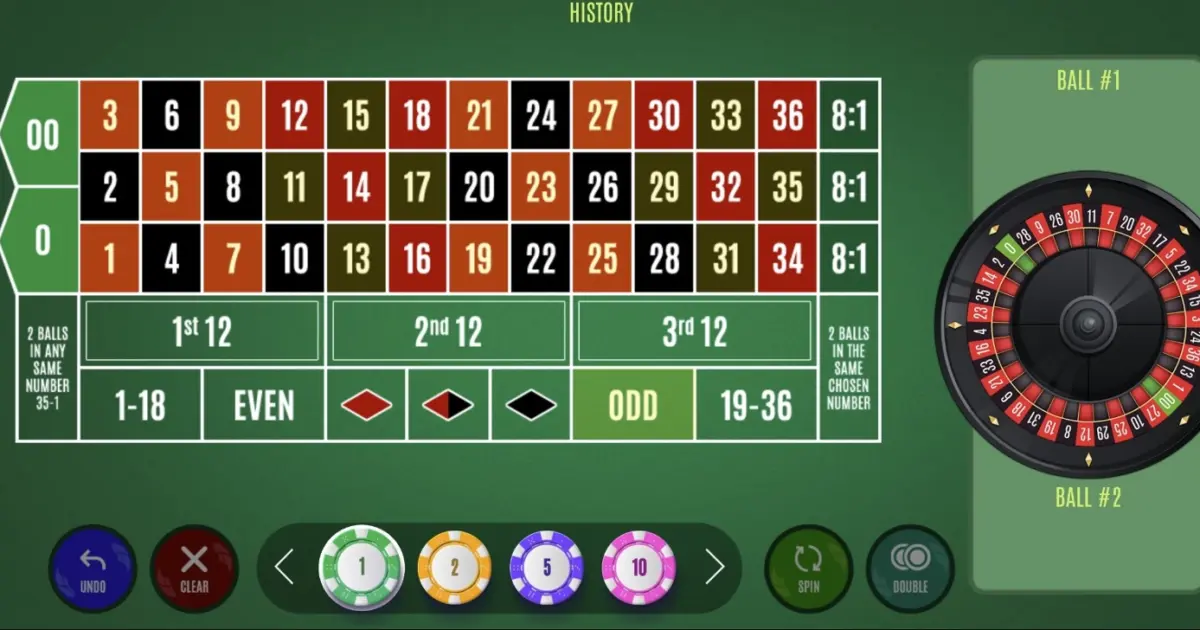
Double Ball American Roulette by FlipLuck Games is not your standard roulette experience. Two balls spin on every round, meaning two results land per spin and the payout table is restructured to account for that. If you enjoy the idea of more outcomes per turn but want to understand exactly what the maths look like before committing real money, this review covers what the game tells us — and, just as importantly, what it does not.
Double Ball American Roulette at a glance
The name does most of the talking here. This is a FlipLuck Games title in the roulette category, and the provider’s portfolio is small — just four roulette games, with an average RTP of 97.3% across them. Double Ball American Roulette itself carries a listed RTP of 97.3%, which sits slightly above the corpus average of 96.97% for the site’s roulette catalogue. The game is available as a free demo with no download required, so you can spin without risking anything. Where the game falls in a broader ranking, it sits at position 66 with a popularity percentile of 70.9, meaning it draws more interest than roughly 71% of the roulette titles tracked here.
Which wheel is this, and what it costs you
The word “American” in the title points strongly to a 38-pocket wheel — numbers 1 through 36, a single zero, and a double zero. On a standard American wheel with no special rules, the house edge on most bets is 5.26%. That is nearly double the 2.70% edge of a European single-zero wheel, and it is the single biggest factor in how fast your bankroll moves. However, the title also suggests a multi-ball format. When two balls are in play, the stake is typically split across them, and payouts are adjusted so that both balls must land in specific pockets for certain bets to pay. This means the effective RTP on individual bet types may differ from the headline 97.3% figure. You should open the game’s own rules screen and paytable before placing any real bets to confirm exactly how the dual-ball mechanic affects each bet category.
What a 97.3% RTP means per spin
RTP — return to player — is the percentage of all wagered money a game is expected to pay back over an enormous number of spins. At 97.3%, Double Ball American Roulette would, in theory, return $97.30 for every $1,000 wagered over millions of rounds. In practice, that number tells you almost nothing about a single session. A player making 100 bets of $1 each might walk away with $105 or $40 — the variance is enormous on any individual spin. What RTP does tell you is the long-run cost of playing. The 2.7% retained by the house is the price of the game. Compare that to a standard American single-ball wheel at 5.26% and the listed RTP here looks more generous, but remember that the dual-ball format changes how bets are structured and paid, so the comparison is not apples-to-apples without reading the paytable.
Inside versus outside bets
Inside bets cover specific numbers or small groups; outside bets cover broader categories like red/black or odd/even. In classic roulette, the maths are fixed: a straight-up number bet pays 35:1 on a wheel where the true odds are 36:1 (European) or 37:1 (American). That gap is the house edge. In Double Ball American Roulette, the presence of two balls means some bets pay differently because both balls need to land in your chosen outcome. The table below shows the standard American single-ball payouts and true odds for reference. Your actual payouts in this game may differ — check the in-game paytable.
| Bet type | Standard payout | True odds (American) | House edge |
|---|---|---|---|
| Straight up (single number) | 35:1 | 37:1 | 5.26% |
| Split (two numbers) | 17:1 | 18:1 | 5.26% |
| Street (three numbers) | 11:1 | 11.67:1 | 5.26% |
| Corner (four numbers) | 8:1 | 8.5:1 | 5.26% |
| Six line (six numbers) | 5:1 | 5.33:1 | 5.26% |
| Dozen / Column (12 numbers) | 2:1 | 2.17:1 | 5.26% |
| Even money (red/black, odd/even) | 1:1 | 1.11:1 | 5.26% |
Notice that the house edge is the same across every standard bet on a plain American wheel. The shape of your session changes — straight-up bets produce wild swings, even-money bets produce steadier results — but the expected cost per dollar wagered does not. In a multi-ball variant, the interplay between the two balls can create new bet types (for example, both balls landing on red), and these will have their own payout structures. Always read the paytable.
Why no betting system changes the maths
If you have ever read about the Martingale system — double your bet after every loss, return to base after a win — you already know the appeal. It feels logical. It is also mathematically useless for changing your expected outcome. Every spin of the wheel is independent. The wheel has no memory of what landed last time. A sequence of five reds does not make black “due,” and a string of losses does not make a win more likely on the next round. What betting systems actually do is redistribute variance: the Martingale produces many small wins punctuated by rare catastrophic losses that hit the table limit or wipe your bankroll. The Fibonacci, D’Alembert, and flat-bet approaches have the same fundamental problem. They change the shape of your results, not the expected value. On a game with a 5.26% house edge — or whatever the effective edge turns out to be on this dual-ball variant — every system loses money in the long run at the same rate. The only reliable way to reduce the house edge is to play a game with better rules, such as French roulette with La Partage, which cuts the even-money house edge to about 1.35%.
Playing the Double Ball American Roulette demo
FlipLuck Games makes a free demo of Double Ball American Roulette available, and it requires no download. Demo play is the right place to start because the dual-ball payout structure is not standard roulette — you need to see how the bets work, what pays what, and how the two balls interact before any real money is on the line. Use the demo to read the paytable, test different bet types, and get a feel for the rhythm of the game. Remember that demo results do not predict real-money outcomes. If you decide to play for real, set a budget you can afford to lose before you start, stick to it, and treat every session as entertainment with a cost — not as a way to make money. Roulette is a game where the maths always favour the house. Playing responsibly means knowing that going in. 18+ only.
Verdict
Double Ball American Roulette is an interesting twist on the classic format. Two balls per spin create more action and different betting possibilities, and the listed RTP of 97.3% is above the site’s roulette average. But the American wheel underneath still carries a house edge that is nearly double a European wheel’s, and the dual-ball mechanics mean you need to study the paytable carefully before assuming any bet offers good value. If you are curious, the free demo is the sensible starting point. If you prefer simpler maths with a lower house edge, the provider’s own European Roulette (Flipluck) or the straightforward American Roulette (Flipluck) may suit you better. For something with a different feel entirely, Platinum Chip Roulette is worth a look. None of these games will beat the house over time — but knowing the numbers lets you choose how fast you pay for the entertainment.
Frequently Asked Questions
Can I play Double Ball American Roulette for free?
Yes. FlipLuck Games provides a free demo of Double Ball American Roulette that requires no download. You can try the game without risking real money, which is especially useful here because the dual-ball payout structure differs from standard roulette and takes some getting used to.
What is the RTP of Double Ball American Roulette?
The listed RTP for Double Ball American Roulette is 97.3%, which is slightly above the site's roulette average of 96.97%. However, because the game uses two balls and restructured payouts, the effective RTP on individual bet types may vary — check the in-game paytable for specifics.
What wheel type does Double Ball American Roulette use?
The name indicates an American wheel with 38 pockets — numbers 1 through 36 plus 0 and 00 — which carries a standard house edge of 5.26%. The "double ball" element means two balls are spun simultaneously, altering payouts rather than the wheel itself. Confirm the exact rules on the game's info screen before playing.
Does the Martingale system work on Double Ball American Roulette?
No betting system changes the mathematical house edge on any roulette game. The Martingale, Fibonacci, and D'Alembert systems redistribute variance — producing more small wins and larger losses — but every spin is independent. The wheel has no memory, and no progression can overcome the house edge over time.
How does Double Ball American Roulette compare to European Roulette by FlipLuck Games?
Both are made by FlipLuck Games and share a listed RTP of 97.3%, but the wheel type differs. European Roulette (Flipluck) uses a single-zero wheel with a 2.70% house edge, while the American wheel in Double Ball American Roulette has a 5.26% edge. The dual-ball mechanic adds complexity that the simpler European version avoids.




