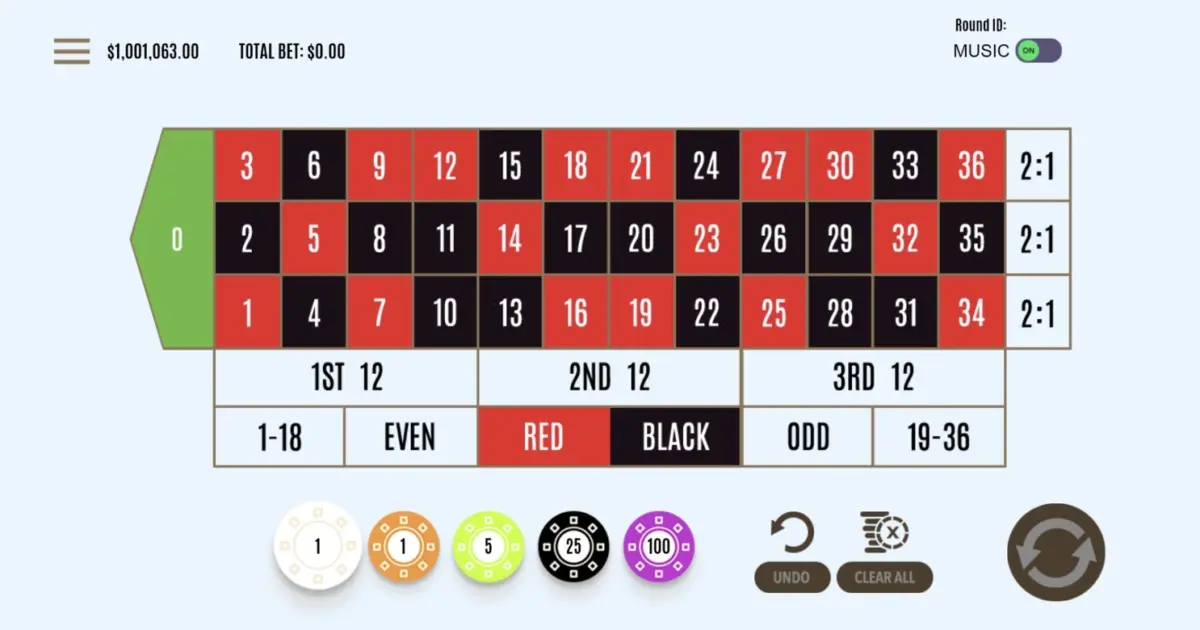
If you want a straightforward wheel with no side bets to decode, european roulette (flipluck) is an easy table to sit down at. FlipLuck Games publishes an RTP of 97.3%, and a free demo is available, so nothing about the layout or the bet limits has to be discovered with your own money. The name points to a single-zero wheel, which normally means 37 pockets and a 2.70% house edge on every standard bet — but confirm that on the game’s own rules screen before you play for real.
How European Roulette (Flipluck) plays
The FACTS available for this table cover the provider, the RTP figure and demo availability. They do not cover the interface: whether there is a racetrack for call bets like voisins du zéro or orphelins, whether you can save favourite bet patterns, or how fast the spin animation runs. Those are worth checking in the demo, because on a game with no side bets and no multipliers, the interface is most of what separates one table from another.
What you can expect from any roulette wheel is the same loop. You place chips on the felt, the wheel spins, an RNG determines the winning pocket, losing chips are cleared and winning chips are paid at fixed odds. There is no skill component and no decision after the ball is released. Every spin is independent of every spin before it.
Because the FACTS list no bonus round, no jackpot and no multiplier mechanic, this reads as a classic table rather than a game-show format. That is a design choice with a real consequence: a plain wheel pays its published odds on every bet, with no portion of the return diverted into funding rare high-multiplier hits.
The pocket count is the whole story
Roulette’s maths reduces to one number: how many pockets the ball can land in. On a single-zero wheel there are 37 pockets. A straight-up number pays 35:1 when the true odds are 36:1, and that one-pocket gap is the entire house edge — 2.70%, identical on every standard bet from a single number to red/black.
A double-zero wheel adds a 00 pocket for 38 total. The payouts do not change, so the edge roughly doubles to 5.26%, and the five-number basket bet is worse still at 7.89%. French rules go the other way: La Partage or En Prison return half your stake on even-money bets when zero lands, cutting that edge to about 1.35%, the best standard bet in roulette.
The FACTS here do not confirm which of those three rule sets this table uses, only that the title suggests the European family. Check the rules screen for the pocket count and for any zero-refund rule. Those two lines determine your expected cost per spin more than anything else on the screen.
Reading the 97.3% figure
An RTP of 97.3% means that across a very large number of spins the game is modelled to return 97.30 units for every 100 staked, leaving 2.70 as the house margin. That figure lines up exactly with the textbook single-zero house edge of 2.70%, which is a useful consistency check — the published number matches the wheel the title implies.
Against the wider picture, 97.3% sits 0.33 percentage points above the 96.97% average across the games on this site. FlipLuck Games has four titles covered here and averages 97.3% across all of them, so this is not an outlier promotion but the house standard. The stablemates carry the same figure: American Roulette (Flipluck) is listed at 97.3% too, which is worth pausing on — a double-zero wheel and a single-zero wheel cannot both deliver 2.70% on standard bets, so the rules screen is where that gets resolved.
Treat RTP as a long-run average, not a session forecast. Over a hundred spins the outcome distribution is wide enough that 97.3% tells you almost nothing about what you will see. It tells you the cost of playing, spread across far more spins than one sitting contains.
Choosing bets for the session you want
On a single-zero wheel every standard bet carries the same 2.70% edge, so bet selection changes the shape of your results rather than their expected value. Wide outside bets win often and pay little; narrow inside bets almost never win and pay a lot. Neither is cheaper to play.
| Bet | Pockets covered | Payout | True odds (37 pockets) |
|---|---|---|---|
| Straight up | 1 | 35:1 | 36:1 |
| Split | 2 | 17:1 | 17.5:1 |
| Street | 3 | 11:1 | 11.33:1 |
| Corner | 4 | 8:1 | 8.25:1 |
| Line (six) | 6 | 5:1 | 5.17:1 |
| Dozen / column | 12 | 2:1 | 2.08:1 |
| Red, black, odd, even | 18 | 1:1 | 1.06:1 |
Read the right-hand column: in every row the payout is a fraction short of the true odds, and that consistent shortfall is the 2.70%. If you want a long session on a small budget, even-money bets keep your balance moving slowly. If you want the chance of a large swing and accept losing most spins, straight-ups do that. Mixing both is fine — it just averages the variance.
Martingale and friends: the honest answer
No betting system changes expected value. Not Martingale, not Fibonacci, not D’Alembert, not waiting for five reds before backing black. Each spin is independent and the wheel has no memory, so the probability of red is identical after ten blacks as it was before them. A progression cannot lower a 2.70% edge because it does not touch the payout table.
What progressions do is redistribute variance. Martingale converts many small wins into rare large losses, and it hits the table maximum quickly — eight consecutive losses on a doubling sequence needs 256 times your opening stake, and the wheel produces that run often enough to matter. Negative progressions feel like they are working right up to the spin where they are not.
Flat betting is the honest baseline. It makes your cost per spin visible and predictable, and it never asks you to stake an amount you did not plan to risk. Nothing in the spin history is due, hot or cold, and tracking previous results on an RNG wheel has no predictive value whatsoever.
Bankroll and table limits
The FACTS do not include the minimum or maximum bet for this table, and that gap matters. Table limits set both your floor — how small a session you can actually run — and the ceiling that caps any progression. Check them in the demo before you commit, along with whether inside and outside bets carry separate maximums, as they often do.
A workable approach is to fix your session budget first, then divide by the number of spins you want. At 2.70%, a 200-spin session at 1 unit per spin has an expected cost of about 5.4 units, though the actual outcome will land well either side of that.
Roulette is 18+ entertainment, not income. Set a budget before you open the game, stake only money you can afford to lose, and stop when you reach the limit you set rather than the one your balance suggests. Demo play does not predict real-money results — it shows you the interface and nothing about your outcomes.
Verdict on European Roulette (Flipluck)
The published 97.3% return matches what a single-zero wheel should deliver, and it sits marginally above the site-wide average, so on the numbers available this is a fairly priced classic table. The absence of side bets and multipliers is a feature if you want the plain game and a drawback if you want events between spins.
What is missing from the record is the pocket count, any La Partage rule and the table limits — all three worth reading off the rules screen. If you would rather sample the provider’s range first, Double Ball American Roulette adds a second ball and a different payout structure, while Platinum Chip Roulette is another 97.3% option from the same studio. Try this one free, no download required, and confirm the rules before staking.
Frequently Asked Questions
Can I play European Roulette (Flipluck) free?
Yes, a free demo is available for this table, so you can place bets with play credits and see the layout and interface without staking money. Use it to check the rules screen, the pocket count and the table limits, none of which are listed in the information published for this game.
What is the European Roulette (Flipluck) RTP?
FlipLuck Games publishes 97.3%, meaning a modelled long-run return of 97.30 units per 100 staked. That is 0.33 points above the 96.97% average across the games covered here, and it matches the FlipLuck house figure across all four of its titles listed on this site.
How many pockets does this wheel have and what is the house edge?
The title points to a European wheel, which normally means 37 pockets, a single zero and a 2.70% house edge on every standard bet. The published 97.3% RTP is consistent with that, but the pocket count is not confirmed in the available information, so verify it on the rules screen.
Does the Martingale system work on this table?
No. Every spin is independent and the wheel has no memory, so no progression changes the expected value. Martingale swaps frequent small wins for rare large losses and runs into the table maximum fast: eight straight losses while doubling requires 256 times your opening stake.
Which bet is best if I want a long session?
Even-money bets like red, black, odd or even cover 18 pockets and pay 1:1, so they win most often and keep your balance moving in small steps. They carry the same 2.70% edge as a straight-up number — the difference is variance, not cost per spin.




