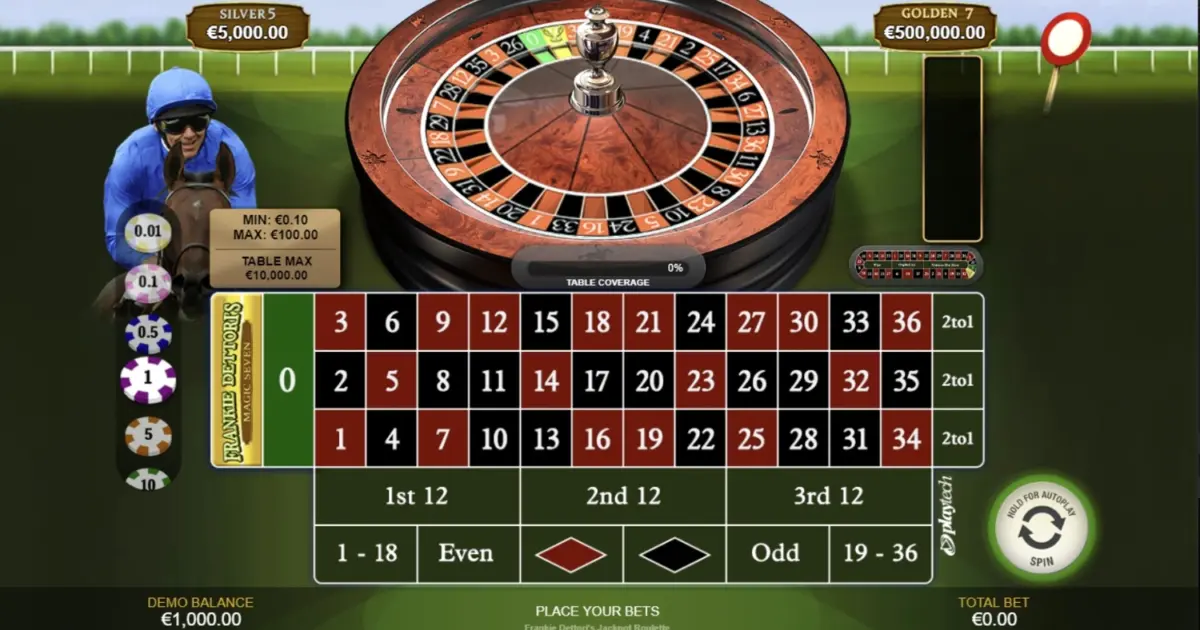
Frankie Dettori’s Jackpot Roulette is a Playtable jackpot variant that layers a progressive side bet on top of what appears to be a standard European-style roulette layout. The headline RTP sits at 95.73%, which is noticeably below the 96.97% corpus average for roulette on this site. That gap is not accidental — it is the mathematical price of the jackpot contribution. Whether that trade-off is worth it depends entirely on whether you enjoy chasing long-shot progressives or prefer to keep the house edge as small as possible on every spin.
Is Frankie Dettori’s Jackpot Roulette worth your spins?
The honest answer is: it depends on what you are buying. If you want the lowest possible house edge on a roulette wheel, this is not the cheapest option available. The 95.73% RTP translates to a house edge of roughly 4.27% across all money wagered — higher than the 2.70% you would find on a plain single-zero European wheel, and far above the 1.35% you can get on French-rule even-money bets. The gap funds the jackpot pool. If you are the kind of player who enjoys the possibility of a large progressive payout and treats the extra cost as entertainment spending, the game delivers on that premise. If you are optimising for long-term expected value, every spin on this table costs you more than a standard European or French roulette wheel. The demo exists so you can make that judgement for yourself without spending a cent.
Origins (playtech) and this wheel
Origins is Playtech’s studio arm focused on table-game variants and branded roulette titles. On this review site, Origins accounts for 11 roulette games with an average RTP of 96.64%. Frankie Dettori’s Jackpot Roulette sits below that studio average by nearly a full percentage point, which again reflects the progressive jackpot mechanics baked into this specific title rather than a studio-wide pattern. If you are browsing Origins’ catalogue and want a lower-edge alternative from the same family, Classic Roulette (Origins) strips away the jackpot layer and offers a cleaner mathematical profile. For players drawn to multiplier-style excitement without the progressive side bet, Quantum Roulette applies random multipliers to straight-up bets on a different mechanic. Both are worth comparing before you commit real money to any single table.
House edge: 2.70%, 5.26% or 1.35%?
Roulette house edges come in three standard flavours, and knowing which one applies to your table is the single most important thing you can learn before betting. A single-zero (European) wheel has 37 pockets, producing a house edge of 2.70% on every standard bet. A double-zero (American) wheel adds a 38th pocket, pushing the edge to 5.26% — or 7.89% on the five-number basket bet. French rules, which return half your stake on even-money bets when zero lands (La Partage or En Prison), cut the even-money house edge to roughly 1.35%, the best standard bet in the game. The name “Frankie Dettori’s Jackpot Roulette” points to a European-style single-zero wheel, which would normally mean 2.70%. However, the confirmed RTP of 95.73% tells us the effective edge is higher here — around 4.27% — because a slice of every wager feeds the progressive jackpot. Always check the game’s own rules screen for the exact wheel configuration and whether any jackpot contribution changes the base-game RTP before you play for real.
Bet types, payouts and true odds
The table below shows standard single-zero roulette payouts and true odds. On this jackpot variant, the base-game payouts for standard bets typically match the European figures below, but always confirm on the game’s paytable because jackpot contributions can occasionally alter straight-up returns.
| Bet type | Payout | True odds (single-zero) | House edge |
|---|---|---|---|
| Straight up (1 number) | 35 : 1 | 36 : 1 | 2.70% |
| Split (2 numbers) | 17 : 1 | 17.5 : 1 | 2.70% |
| Street (3 numbers) | 11 : 1 | 11.33 : 1 | 2.70% |
| Corner (4 numbers) | 8 : 1 | 8.25 : 1 | 2.70% |
| Six line (6 numbers) | 5 : 1 | 5.17 : 1 | 2.70% |
| Column / Dozen (12 numbers) | 2 : 1 | 2.17 : 1 | 2.70% |
| Even-money (Red/Black, Odd/Even, High/Low) | 1 : 1 | 1.056 : 1 | 2.70% |
Notice the pattern: on a standard single-zero wheel, every bet carries the same 2.70% house edge. The difference between a straight-up bet and an even-money bet is not edge — it is variance. A straight-up bet wins rarely but pays 35:1; an even-money bet wins roughly half the time but pays 1:1. Neither is “better” mathematically; they simply deliver different ride profiles over the same number of spins.
What experienced players actually do
Experienced roulette players tend to focus on three things: minimising the house edge, controlling session length, and keeping bet sizes flat. First, pick the lowest-edge bet available on the table. On a standard European wheel, that is any bet — they are all 2.70%. On a French-rule table, even-money bets with La Partage drop to 1.35%. On this jackpot variant, the base edge is higher, so you are paying more per spin regardless of bet type. Second, set a fixed session budget and stick to it. If your budget for a session is £50, that is your ceiling — not a starting point for recovery. Third, use flat staking rather than progressions. A Martingale system doubles your bet after every loss, which sounds safe until you hit a losing streak of eight or ten and either bust your bankroll or hit the table limit. Progressions do not change expected value; they redistribute variance and accelerate the moment when your bankroll or the table limit stops you. The most disciplined approach is a fixed bet size, a fixed number of spins, and a hard stop-loss — then you walk away and treat whatever happened as the price of entertainment.
Free play before real money
A free demo of Frankie Dettori’s Jackpot Roulette is available on this page — no download required, no account needed. Playing the demo lets you see the interface, understand the jackpot side bet mechanics, and get a feel for the table’s rhythm without risking anything. It is also the fastest way to confirm the wheel configuration, the available bet types, and whether the jackpot contribution alters any base-game payouts. However, remember that demo results are generated by the same RNG as real-money play, and a winning session in demo mode tells you nothing about what will happen when real money is on the line. If you choose to play for real, set a budget before you start, treat every spin as entertainment, and stop when the budget is gone. Roulette is a game of chance — it is not a source of income. You must be 18 or older to play for real money. If gambling stops being fun, step away and seek help from a responsible-gambling service.
Final take
Frankie Dettori’s Jackpot Roulette is a branded progressive variant that trades a chunk of base-game RTP for the chance at a large jackpot payout. At 95.73%, it sits below both the provider average and the wider corpus average for roulette on this site, which is the cost of funding that progressive pool. If you enjoy the thrill of chasing a jackpot and you understand you are paying a premium for that privilege, the game delivers exactly what its name promises. If your priority is the smallest possible house edge, a plain European wheel at 2.70% or a French-rule table at 1.35% will keep more of your money in play over time. Either way, try the free demo first, confirm the rules on the game’s own help screen, and never bet more than you can afford to lose. For a lower-edge alternative from the same provider, Spin Till You Win Roulette offers a different twist on the format without the progressive overhead.
Frequently Asked Questions
Can I play Frankie Dettori's Jackpot Roulette for free?
Yes. A free demo is available on this page with no download and no account required. It lets you explore the table layout, the jackpot side bet, and the interface before risking any real money.
What is the RTP of Frankie Dettori's Jackpot Roulette?
The confirmed RTP is 95.73%, which is below the 96.97% corpus average for roulette on this site. The gap reflects the progressive jackpot contribution deducted from every wager on the table.
What is the house edge on this table?
Based on the 95.73% RTP, the effective house edge is approximately 4.27%. A standard single-zero European wheel without a jackpot side bet carries a 2.70% edge, so this table costs you more per spin to fund the progressive pool.
Does any betting system work on this roulette table?
No. No betting system — Martingale, Fibonacci, D'Alembert, or any "wait for X losses" approach — changes the expected value. Spins are independent, the wheel has no memory, and progressions merely redistribute variance while accelerating table-limit risk.
How does Frankie Dettori's Jackpot Roulette compare to Quantum Roulette?
Quantum Roulette by the same provider carries a 97.31% RTP, which is 1.58 percentage points higher than this table's 95.73%. Quantum uses random multipliers on straight-up bets rather than a progressive jackpot, so the maths and the entertainment value work differently.




