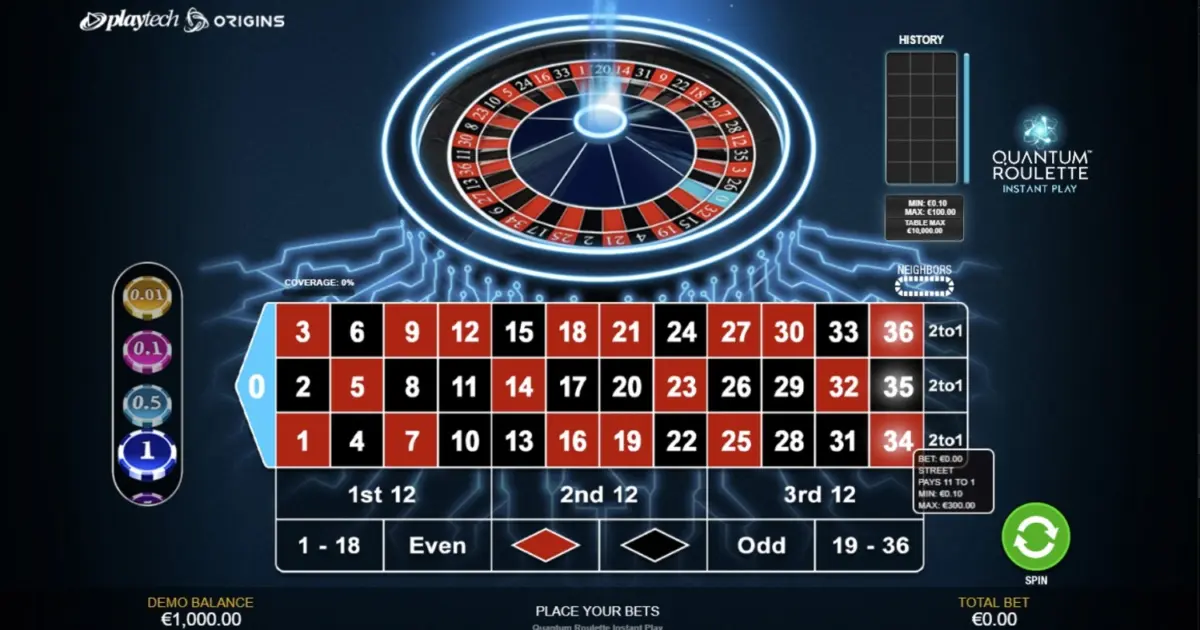
Quantum Roulette delivers 97.31% RTP in a multiplier format where random numbers receive boosted payouts each spin, funded by reducing the base straight-up payout below the classic 35:1. That tradeoff changes the variance profile without improving your expected return versus a standard European wheel at 97.30%. The appeal is the chance at multiplied wins; the cost is lower payouts when you hit an unboosted number.
Quantum Roulette at a glance
Provider: Playtech Origins. RTP: 97.31%. Free demo: yes. This is a multiplier-format wheel where between one and five straight-up numbers receive random multipliers each round, typically ranging from 50× to 500×. The base payout for non-multiplied straight-up wins is reduced to fund those boosted prizes, so the effective house edge on inside bets differs from classic roulette. Outside bets pay standard rates. Playtech Origins’ catalogue includes Classic Roulette (Origins) at 97.30% RTP for players who prefer the traditional payout structure.
Which wheel is this, and what it costs you
The title and RTP figure point toward a single-zero European layout, which normally delivers 2.70% house edge on all standard bets. Multiplier formats like this one modify the straight-up payout structure: instead of the classic 35:1, the base payout drops to fund the random multipliers applied to a handful of numbers each spin. That redistribution does not change the overall 97.31% RTP, but it does shift variance heavily toward the multiplied outcomes. When you land a straight-up number without a multiplier, you collect less than you would on a classic European wheel; when you hit a multiplied pocket, the payout can reach hundreds of times your stake.
The name suggests a single-zero wheel, which would mean 37 pockets and a theoretical house edge near 2.70% on non-multiplier bets, but confirm the pocket count and exact payout table on the in-game rules screen before committing real money. If French rules (La Partage or En Prison) applied to even-money bets, the house edge on those wagers would drop to approximately 1.35%, but no such rule is indicated in the available data. Assume standard European rules unless the paytable states otherwise.
What a 97.31% RTP means per spin
RTP is the long-run theoretical return: over millions of spins, the game pays back £97.31 for every £100 wagered. Per spin, the house edge is 2.69%, so a £10 bet costs you an average of £0.27 in expected value. That figure applies across the entire game, blending the reduced-payout straight-up bets with the multiplier hits and the standard outside bets. Your actual session result will deviate wildly from that average because roulette variance is high, and multiplier formats amplify it further.
The 97.31% RTP places this table fractionally above a standard single-zero wheel at 97.30%, but 0.01 percentage points is noise. The practical difference emerges in the payout distribution: multiplier wheels concentrate more of the return into rare high-multiplier outcomes, so your balance swings more sharply than it would on a classic table. If you prefer steadier, more predictable results, Spread-Bet Roulette at 97.30% RTP offers a different structure worth comparing.
Inside versus outside bets
The core house-edge arithmetic is the same across bet types on a standard wheel, but multiplier formats break that symmetry by altering the straight-up payout. The table below shows the classic European payout structure for reference; Quantum Roulette’s base straight-up payout is lower, with the difference redistributed into the random multipliers applied each round.
| Bet type | Payout (classic) | True odds (37 pockets) | House edge |
|---|---|---|---|
| Straight-up | 35:1 | 36:1 | 2.70% |
| Split | 17:1 | 17.5:1 | 2.70% |
| Street | 11:1 | 11.33:1 | 2.70% |
| Corner | 8:1 | 8.25:1 | 2.70% |
| Red/Black, Odd/Even, High/Low | 1:1 | 1.0556:1 | 2.70% |
Inside bets deliver higher volatility: a straight-up wager wins roughly once every 37 spins, producing long losing streaks punctuated by large wins. Outside bets win more frequently but pay less. On a multiplier wheel, that volatility compounds when chasing boosted numbers. The house edge per spin remains near 2.70% either way, but the multiplier mechanic rewards concentrated inside-bet play if you can tolerate the swings.
Why no betting system changes the maths
Martingale, Fibonacci, D’Alembert, waiting for five reds then doubling on black—none of these progressions alter your expected loss. Each spin is independent; the wheel has no memory of previous results. On a European wheel with a 2.70% house edge, every £100 wagered costs you £2.70 in expectation, regardless of bet size or sequence. Betting systems redistribute variance, spreading risk across many small losses and occasional large wins or doing the reverse, but they cannot erase the house edge.
Martingale doubles your bet after every loss, attempting to recover all previous losses with one win. It works until you hit a long losing streak and slam into the table limit or exhaust your budget. On a wheel with 18 red, 18 black and one zero, the chance of ten consecutive blacks is roughly 1 in 1,784. That is rare but not rare enough. When it happens, you have lost 1,023 units chasing a one-unit profit. The expected value of the entire sequence is still negative 2.70% per unit wagered.
Multiplier formats do not change this. The random boosted payouts raise variance, making your balance swing more dramatically, but the long-run cost per spin remains fixed by the RTP. If you enjoy the structure of a progression, treat it as a variance preference, not a profit strategy. Spin Till You Win Roulette at 97.31% RTP offers a different guarantee mechanic if you want another variance shape to compare.
Playing the Quantum Roulette demo
The free demo runs on the same RNG and payout table as the real-money version, so you can observe the multiplier frequency and payout distribution without risking your balance. Use it to decide whether the high-variance profile suits your tolerance. The reduced base straight-up payout becomes obvious after a few unboosted wins; the multiplier hits feel rare but large. Neither experience predicts your real-money results—variance ensures that—but the demo shows you the mechanical rhythm of the game.
Set a budget before you play for real money, and treat that amount as the cost of entertainment, not an investment. Roulette is a negative-expectation game: over time, the house edge guarantees you lose more than you win. Play because you enjoy the process, not because you expect to turn a profit. You must be 18 or older to wager real money. If gambling stops being fun, stop.
Verdict
Quantum Roulette offers 97.31% RTP in a high-variance multiplier format that appeals if you want the chance at boosted straight-up payouts and can tolerate long stretches at the reduced base rate. The RTP matches a standard European wheel within a hundredth of a percent, so the choice is purely about variance preference: multiplier spikes versus steadier classic payouts. The demo is available, the provider is established, and the maths is transparent. If the multiplier mechanic does not appeal, Classic Roulette (Origins) delivers nearly identical RTP with traditional 35:1 straight-up payouts and no variance gimmicks.
Frequently Asked Questions
Is Quantum Roulette available to play for free?
Yes, a free demo is available. It runs on the same RNG and payout structure as the real-money version, so you can experience the multiplier frequency and reduced base payouts without risking your balance. Demo results do not predict real-money outcomes, but the demo shows you the variance profile and lets you decide whether the format suits your tolerance before you commit funds.
What is the RTP of Quantum Roulette?
The RTP is 97.31%, meaning the game returns £97.31 for every £100 wagered over the long run. That figure is fractionally higher than a standard European wheel at 97.30%, but the difference is negligible. The multiplier format redistributes variance rather than improving expected value, concentrating more return into rare high-multiplier outcomes while reducing the base straight-up payout.
Does Quantum Roulette use a single-zero or double-zero wheel?
The name and RTP strongly suggest a single-zero European wheel with 37 pockets and a house edge near 2.70%, but the available data does not confirm the pocket count explicitly. Check the in-game rules screen for the exact layout and payout table before wagering real money. A double-zero wheel would push the house edge to 5.26%, incompatible with the stated 97.31% RTP.
Can a betting system beat the house edge on Quantum Roulette?
No. Martingale, Fibonacci, and all other progressions redistribute variance but cannot overcome the house edge. Each spin is independent, and the wheel has no memory. The 97.31% RTP means you lose £2.69 per £100 wagered in the long run, regardless of bet sequence. Systems change how losses accumulate—slowly or in sudden bursts—but they do not change expected value.
How does Quantum Roulette compare to classic roulette from the same provider?
Playtech Origins offers Classic Roulette at 97.30% RTP, functionally identical in expected value but with traditional 35:1 straight-up payouts and no multipliers. Quantum Roulette trades the steady classic structure for high-variance multiplier spikes funded by a reduced base payout. If you prefer predictable payout ratios, the classic version is the better choice; if you want the chance at multiplied wins and can tolerate longer losing runs, Quantum Roulette delivers that profile.




