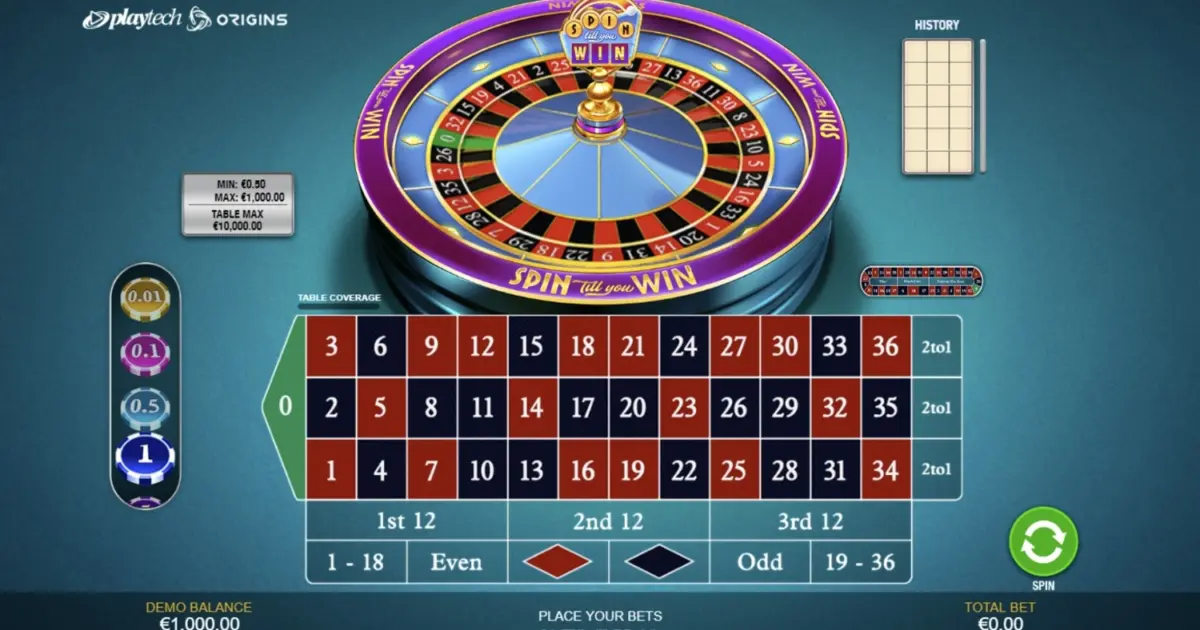
Spin Till You Win Roulette sits in Origins’ roulette range with a stated RTP of 97.31%, placing it slightly above the corpus average of 96.97%. The critical question this review addresses is whether the underlying wheel matches that number, because the answer changes what you should expect from every spin.
Spin Till You Win Roulette and the Origins (Playtech) roulette range
Origins operates as a Playtech-powered platform carrying eleven roulette titles. Spin Till You Win Roulette ranks 35th in the broader catalogue at the 84.8th percentile of popularity, meaning it draws meaningful traffic without being a flagship release. The provider’s average RTP across all eleven games is 96.64%, which puts Spin Till You Win at the top end of its own portfolio by 0.67 percentage points.
That positioning matters because it tells you something about the range. Origins does not appear to differentiate its roulette products by pushing some toward dramatically higher or lower returns. Quantum Roulette matches this table exactly at 97.31% RTP, while Classic Roulette Origins sits just below at 97.30% and Spread-Bet Roulette at 97.30% as well. The three related titles cluster within a single basis point of each other, which suggests either a common wheel configuration across the range or a deliberately tight product strategy.
Within this lineup, Quantum Roulette deserves mention because it carries the same RTP figure and shares the multiplier-roulette format that distinguishes it from standard tables. Spread-Bet Roulette takes the other direction, offering a layout variation without the multiplier layer. Classic Roulette Origins, available through the same provider, strips back to the most basic presentation. Comparing these three against Spin Till You Win helps you understand where this table sits: not obviously a multiplier game, not obviously a spread-bet variant, and not branded as a classic layout either.
The wheel, the pockets and the edge
The FACTS for this table do not specify whether Spin Till You Win Roulette runs a single-zero (37-pocket) European wheel or a double-zero (38-pocket) American wheel. This is the most consequential missing piece of information in this review, and I will not fill it with guesswork.
Here is why it matters so much. A single-zero European wheel produces a house edge of 2.70% on every standard bet, which translates to an RTP of 97.30%. A double-zero American wheel produces 5.26% on standard bets (94.74% RTP), except the five-number basket bet between 0, 00, 1, 2, and 3 which carries 7.89%. French rules with La Partage or En Prison can cut the even-money edge to approximately 1.35%, but FACTS do not confirm whether either rule applies here.
The stated RTP of 97.31% is one hundredth of a percentage point above the exact European wheel figure of 97.30%. In mathematical terms, 97.30% is the RTP you get from 37 pockets with standard payouts (1/37 = 2.7027% house edge). A reported 97.31% could reflect rounding, a weighted average across bet types, or a slightly different configuration. It is not consistent with a double-zero wheel under any standard payout structure.
What you should do: open the game, find the rules or help screen, and count the zeros. If you see one zero, you have a European wheel and the 97.31% figure checks out. If you see two zeros, the RTP is likely weighted by a game-specific rule set that differs from standard American roulette maths. Confirm before staking real money.
97.31% in practice
An RTP of 97.31% means that across a very large number of spins, the table returns approximately 97.31 units for every 100 units wagered, retaining 2.69 units as house margin. This is a long-run statistical expectation, not a prediction about any session length you will actually play.
In practice, the RTP figure tells you two things: how well the table is configured relative to its peers, and what your expected loss rate is per unit wagered. At 2.69% house edge, wagering $50 per spin for 200 spins ($10,000 total action) produces an expected loss of $269. Your actual result will vary enormously from that figure — you might be up $2,000 or down $2,000 — but the distribution of those outcomes centers on the expected value.
Against the corpus average of 96.97%, Spin Till You Win’s 97.31% represents +0.34 percentage points of return. Translated: for every $10,000 you wager, this table keeps approximately $34 less than an average roulette game in the database. Over thousands of spins, that gap compounds into a meaningful difference.
The figure also sits above Origins’ own portfolio average of 96.64%, making it the strongest product in that range. If you are choosing between roulette tables on the Origins platform specifically, this is the best-returning option by a margin of 0.67 percentage points, which over $50,000 in total wagering amounts to roughly $335 of retained value.
Building a bet you understand
Since the wheel type remains unconfirmed, the table below presents the standard payout structure for a single-zero European wheel (which the RTP figure implies) alongside the true odds of each bet landing. The gap between payout and true odds is where the house edge lives.
| Bet type | Payout | True odds (European, 37 pockets) | House edge |
|---|---|---|---|
| Straight-up (single number) | 35:1 | 36:1 | 2.70% |
| Red/Black, Odd/Even, High/Low | 1:1 | 18:19 | 2.70% |
| Column or Dozen | 2:1 | 12:25 | 2.70% |
| Split (two adjacent numbers) | 17:1 | 18:1 | 2.70% |
| Street (three in a row) | 11:1 | 12:1 | 2.70% |
| Corner (four numbers) | 8:1 | 9:1 | 2.70% |
Notice that the house edge is identical on every bet type. Inside bets (straight-up, split, street, corner) do not carry a worse edge — they carry higher variance. You lose more often, win larger amounts when you hit, and your session swings more violently. Outside bets (red/black, dozen, column) give you closer-to-even action with smaller fluctuations.
The practical implication: no bet type on this table is “better” than any other in expected-value terms, assuming standard payouts and a single-zero wheel. Choose based on whether you want frequent small wins or rare large wins. If you want to minimize variance per spin, outside bets deliver the tightest distribution. If you want the biggest single-spin ceiling, straight-up at 35:1 gives you that, but you will encounter stretches of 40, 50, or 80 consecutive losing spins on a single number with non-trivial frequency.
Systems, streaks and independent spins
The name “Spin Till You Win” invites a particular fantasy: that persistence converts into profit, that enough spins guarantee a recovery. The roulette wheel does not work that way, and no sequence of bets can override the house edge embedded in the payout structure.
Martingale — doubling after each loss until you recover — produces frequent small wins and rare catastrophic losses capped by table limits. On a European wheel, after seven consecutive losses on red (which occurs approximately 0.9% of the time in a session of 7 spins), you are staking 128 units to win 1 unit. Fibonacci, D’Alembert, Labouchère, and every other progression you find on forums redistribute when your losses hit without changing the fact that each spin is independent. The expected value per unit wagered remains -2.69% on a European wheel no matter what you bet next.
“Wait for five reds then bet black” assumes the wheel remembers past outcomes. It does not. An RNG roulette has no memory of any previous spin, and neither does a physical wheel. The probability of the next spin landing red is determined entirely by the number of red pockets divided by the total pockets — nothing else. Past streaks have zero predictive value.
Progressions do not reduce the house edge. They increase your average bet size over time (because you are staking more after losses than after wins), which means they increase your total action against the same percentage edge, which means they increase your expected absolute loss per session. The system that feels like a winning strategy is a faster route to your bankroll’s end.
Free demo and staying in control
Spin Till You Win Roulette is available in free demo mode, which gives you the single most useful tool this game provides: the ability to observe the layout, test the rules screen, and confirm the wheel type without risking a cent. Use the demo to answer the question this review cannot: one zero or two?
The demo also lets you feel the variance without consequences. Set a mental budget for your demo session, play 200 spins with a fixed stake, and note how often you go on losing streaks of six or more red/black results. The experience is instructive in a way that reading about probability is not. You will feel the urge to “chase” after a run of losses, and in demo mode that urge costs nothing — which is precisely the moment to recognize it.
For real-money play, the rules are simple: set a budget before your first spin and treat the entire amount as the cost of entertainment, not an investment with an expected return. This is a game of 97.31% RTP — meaning over a very long run you will keep 97.31 cents of every dollar you stake, but in any single session you may keep 50 cents or 150 cents. The variance is the product. You are paying for the experience, not buying a return.
Play only if you are 18 or over. Never chase losses. If roulette stops feeling like entertainment, stop.
Who should play Spin Till You Win Roulette
This table suits players who want a competent, above-average RTP roulette product and who will take thirty seconds to verify the wheel configuration before committing real money. If you skip that verification step, you are gambling on an assumption rather than playing a known game.
If you arrived searching for a “spin until you win” strategy — a progression that guarantees recovery through persistence — this table will frustrate you. The name is marketing, not mathematics. The house edge does not care how many times you spin, and neither does the probability of any individual outcome.
Players who value familiarity will find the provider range useful: Classic Roulette Origins is available alongside this table if you want to compare interfaces within the same platform, and the 97.31% RTP means you are choosing one of the better-configured products in the database. Multiplier enthusiasts should note that Quantum Roulette shares this exact RTP figure while adding a completely different payout structure on straight-up bets — read its paytable separately because multiplier games fund their enhanced payouts by reducing base returns, and the maths differs from standard roulette despite the matching headline number.
Frequently Asked Questions
Can I play Spin Till You Win Roulette for free?
Yes, free demo play is available through the site. The demo lets you inspect the layout and rules screen, which is the fastest way to confirm the wheel type before playing real money. Use it to check whether one zero or two zeros appear on the table.
What is the RTP on Spin Till You Win Roulette?
The stated RTP is 97.31%, which places this table above the corpus average of 96.97% and is the highest figure in Origins' eleven-title roulette range. This translates to a house margin of approximately 2.69% on standard bets, consistent with a single-zero European wheel configuration.
Is Spin Till You Win Roulette a European or American wheel?
The game facts do not explicitly confirm the wheel type, though the 97.31% RTP figure is mathematically consistent with a single-zero European wheel (standard RTP 97.30%) rather than a double-zero American wheel (standard RTP 94.74%). Check the rules screen inside the game to verify before betting real money.
Does the Martingale system work on Spin Till You Win Roulette?
No. Every spin on this table is independent, and the house edge of approximately 2.69% applies to every individual bet regardless of what you wagered previously. Martingale and other progressions redistribute variance and accelerate table-limit risk without changing the expected loss per unit wagered.
How does Spin Till You Win Roulette compare to Quantum Roulette?
Both tables share an identical RTP of 97.31% and come from the same Origins (Playtech) provider. The key difference is that Quantum Roulette operates as a multiplier format, meaning straight-up payouts are adjusted to fund the multipliers. Compare the base payouts side by side before choosing between them.




