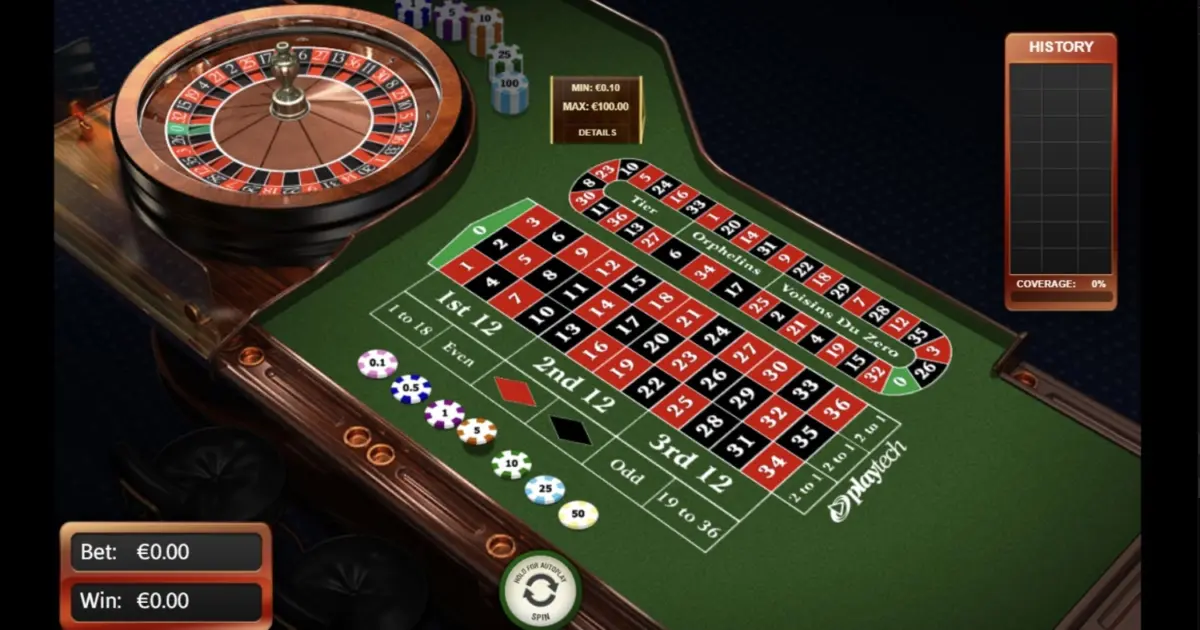
Classic Roulette (Origins) is a straight-down-the-line single-zero wheel that does what its name promises: European roulette maths, no multipliers, no side bets, and a 97.3% RTP that matches the theoretical return of every standard European table. Origins (Playtech) built this for players who want the core game without the noise, and the free demo gives you a risk-free proving ground to see whether the interface and pace suit you.
Classic Roulette (Origins) at a glance
This is a single-zero roulette table published by Origins, a Playtech label. The 97.3% RTP confirms it runs European rules: 37 pockets (numbers 1–36 plus a single zero), a 2.70% house edge on all standard bets, and no special rules like La Partage to reduce that edge further. The game ranks in the 87th percentile for popularity within the wider roulette catalogue, and Origins’ eleven-table portfolio averages 96.64% RTP across its variants — this wheel sits half a percentage point above that studio mean and a third of a point above the corpus-wide roulette average of 96.97%. It is available in free demo mode, so you can test the interface, bet limits, and game flow without opening an account.
Which wheel is this, and what it costs you
The 97.3% return-to-player figure tells you this is a single-zero European wheel, which has 37 pockets and a house edge of 2.70% on every standard bet. The alternative is a double-zero American wheel with 38 pockets and a 5.26% house edge (or 7.89% on the five-number basket bet). The difference is not subtle: over 100 spins at £1 per spin, the European wheel costs you £2.70 in expectation, the American wheel £5.26. Some European tables offer French rules — La Partage or En Prison — which return half your stake on even-money bets when zero lands, cutting the even-money house edge to about 1.35%, the best standard bet in roulette. Classic Roulette (Origins) does not advertise French rules in its published specs, so assume the full 2.70% edge applies to every bet. Always check the game’s own rules screen before you commit real money: the paytable and stated RTP are the only source you can rely on when the operator loads the game.
What a 97.3% RTP means per spin
A 97.3% RTP means that for every £100 you wager, the game returns £97.30 over the long run and keeps £2.70 as the house edge. That is the arithmetic average across thousands of spins; any single session can swing wildly. If you place 100 straight-up bets of £1 and hit your number twice, you collect £70 (35:1 payout on two winners) but spend £100, netting a £30 loss. If you hit three times, you are £5 ahead. The RTP does not promise or predict your next hundred spins; it describes the wheel’s behaviour at infinite scale. Variance is the reason you can walk away up after twenty spins or down after two hundred, even though the expectation is identical on every spin. The 2.70% house edge is baked into every bet you make: the straight-up pays 35:1, but the true odds on a 37-pocket wheel are 36:1, and that single-unit shortfall is the entire edge. No bet on this wheel escapes it, and no session is long enough to make the edge irrelevant.
Inside versus outside bets
Inside bets cover small subsets of the layout — a single number, a pair, a street, a corner, or a six-line — and pay higher multiples. Outside bets cover large groups (red/black, odd/even, dozens, columns) and pay smaller multiples. The house edge is the same on both because the payout is always one unit short of the true odds. The table below shows the maths for a single-zero European wheel:
| Bet type | Numbers covered | Payout | True odds (37 pockets) | House edge |
|---|---|---|---|---|
| Straight-up | 1 | 35:1 | 36:1 | 2.70% |
| Split | 2 | 17:1 | 17.5:1 | 2.70% |
| Street | 3 | 11:1 | 11.33:1 | 2.70% |
| Corner | 4 | 8:1 | 8.25:1 | 2.70% |
| Six-line | 6 | 5:1 | 5.17:1 | 2.70% |
| Dozen / Column | 12 | 2:1 | 2.08:1 | 2.70% |
| Even-money | 18 | 1:1 | 1.06:1 | 2.70% |
Inside bets deliver higher volatility: longer losing streaks punctuated by bigger wins. Outside bets smooth the ride but converge to the same -2.70% expectation. Your choice changes the shape of variance, not the cost of playing. If you want a chance at a 35:1 hit, bet straight-up; if you want to stay in the game longer on a fixed budget, bet red or black. Neither choice is smarter in expectation, and neither changes what the wheel costs you per spin.
Why no betting system changes the maths
Roulette is the game where the maths is completely known and completely unforgiving, and the internet is full of confident nonsense about systems. The truth is simple: no staking pattern — Martingale, Fibonacci, D’Alembert, waiting for five reds, tracking “hot” numbers, cancellation ladders — changes your expected value. The house edge is 2.70% on every spin, and every spin is independent. The wheel has no memory. The probability of red on the next spin is 18/37 whether the last ten spins were red, black, or alternating. Doubling your stake after a loss (Martingale) does not make the next spin more likely to win; it only guarantees that when you do hit a long losing streak — and you will — you crash into the table limit or your own budget ceiling and cannot recover. Progression systems redistribute variance: they trade frequent small wins for rare, catastrophic losses. The average remains -2.70% per unit wagered, always. If a system worked, casinos would not offer the game. That is the only fact you need.
Playing the Classic Roulette (Origins) demo
The free demo is available without registration and runs on the same RNG and rules as the real-money version, so it is a useful tool to test the interface, confirm the bet limits, and get a feel for the pacing. Demo play cannot predict real-money results — variance is wide enough that your demo session will differ from your cash session, sometimes dramatically — but it will tell you whether the layout is readable, whether the controls respond the way you expect, and whether the game speed suits you. Use it to confirm the wheel type and RTP in the game’s own rules panel, and to verify that the paytable matches the figures you expect from a European wheel. If you decide to play for real money, set a budget in advance, treat it as the cost of entertainment, and stop when it is gone. Roulette is a negative-expectation game; no session length or bet size changes that. You should be 18 or over, and you should never chase losses or bet money you cannot afford to lose. For related single-zero options from the same studio, try Quantum Roulette with its multiplier mechanic or Spread-Bet Roulette for an alternative betting structure, both at 97.3% RTP.
Verdict
Classic Roulette (Origins) does exactly what it says: standard European roulette with a 97.3% RTP, a 2.70% house edge, and no special rules or gimmicks to complicate the equation. It sits slightly above the studio average and the wider roulette corpus average, but that gap is marginal — the real comparison is European versus American wheels, and this one is on the right side of that divide. The free demo lets you confirm the wheel type and test the interface before you risk anything, and the game’s 87th-percentile popularity suggests it has found an audience that values clarity over novelty. If you want French rules and the 1.35% even-money edge, look elsewhere; if you want the core European game with no distractions, this delivers it. The maths is the same as every other single-zero table, so your decision comes down to interface preference, bet limits, and whether the demo experience convinces you the game flow is right for you. Check the rules screen, set a budget, and remember that no session is long enough to escape the house edge. Compare it to Spin Till You Win Roulette if you want a twist on the standard format while keeping the same RTP.
Frequently Asked Questions
Is Classic Roulette (Origins) available in free demo mode?
Yes, Classic Roulette (Origins) offers a free demo that runs on the same RNG and rules as the real-money game, letting you test the interface, confirm the wheel type, and check the bet limits without registering or risking money. Demo results do not predict real-money outcomes because variance is wide, but the demo is useful for confirming the paytable and game flow before you decide to play for cash.
What is the RTP and house edge on Classic Roulette (Origins)?
The game has a 97.3% RTP, which corresponds to a 2.70% house edge — the standard figure for a single-zero European roulette wheel with 37 pockets. That edge applies to every standard bet, and there are no French rules (La Partage or En Prison) to reduce it further on even-money bets. Always verify the RTP in the game's own rules screen when you load it.
Does any betting system or pattern improve your odds on this wheel?
No. The house edge is 2.70% on every spin, and every spin is independent. No staking pattern — Martingale, Fibonacci, waiting for streaks, tracking "hot" numbers — changes the expected value or makes the next spin more likely to win. Progression systems only redistribute variance, trading frequent small wins for rare, catastrophic losses when you hit the table limit. The wheel has no memory, and the maths is unforgiving.
Which bet gives the best return on Classic Roulette (Origins)?
Every standard bet on this wheel has the same 2.70% house edge, so no bet is "better" in terms of expected value. Straight-up bets (35:1) give you high volatility and a chance at a big single win; even-money bets (red/black, odd/even) smooth the variance and keep you in the game longer on a fixed budget. Your choice changes the shape of your session, not the long-run cost.
How does Classic Roulette (Origins) compare to other Origins tables?
Classic Roulette (Origins) sits at 97.3% RTP, half a point above the Origins (Playtech) studio average of 96.64% across eleven roulette variants. For a similar return with a different mechanic, try Quantum Roulette at 97.31%, which adds multipliers to straight-up wins, or Spread-Bet Roulette at 97.3% for an alternative betting structure. All three are single-zero wheels with the same foundational house edge.




