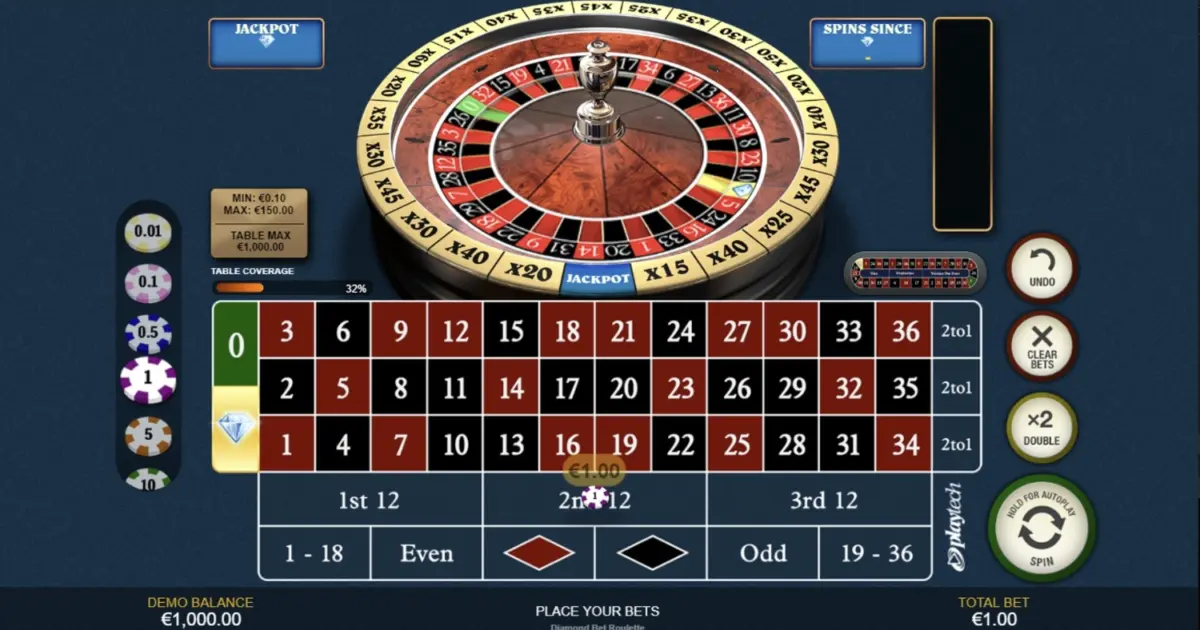
Is Diamond Bet Roulette worth your spins? The short verdict is yes — but only if you know what you are trading away. This wheel carries a 95.39% RTP, which is decisively lower than the 97.3% the same provider gets on its Classic Roulette table scrape. That gap is not noise: it is roughly a 1.6-percentage-point difference in the house edge, and on a game where every spin is an independent event, that number is the single most decision-relevant fact about diamond bet roulette. The free demo is worth a look precisely so you can feel the lower return before it costs you real money.
Diamond Bet Roulette and the Origins (Playtech) roulette range
Diamond Bet Roulette comes from Origins, the studio behind Playtech’s games, and it sits at number 137 in our roulette rankings with a popularity percentile of 39. That places it solidly mid-pack — nowhere near the top of the category, but not lost in the long tail either. Origins offers 11 roulette titles in total, and across that whole range the average RTP is 96.64%. Diamond Bet Roulette sits below that average, which tells you it is not the first table from this studio you should be chasing.
To see the contrast plainly, look at the studio’s other wheels. Quantum Roulette runs at 97.31%, and Classic Roulette (Origins) sits at 97.3% — both meaningfully better on paper. If your only goal is maximising expected value, those are the sensible first stops. What Diamond Bet Roulette offers in return is its own identity within the range: it is the lower-RTP, higher-flavour option, and the choice comes down to whether that flavour justifies the cost.
There is also Spin Till You Win Roulette at 97.31% in the same family. The pattern across the provider’s catalogue is consistent: most of its wheels cluster near 97.3%, and Diamond Bet Roulette is the outlier at 95.39%. That makes it the most expensive table in the Origin’s line-up by a clear margin, and it is worth asking why before you commit to it.
The wheel, the pockets and the edge
Roulette’s mathematics are unforgiving and completely known, and Diamond Bet Roulette does not escape them. The game’s name points to a single-zero, European-style wheel, which normally means 37 pockets — numbers 1 through 36 plus the single green zero. On a standard wheel of that shape, every bet carries a house edge of 2.70%, because a straight-up number pays 35:1 against true odds of 36:1. That single-pocket gap is the entire house edge; it is not a flaw, it is precisely how the casino earns.
However, the 95.39% RTP on this table implies a steeper house edge than the classic 2.70%. The difference between the 95.39% figure and the theoretical 97.30% of a clean single-zero wheel is roughly 1.9 percentage points, and that gap has to come from somewhere. It almost always comes from a side bet or a special-wager mechanic that carries its own poor return, drags the overall RTP down, or both. The name “Diamond Bet” strongly suggests there is a dedicated wager that behaves differently from the standard inside and outside bets.
Because the FACTS for this game do not confirm the exact pocket count or the precise structure of the Diamond Bet, you cannot assume this is a pure European wheel. The honest reading is this: the title points to a single-zero format, which normally means a 2.70% house edge — but the stated RTP says the base game is likely fine while some additional wager is expensive. Confirm it all on the game’s own rules screen before betting real money pt. That screen is the only authority on this table’s specific mechanics.
95.39% in practice
The RTP of 95.39% is the number that should govern your expectations, and it needs to be read correctly. RTP is a long-run statistical average across thousands and thousands of spins; it is not a promise for any single session, and it is certainly not a figure that goes up because you are “due” a win. Compare it to the corpus average across all the roulette games we track, which sits at 96.97%. Diamond Bet Roulette runs 1.58 points below that, and 1.25 points below the Origins studio average of 96.64% tout.
What does 1.58 points actually feel like? On a £100 total stake cycled through the table, the theoretical expected loss rises from about £3.03 on an average wheel to about £4.61 here — roughly £1.50 more per hundred, on average, over the long run. That is a modest gap on a single session tolerable, but it compounds across weeks of regular play. The lower RTP does not mean this wheel is rigged or broken; it means the studio has built in a slightly thicker margin, presumably to fund whatever the Diamond Bet feature is.
Critically, do not expect demo play to resemble real-money results. The demo uses the same underlying RNG maths in the sense that spins are independent, but a short demo session is a tiny sample. Ten minutes of good luck in the demo proves nothing about your next real-money spin. The 95.39% is what matters, and it is a long-run fact, not a session outcome.
Building a bet you understand
Because the specific Diamond Bet mechanic is not fully documented in our data, the most useful table for this game is the standard comparison of bet types on a single-zero wheel. These payout figures are universal on a European formatrior, and they are what the base game will use. The Diamond Bet wager itself, if it exists as a separate bet, will have its own paytable — read it directly on the screen before you play it.
| Bet type | Payout | True odds (single-zero) |
|---|---|---|
| Straight-up (one number) | 35:1 | 36:1 |
| Split (two numbers) | 17:1 | 17.5:1 |
| Street (three numbers) | 11:1 | 11.33:1 |
| Corner (four numbers) | 8:1 | 8.25:1 |
| Six-line (six numbers) | 5:1 | 5.17:1 |
| Column / Dozen (12 numbers) | 2:1 | 2.08:1 |
| Even-money (red/black, odd/even, high/low) | 1:1 | 1.06:1 |
The key insight of that table is that inside and outside bets change the shape of variance, not the expected value. A straight-up number is exciting because it pays 35:1, but it loses on 36 of 37 spins on average. A red/black bet wins almost half the time but only pays even money. Both are built on the same 2.70% house edge — the short-term feel differs enormously, the long-term expectation does not. Choose bets you understand and can stomach the variance of, rather than chasing a payout structure you hope will be friendlier.
Systems, streaks and independent spins
The internet is full of confident nonsense about roulette systems, and this is the page that tells you the truth. No betting system — Martingale, Fibonacci, D’Alembert, “wait for five reds” — changes expected value. It is mathematically impossible. Spins are independent events; the wheel has no memory from one spin to the next pload. A red that just landed has no influence on the next spin’s colour, and a number that has not appeared in an hour is not “due” to appear. Never call a number, colour or sector “hot” or “cold” — tracking previous results on an RNG wheel has zero predictive value.
What progression systems actually do is redistribute variance and accelerate table-limit risk. The Martingale, where you double after a loss, feels safe until the fifth consecutive loss empties your budget or hits the table maximum. The Fibonacci and D’Alembert are slower versions of the same illusion. They do not turn a negative-expectation game positive; they merely change the shape of the losses. On a 95.39% RTP wheel, the systems work exactly as poorly as they do anywhere else.
The only mathematically sound way to lower the house edge in roulette is to seek out French rules — La Partage or En Prison — which return half your stake on even-money bets when zero lands, cutting that even-money edge to about 1.35%. Nothing in our data says Diamond Bet Roulette offers those rules, and the strict RTP number suggests it does not. If you want the best standard bet in the game, you must find a table that explicitly advertises French rules rather than assuming them.
Free demo and staying in control
Diamond Bet Roulette has a free demo available, and that is genuinely the right way to approach it. Use the demo to learn the layout, feel the rhythm of the Diamond Bet mechanic, and decide whether the lower RTP is a trade you are comfortable with. The demo costs nothing and removes all financial pressure from the learning curve. It does not, however, predict real-money results — treat the demo as a way to learn the game, not as a crystal ball for what comes next.
The responsible-gambling reality is unchanged by the demo’s existence. You should be 18 or older to play, set a budget in advance of any session, and treat any money you wager as the price of entertainment rather than as an investment. Roulette is a game of chance where the casino holds a fixed edge; it is not a job, and it should never become one. If you play, play for the moment, not for the expectation of winning.
The demo also lets you assess the Diamond Bet wager directly. If the bet carries a high payout, the table’s 95.39% RTP tells you it is likely funded by a reduced base-game return, and you should read its specific paytable with care. A high-payout side bet on a lower-RTP wheel is usually the most expensive part of the game, not the most generous one.
Who should play Diamond Bet Roulette
You should play Diamond Bet Roulette if you are a casual player who enjoys the theme and the Diamond Bet gimmick, and who accepts that this particular Origin’s table costs about 1.6 points more than the studio’s other wheels. If you are the kind of player who wants a session that feels different from plain red-and-black, the demo is a free way to explore that without risk.
You should skip it if your priority is the most favourable mathematics. At 95.39% against the corpus average of 96.97%, this is one of the weaker tables on paper in our roulette rankings, and the studio’s own Classic or Quantum variations both sit above 97.3%. For a mathematically minded player, the choice is clear: take the free demo for curiosity, but put your real-money budget on the richer RTP wheels from the same provider. The wheel has no memory)Skip the Diamond Bet if you want the best expected value.
The final verdict is honest and straightforward: Diamond Bet Roulette is a perfectly playable game with a fun identity, but it charges a premium you cannot see at the table. Know the 95.39% RTP before you play, read the Diamond Bet paytable on screen, and decide with your eyes open whether the theme is worth the edge.
Frequently Asked Questions
Can I play Diamond Bet Roulette free?
Yes, a free demo is available for Diamond Bet Roulette on this page. The demo lets you learn the layout and the Diamond Bet mechanic without risking real money. Remember that demo results do not predict real-money outcomes — treat it purely as a way to understand the game before you wager.
What is the RTP of Diamond Bet Roulette?
Diamond Bet Roulette has an RTP of 95.39%. That is about 1.6 percentage points below the average for roulette games we track (96.97%) and below the Origins studio average of 96.64%. This lower figure means a modestly higher expected loss over the long run.
Which wheel and house edge does Diamond Bet Roulette use?
The name points to a single-zero, European-style wheel with 37 pocketschen, which normally means a 2.70% house edge. However, the confirmed 95.39% RTP implies a steeper effective edge, likely from a separate Diamond Bet wager's payout structure. Confirm the exact rules on the game's own paytable.
Does any betting system work on Diamond Bet Roulette?
No. No system — Martingale, Fibonacci, D'Alembert, or streak-tracking — changes expected value. Spins are independent and the wheel has no memory. Progressions only reshape variance and increase the risk of hitting table limits. The 2.70% house edge (or steeper here) applies regardless of your stake pattern.
Who is the provider of Diamond Bet Roulette?
Diamond Bet Roulette is made by Origins, the studio behind Playtech games. The provider offers 11 roulette titles with an average RTP of 96.64%, and Diamond Bet sits below that average. Compare it to the same studio's Quantum Roulette at 97.31% or Classic Roulette (Origins) at 97.3% for better returns.




